ROAS Formula, Benchmarks & Improvement Methods
ROAS Formula, Benchmarks & Improvement Methods
"What is ROAS?" "Is the cost-effectiveness of our advertising operations appropriate?" When engaged in advertising operations, it is not uncommon to face such questions. ROAS is an index that allows for quantitative understanding of the cost-effectiveness of advertising and is utilized across a wide range of fields, including e-commerce operations and BtoB marketing. However, pursuing only the numbers without properly understanding the meaning of the calculation formula may lead to incorrect judgments. In this article, we will systematically explain the basic definition of ROAS, the calculation formula, industry benchmarks, specific improvement methods, and points to be aware of during operation.
What is ROAS? A clear explanation of its basic meaning
First, let's grasp the meaning of ROAS and why many companies are paying attention to it.
Definition and reading of ROAS
ROAS stands for "Return On Advertising Spend," which is translated into Japanese as "広告費用対効果." The common reading is "ro-as." Simply put, it is an index that shows "how much sales were generated for the amount spent on advertising."
For example, if you spent 100,000 yen on advertising and generated 500,000 yen in sales, the ROAS would be 500%. The larger this number, the higher the sales efficiency per yen spent on advertising.
Why is ROAS considered important?
In recent years, many companies tend to adopt ROAS as a KPI. There are two main reasons behind this.
Firstly, it is difficult to grasp the scale of sales using only CPA (Cost Per Acquisition). CPA indicates the cost per conversion but does not reveal how much sales the acquired customers generate. On the other hand, ROAS directly shows the relationship between advertising expenses and sales, making it easier to assess the profitability of the entire business.
Secondly, it is easy to compare across different advertising media or campaigns. If you are running ads across multiple channels such as Google Ads, Meta Ads, and display ads, comparing the ROAS of each can help optimize budget allocation.
The ROAS calculation formula and examples
The calculation of ROAS itself is simple, but it's essential to relate it to concrete figures to use it effectively in practice.
Basic calculation formula
ROAS (%) = Sales via advertising ÷ Advertising cost × 100
For example, if the advertising cost is 200,000 yen and sales from advertising are 800,000 yen, then ROAS = 800,000 yen ÷ 200,000 yen × 100 = 400%. This means "for every 1 yen spent on advertising, 4 yen in sales is generated."
When ROAS is 100%, it means that the advertising cost and sales are equal, and considering costs like goods and labor, it results in a loss. Generally, a ROAS of 200% or more is considered desirable, although benchmarks can vary by industry and profit margin.
Understanding ROAS through calculation examples (3 patterns)
Case 1: E-commerce (Apparel)
Item | Amount |
|---|---|
Advertising cost | 500,000 yen |
Sales via advertising | 2,000,000 yen |
ROAS | 400% |
In apparel e-commerce, the cost of goods sold is often around 40-60%, so a ROAS of 400% means that even after subtracting advertising costs, there will still be profit.
Case 2: BtoB (Lead Generation)
Item | Amount |
|---|---|
Advertising cost | 300,000 yen |
Sales via advertising (based on contracts) | 600,000 yen |
ROAS | 200% |
In BtoB, you typically acquire leads (prospective customers) through advertising, and the process to reach conversion can be lengthy. While ROAS of 200% may seem low at first glance, it is essential to note that the cost per conversion is high, so the number can vary significantly when measured on a conversion basis.
Case 3: BtoB SaaS (Subscription Model)
Item | Amount |
|---|---|
Advertising cost | 1,000,000 yen |
Sales via advertising in the first year | 2,500,000 yen |
First Year ROAS | 250% |
In the case of SaaS, as customers continue to use the service, sales accumulate in the second and third years. Even if the first-year ROAS is 250%, if calculated based on LTV (Customer Lifetime Value) over three years, it can reach 700-1000%.
Calculating Break-even Point ROAS
To determine "What ROAS percentage is necessary to avoid a loss?" you calculate the break-even point ROAS.
Break-even Point ROAS (%) = Customer unit price ÷ (Customer unit price − Cost price) × 100
For example, if the customer unit price is 10,000 yen and the cost price is 6,000 yen:
Break-even Point ROAS = 10,000 yen ÷ (10,000 yen − 6,000 yen) × 100 = 250%
This means that if the ROAS is below 250%, you will not recover your advertising costs and will incur a loss. By understanding your cost structure beforehand and calculating the break-even point ROAS, you can create clearer benchmarks for goal setting and operational judgments.
Differences and distinctions between ROAS, ROI, and CPA
In addition to ROAS, there are also ROI and CPA as indices for measuring advertising effectiveness. By correctly understanding their differences, you can appropriately evaluate them according to the given situation.
Comparison of the three indices in a table
Index | Official Name | Calculation Formula | What it is observing |
|---|---|---|---|
ROAS | Return On Advertising Spend | Sales via advertising ÷ Advertising cost × 100 | Percentage of sales relative to advertising costs |
ROI | Return On Investment | (Sales − Costs) ÷ Advertising cost × 100 | Percentage of profit relative to advertising costs |
CPA | Cost Per Acquisition | Advertising cost ÷ Number of conversions | Cost incurred to acquire one conversion |
When to use each index
ROAS: Best used when you want to compare the sales efficiency of advertising channels or campaigns. It is particularly powerful in businesses like e-commerce sites, where sales data from advertising are easy to obtain.
ROI: Ideal for reporting to management or evaluating the profitability of the entire business. Including labor costs and outsourcing costs allows for more accurate profit judgment.
CPA: Best during phases where you want to maximize the number of conversions, particularly in lead-generation BtoB businesses. However, it is ideal to use it in conjunction with ROAS and ROI.
In practice, more and more companies are shifting from CPA-centered evaluation to ROAS-centered evaluation. This is due to a growing trend that values not just the number of conversions but also the "contribution to sales."
Industry-specific ROAS guidelines
The "good or bad" of ROAS greatly varies by industry and product.
Industry | ROAS Guidelines | Notes |
|---|---|---|
E-commerce (Apparel, etc.) | 300% to 500% | Ideal is 400% to 800%. Variations are greatly influenced by gross profit margin. |
Real Estate & Finance | 150% to 250% (Lead Generation) / 600% to 1200% (Contracts) | Leads have a long lead time to conversion; caution is necessary during evaluation periods. |
BtoB Services | 200% to 600% | The range is broad depending on product price and sales period. |
BtoB SaaS | First year 200% to 400% / Third year 500% to 1000% | Evaluating based on LTV is fundamental. |
Beauty & Health | 250% to 400% | The higher the repeat rate, the more ROAS measured in LTV will increase. |
Food & Beverage | 300% to 500% | For brick-and-mortar businesses, measuring customer visits can be somewhat challenging. |
Education & School | 200% to 350% | Design must anticipate ongoing participation after enrollment. |
Considerations when setting ROAS targets
When setting target ROAS, it's important to start with the "break-even point ROAS." Calculate the break-even point ROAS and set a target value by adding a certain margin to it.
For example, if the break-even point ROAS is 250%, then the target ROAS could be set at around 350% to 400%. This margin should include fixed costs (like labor and tool costs) and anticipated fluctuations in costs.
Additionally, it is effective to set different target ROAS for new customer acquisition campaigns and repeat customer campaigns. Allow a lower ROAS for new acquisitions as an initial investment, while aiming for a higher ROAS for repeat customers; this differentiation can lead to overall optimization.
Eight methods to improve ROAS
Approaches to improve ROAS can be largely divided into two axes: "reducing costs" or "increasing sales."
(1) Enhance targeting accuracy
Analyze past conversion data to extract characteristics of the "user segments most likely to purchase" and reflect these in the setup of similar audiences and custom audiences. By excluding media and demographics that do not contribute to conversions, unnecessary advertising costs can be reduced.
(2) Optimize advertising creatives through A/B testing
Limit changed elements to one per time, such as headlines, images, and CTA (Call to Action) button copy, to accurately understand which variable affects performance. It's crucial to ensure that test results are judged based on sufficiently statistically significant sample sizes.
(3) Review media and budget allocation
Regularly compare ROAS by media and adjust budget allocations accordingly. The basic principle is to allocate more budget to media with high ROAS, but you should also check for the "quality of conversions" (e.g., repeat rates). Establish a regular review process, such as monthly or quarterly, to optimize allocation.
(4) Increase customer unit price (Upsell & Cross-sell)
The numerator of ROAS is "sales." By raising the customer unit price without changing advertising costs, ROAS directly improves. Upselling (leading to higher-tier products), cross-selling (proposing related products), and structures like "Spend X more for free shipping" can be effective.
(5) Optimize landing pages to increase CVR
Key improvement points include first-view catchphrases, the number of form input fields, page load speed, and mobile responsiveness. Often, just reducing the number of form fields can significantly enhance CVR. Identify drop-off points with heatmap tools and prioritize improvements in high-impact areas.
(6) Increase repeat rates to enhance LTV
In particular for subscription models or products with repeat purchases, it's important to view ROAS from the perspective of LTV (Customer Lifetime Value). Combining email marketing and LINE official account strategies to promote repeat purchases can ensure that even if the ROAS of first purchases is low, the overall cost-effectiveness remains high.
(7) Optimize bidding strategy
Utilizing Google Ads' "Target ROAS Bidding" allows for automatic adjustments to bid amounts to approach the set target ROAS. However, it's necessary to have a certain amount of conversion data for automatic bidding to function well. In stages with insufficient data, start with manual bidding and switch to target ROAS bidding once enough data has been accumulated; this is standard practice.
(8) Utilize AI for automated optimization
Continuing to execute these improvement measures manually requires considerable time and expertise. Recently, approaches that utilize AI for the automated optimization of various advertising operations processes have garnered attention. By entrusting bid adjustments, budget allocations, creative evaluations, and targeting reconsiderations to AI, human resources can concentrate on strategy development and creative planning. For instance, adopting tools like the AI agent "Cascade" that automates advertising management can facilitate rapid data-driven PDCA cycles.
Three points of caution when using ROAS
While ROAS is an incredibly useful index, it is not infallible.
The pitfall of not considering profits
ROAS is merely a "sales-based" index and does not reflect profits. Hearing ROAS of 500% may sound successful, but if the product cost ratio is 80%, the actual profit is minimal. It's essential to cultivate a habit of evaluating not only ROAS but also ROI (profit-based indices) and gross profit margins. Additionally, fixed costs (like labor, tool usage, and warehouse fees) are not included in the calculation of ROAS, so these costs should also be taken into account when assessing the overall profitability of the business.
Evaluations vary between short-term and long-term
ROAS can vary significantly based on the evaluation period. For SaaS businesses offering monthly services at 5,000 yen, evaluating only the first month may make ROAS appear low, but if the average retention period is 24 months, the LTV becomes 120,000 yen, leading to a substantial increase in ROAS calculated on an LTV basis. Setting multiple evaluation periods, such as
"What is ROAS?" "Is the cost-effectiveness of our advertising operations appropriate?" When engaged in advertising operations, it is not uncommon to face such questions. ROAS is an index that allows for quantitative understanding of the cost-effectiveness of advertising and is utilized across a wide range of fields, including e-commerce operations and BtoB marketing. However, pursuing only the numbers without properly understanding the meaning of the calculation formula may lead to incorrect judgments. In this article, we will systematically explain the basic definition of ROAS, the calculation formula, industry benchmarks, specific improvement methods, and points to be aware of during operation.
What is ROAS? A clear explanation of its basic meaning
First, let's grasp the meaning of ROAS and why many companies are paying attention to it.
Definition and reading of ROAS
ROAS stands for "Return On Advertising Spend," which is translated into Japanese as "広告費用対効果." The common reading is "ro-as." Simply put, it is an index that shows "how much sales were generated for the amount spent on advertising."
For example, if you spent 100,000 yen on advertising and generated 500,000 yen in sales, the ROAS would be 500%. The larger this number, the higher the sales efficiency per yen spent on advertising.
Why is ROAS considered important?
In recent years, many companies tend to adopt ROAS as a KPI. There are two main reasons behind this.
Firstly, it is difficult to grasp the scale of sales using only CPA (Cost Per Acquisition). CPA indicates the cost per conversion but does not reveal how much sales the acquired customers generate. On the other hand, ROAS directly shows the relationship between advertising expenses and sales, making it easier to assess the profitability of the entire business.
Secondly, it is easy to compare across different advertising media or campaigns. If you are running ads across multiple channels such as Google Ads, Meta Ads, and display ads, comparing the ROAS of each can help optimize budget allocation.
The ROAS calculation formula and examples
The calculation of ROAS itself is simple, but it's essential to relate it to concrete figures to use it effectively in practice.
Basic calculation formula
ROAS (%) = Sales via advertising ÷ Advertising cost × 100
For example, if the advertising cost is 200,000 yen and sales from advertising are 800,000 yen, then ROAS = 800,000 yen ÷ 200,000 yen × 100 = 400%. This means "for every 1 yen spent on advertising, 4 yen in sales is generated."
When ROAS is 100%, it means that the advertising cost and sales are equal, and considering costs like goods and labor, it results in a loss. Generally, a ROAS of 200% or more is considered desirable, although benchmarks can vary by industry and profit margin.
Understanding ROAS through calculation examples (3 patterns)
Case 1: E-commerce (Apparel)
Item | Amount |
|---|---|
Advertising cost | 500,000 yen |
Sales via advertising | 2,000,000 yen |
ROAS | 400% |
In apparel e-commerce, the cost of goods sold is often around 40-60%, so a ROAS of 400% means that even after subtracting advertising costs, there will still be profit.
Case 2: BtoB (Lead Generation)
Item | Amount |
|---|---|
Advertising cost | 300,000 yen |
Sales via advertising (based on contracts) | 600,000 yen |
ROAS | 200% |
In BtoB, you typically acquire leads (prospective customers) through advertising, and the process to reach conversion can be lengthy. While ROAS of 200% may seem low at first glance, it is essential to note that the cost per conversion is high, so the number can vary significantly when measured on a conversion basis.
Case 3: BtoB SaaS (Subscription Model)
Item | Amount |
|---|---|
Advertising cost | 1,000,000 yen |
Sales via advertising in the first year | 2,500,000 yen |
First Year ROAS | 250% |
In the case of SaaS, as customers continue to use the service, sales accumulate in the second and third years. Even if the first-year ROAS is 250%, if calculated based on LTV (Customer Lifetime Value) over three years, it can reach 700-1000%.
Calculating Break-even Point ROAS
To determine "What ROAS percentage is necessary to avoid a loss?" you calculate the break-even point ROAS.
Break-even Point ROAS (%) = Customer unit price ÷ (Customer unit price − Cost price) × 100
For example, if the customer unit price is 10,000 yen and the cost price is 6,000 yen:
Break-even Point ROAS = 10,000 yen ÷ (10,000 yen − 6,000 yen) × 100 = 250%
This means that if the ROAS is below 250%, you will not recover your advertising costs and will incur a loss. By understanding your cost structure beforehand and calculating the break-even point ROAS, you can create clearer benchmarks for goal setting and operational judgments.
Differences and distinctions between ROAS, ROI, and CPA
In addition to ROAS, there are also ROI and CPA as indices for measuring advertising effectiveness. By correctly understanding their differences, you can appropriately evaluate them according to the given situation.
Comparison of the three indices in a table
Index | Official Name | Calculation Formula | What it is observing |
|---|---|---|---|
ROAS | Return On Advertising Spend | Sales via advertising ÷ Advertising cost × 100 | Percentage of sales relative to advertising costs |
ROI | Return On Investment | (Sales − Costs) ÷ Advertising cost × 100 | Percentage of profit relative to advertising costs |
CPA | Cost Per Acquisition | Advertising cost ÷ Number of conversions | Cost incurred to acquire one conversion |
When to use each index
ROAS: Best used when you want to compare the sales efficiency of advertising channels or campaigns. It is particularly powerful in businesses like e-commerce sites, where sales data from advertising are easy to obtain.
ROI: Ideal for reporting to management or evaluating the profitability of the entire business. Including labor costs and outsourcing costs allows for more accurate profit judgment.
CPA: Best during phases where you want to maximize the number of conversions, particularly in lead-generation BtoB businesses. However, it is ideal to use it in conjunction with ROAS and ROI.
In practice, more and more companies are shifting from CPA-centered evaluation to ROAS-centered evaluation. This is due to a growing trend that values not just the number of conversions but also the "contribution to sales."
Industry-specific ROAS guidelines
The "good or bad" of ROAS greatly varies by industry and product.
Industry | ROAS Guidelines | Notes |
|---|---|---|
E-commerce (Apparel, etc.) | 300% to 500% | Ideal is 400% to 800%. Variations are greatly influenced by gross profit margin. |
Real Estate & Finance | 150% to 250% (Lead Generation) / 600% to 1200% (Contracts) | Leads have a long lead time to conversion; caution is necessary during evaluation periods. |
BtoB Services | 200% to 600% | The range is broad depending on product price and sales period. |
BtoB SaaS | First year 200% to 400% / Third year 500% to 1000% | Evaluating based on LTV is fundamental. |
Beauty & Health | 250% to 400% | The higher the repeat rate, the more ROAS measured in LTV will increase. |
Food & Beverage | 300% to 500% | For brick-and-mortar businesses, measuring customer visits can be somewhat challenging. |
Education & School | 200% to 350% | Design must anticipate ongoing participation after enrollment. |
Considerations when setting ROAS targets
When setting target ROAS, it's important to start with the "break-even point ROAS." Calculate the break-even point ROAS and set a target value by adding a certain margin to it.
For example, if the break-even point ROAS is 250%, then the target ROAS could be set at around 350% to 400%. This margin should include fixed costs (like labor and tool costs) and anticipated fluctuations in costs.
Additionally, it is effective to set different target ROAS for new customer acquisition campaigns and repeat customer campaigns. Allow a lower ROAS for new acquisitions as an initial investment, while aiming for a higher ROAS for repeat customers; this differentiation can lead to overall optimization.
Eight methods to improve ROAS
Approaches to improve ROAS can be largely divided into two axes: "reducing costs" or "increasing sales."
(1) Enhance targeting accuracy
Analyze past conversion data to extract characteristics of the "user segments most likely to purchase" and reflect these in the setup of similar audiences and custom audiences. By excluding media and demographics that do not contribute to conversions, unnecessary advertising costs can be reduced.
(2) Optimize advertising creatives through A/B testing
Limit changed elements to one per time, such as headlines, images, and CTA (Call to Action) button copy, to accurately understand which variable affects performance. It's crucial to ensure that test results are judged based on sufficiently statistically significant sample sizes.
(3) Review media and budget allocation
Regularly compare ROAS by media and adjust budget allocations accordingly. The basic principle is to allocate more budget to media with high ROAS, but you should also check for the "quality of conversions" (e.g., repeat rates). Establish a regular review process, such as monthly or quarterly, to optimize allocation.
(4) Increase customer unit price (Upsell & Cross-sell)
The numerator of ROAS is "sales." By raising the customer unit price without changing advertising costs, ROAS directly improves. Upselling (leading to higher-tier products), cross-selling (proposing related products), and structures like "Spend X more for free shipping" can be effective.
(5) Optimize landing pages to increase CVR
Key improvement points include first-view catchphrases, the number of form input fields, page load speed, and mobile responsiveness. Often, just reducing the number of form fields can significantly enhance CVR. Identify drop-off points with heatmap tools and prioritize improvements in high-impact areas.
(6) Increase repeat rates to enhance LTV
In particular for subscription models or products with repeat purchases, it's important to view ROAS from the perspective of LTV (Customer Lifetime Value). Combining email marketing and LINE official account strategies to promote repeat purchases can ensure that even if the ROAS of first purchases is low, the overall cost-effectiveness remains high.
(7) Optimize bidding strategy
Utilizing Google Ads' "Target ROAS Bidding" allows for automatic adjustments to bid amounts to approach the set target ROAS. However, it's necessary to have a certain amount of conversion data for automatic bidding to function well. In stages with insufficient data, start with manual bidding and switch to target ROAS bidding once enough data has been accumulated; this is standard practice.
(8) Utilize AI for automated optimization
Continuing to execute these improvement measures manually requires considerable time and expertise. Recently, approaches that utilize AI for the automated optimization of various advertising operations processes have garnered attention. By entrusting bid adjustments, budget allocations, creative evaluations, and targeting reconsiderations to AI, human resources can concentrate on strategy development and creative planning. For instance, adopting tools like the AI agent "Cascade" that automates advertising management can facilitate rapid data-driven PDCA cycles.
Three points of caution when using ROAS
While ROAS is an incredibly useful index, it is not infallible.
The pitfall of not considering profits
ROAS is merely a "sales-based" index and does not reflect profits. Hearing ROAS of 500% may sound successful, but if the product cost ratio is 80%, the actual profit is minimal. It's essential to cultivate a habit of evaluating not only ROAS but also ROI (profit-based indices) and gross profit margins. Additionally, fixed costs (like labor, tool usage, and warehouse fees) are not included in the calculation of ROAS, so these costs should also be taken into account when assessing the overall profitability of the business.
Evaluations vary between short-term and long-term
ROAS can vary significantly based on the evaluation period. For SaaS businesses offering monthly services at 5,000 yen, evaluating only the first month may make ROAS appear low, but if the average retention period is 24 months, the LTV becomes 120,000 yen, leading to a substantial increase in ROAS calculated on an LTV basis. Setting multiple evaluation periods, such as
\FreeDownload Now/
\FreeDownload Now/
\FreeDownload Now/
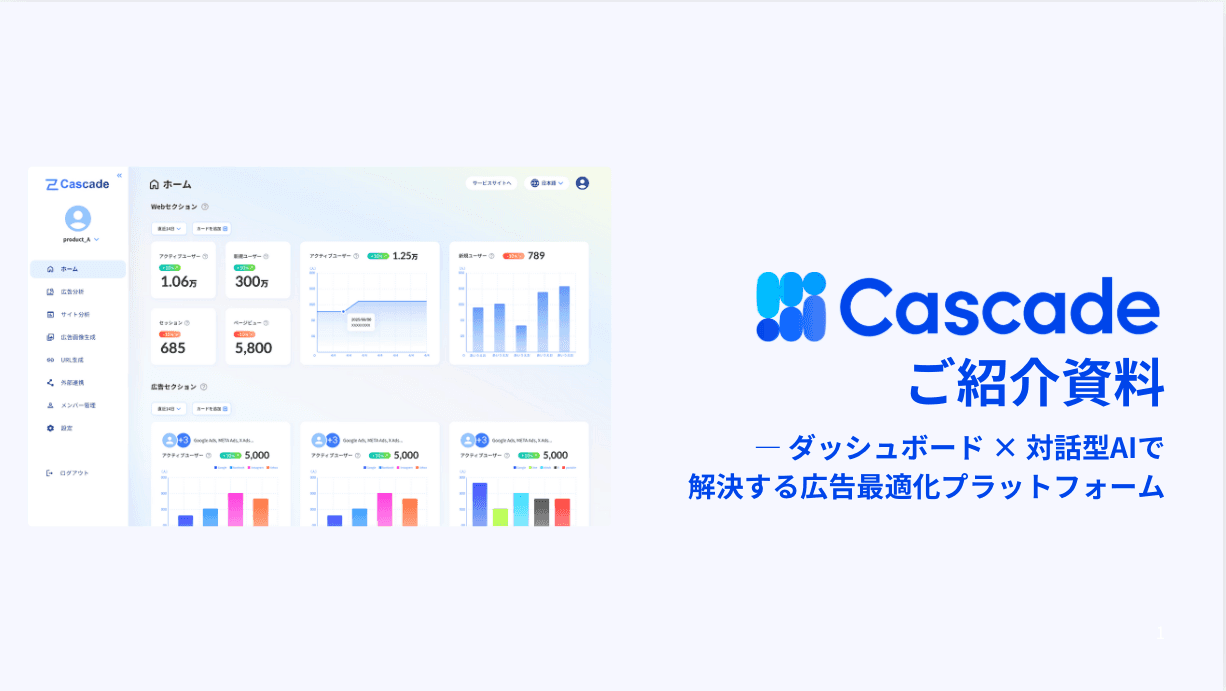
Table of Contents

© 2025 Cascade Inc, All Rights Reserved.

© 2025 Cascade Inc, All Rights Reserved.
© 2025 Cascade Inc, All Rights Reserved.