How Ad Operations Will Change in 2025: 5 Key Shifts and Strategies for the AI Era
Dec 17, 2025


Introduction
Modern advertising operators are facing two massive changes: the rapid evolution of AI technology and the full-scale arrival of the Cookie era. It is now clear that conventional methods are no longer applicable.
In such a situation, it is required to accurately predict the future of advertising operations and take action immediately. In this article, we will thoroughly explain the five most important changes in advertising operations by 2025, using specific examples, focusing on Advertising Operations Automation AI strategies that can be applied starting tomorrow.
1. From "Waiting for Instructions" to "Autonomous Thinking": Agentic AI Completely Changes Operations
In 2025, the automation of advertising operations has undergone a fundamental paradigm shift. Traditional rule-based automation was a "waiting for instructions" system that executed pre-set commands. However, operations are now evolving into an "Agentic AI" that understands natural language instructions and autonomously performs everything from strategy formulation to execution.
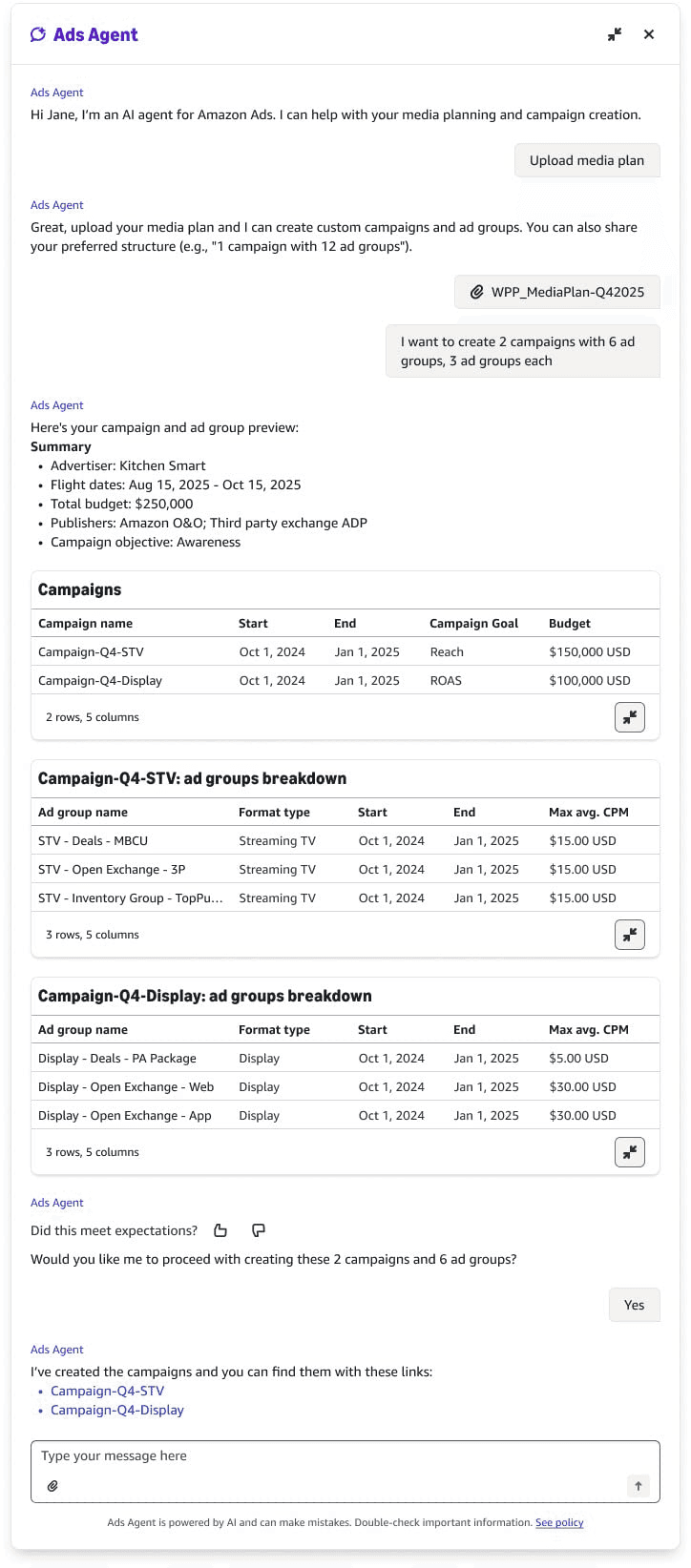
Symbolizing this change is the "Ads Agent" announced by Amazon Ads.
With this tool, operators no longer need to manipulate complex management screens. By giving natural language instructions such as "Pause campaigns with low returns and adjust the budget to use it up by the deadline," AI handles complex setting changes on their behalf. Furthermore, in situations where advanced analysis is required, a feature called "AMC Skills with Ads Agent" transforms natural language questions into SQL queries, enabling deep data insights without expert knowledge.
This evolution means a shift in the role of operators from "managing screen operators" to "strategic commanders" who accurately convey business objectives to AI. However, it should be remembered that the performance of this powerful agent is maximized only with high-quality in-house data, as discussed later.
2. The "Playtime" is Over: Generative AI Takes Center Stage in Advertising Creativity
In 2025, generative AI established its position not just as a tool for idea generation but as a "practical main player" in advertising creative production. The production process that once took weeks can now be completed in hours or even minutes.
Specifically, the following functionalities have been put into practical use.
Fast Mass Production: Amazon's "Creative Agent" analyzes product detail pages, customer reviews, and brand store data, automatically generating text ads, banners, and videos that comply with brand guidelines in a matter of minutes to hours. It is also possible to test more than ten times the variations compared to traditional methods.
Multimodal Generation: Advanced editing tasks, such as converting still images into dynamic video ads and automatically inserting subtitles, are automated by AI.
Hyper-Personalization: Just like Meta's "Advantage+", AI can identify the environment in which ads are delivered (such as reels, stories, etc.) and rearrange them into the optimal format in real-time. This feature has reportedly increased the ROAS (Return On Advertising Spend) by an average of 22%.
Leading domestic companies are also accelerating this trend.
Company Name | Utilization Content |
Ito En | Created TV commercials using AI models. Generative AI was also adopted for package design. |
CyberAgent | Innovated advertising creativity using a non-existent model through "Extreme Prediction AI Human". |
Hakuhodo | Generated "virtual consumers" using generative AI to predict market reactions in advance. |
These examples demonstrate that generative AI is not just about increasing the efficiency of the production process. Generative AI has become a foundational technology that permeates the entire marketing value chain, from Hakuhodo's "virtual consumers" for market research to CyberAgent's "Extreme Prediction AI Human" for creative production, and even to Ito En's package design.
3. Light Shines on the Black Box: AI's "Transparency" and "Control" Improve
As automation by AI progresses, concerns about the black box of "not knowing what AI is doing" have arisen. However, the trend changed significantly in 2025. The platforms responded to operators' concerns by improving AI's "transparency" and "control".
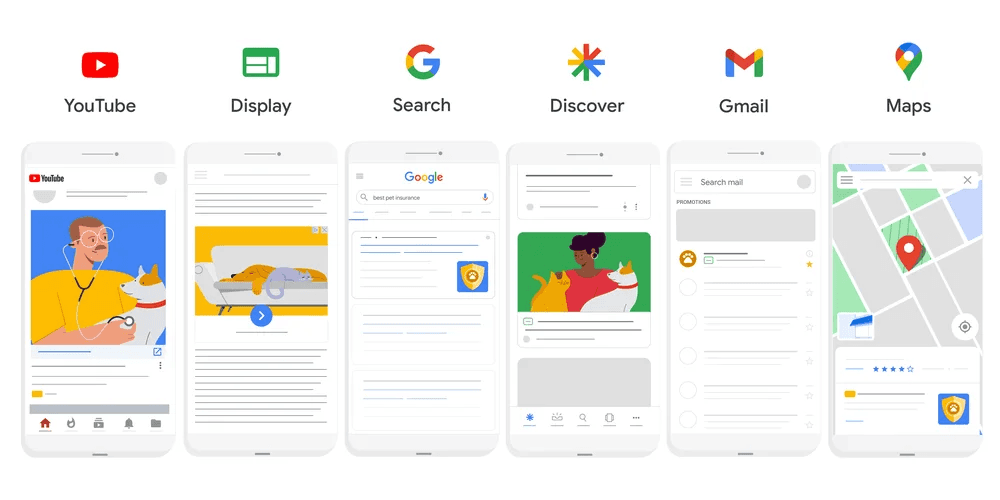
A representative example is Google Ads' "Performance Max (P-MAX)". This feature, once criticized as a black box, has undergone significant updates as follows.
Significant Expansion of Excluded Keywords: The upper limit for settings per campaign has increased from the previous 100 to 10,000. This allows for a thorough exclusion of keywords that may harm the brand image, significantly enhancing brand safety.
Release of Channel-Specific Reporting: Results, which could only be viewed collectively until now, can now be checked by channel, such as YouTube, search, and display. This allows for identifying channels with low investment return and achieving more strategic budget allocation.
Introduction of High-Value New Customer Acquisition Mode: A new feature that trains AI with their high LTV customer data to strengthen bidding towards similar high-quality prospects. In one furniture e-commerce case, it was reported that the customer lifetime value increased by 23%.
Transparency of Search Theme Function: It now allows distinguishing whether the search terms displaying ads are based on AI predictions (indicated in the source column as "URL, page content, assets, etc.") or on search themes set by operators (indicated in the source column as "search theme").
The increase in user-controlled elements is a significant change. This shows that advertising operations are shifting from "complete automation" to "strategic automation", where humans set AI's guardrails (behavioral boundaries) and provide strategic direction. The expansions of excluded keywords and targeting settings for high-value customers introduced here are tools that specifically realize the new role of "humans setting AI's guardrails" outlined later.
4. Survival Strategy in the Post-Cookie Era: "High-Quality In-House Data" Determines AI Performance
In 2025, the abolition of third-party cookies was completed, making the dual challenge of privacy protection and advertising precision the top priority for marketers. With conventional methods of tracking individual users becoming obsolete, the source of competitive advantage is clear. It lies in the "first-party data" that maximizes AI performance.
To survive in an environment that does not rely on cookies, the following measures have become the default.
Server-Side Measurement: By measuring data directly from the server without being affected by browser limitations, it reduces measurement errors by approximately 40%.
Utilization of First-Party Data: Using customer data collected in-house (CRM, POS, membership information, etc.) to maintain and improve targeting accuracy.
Contextual Advertising: A method where AI understands the context and content of the viewed page and delivers highly relevant ads.
Conversion API: Sending conversion data directly from the company's server to the advertising platform without going through the browser, avoiding the impact of cookie regulations.
From a professional perspective, this embodies the principle of "Garbage In, Garbage Out". Even a powerful agentic AI like Amazon's "Ads Agent" introduced in Chapter 1 will optimize in the wrong direction if fed with incomplete and low-quality data. Building a high-quality data foundation is one of the most important tasks for modern marketers.
5. Jobs Will Not Disappear; Rather, They Will Become More Sophisticated: A New "Strong Partnership" Between Humans and AI
The fear of "losing jobs to AI" has become a thing of the past. In 2025, the advertising operations field has shifted to an era of "cooperation between humans and AI" where roles are changing and higher skills are required.
The new division of roles between humans and AI will be as follows.
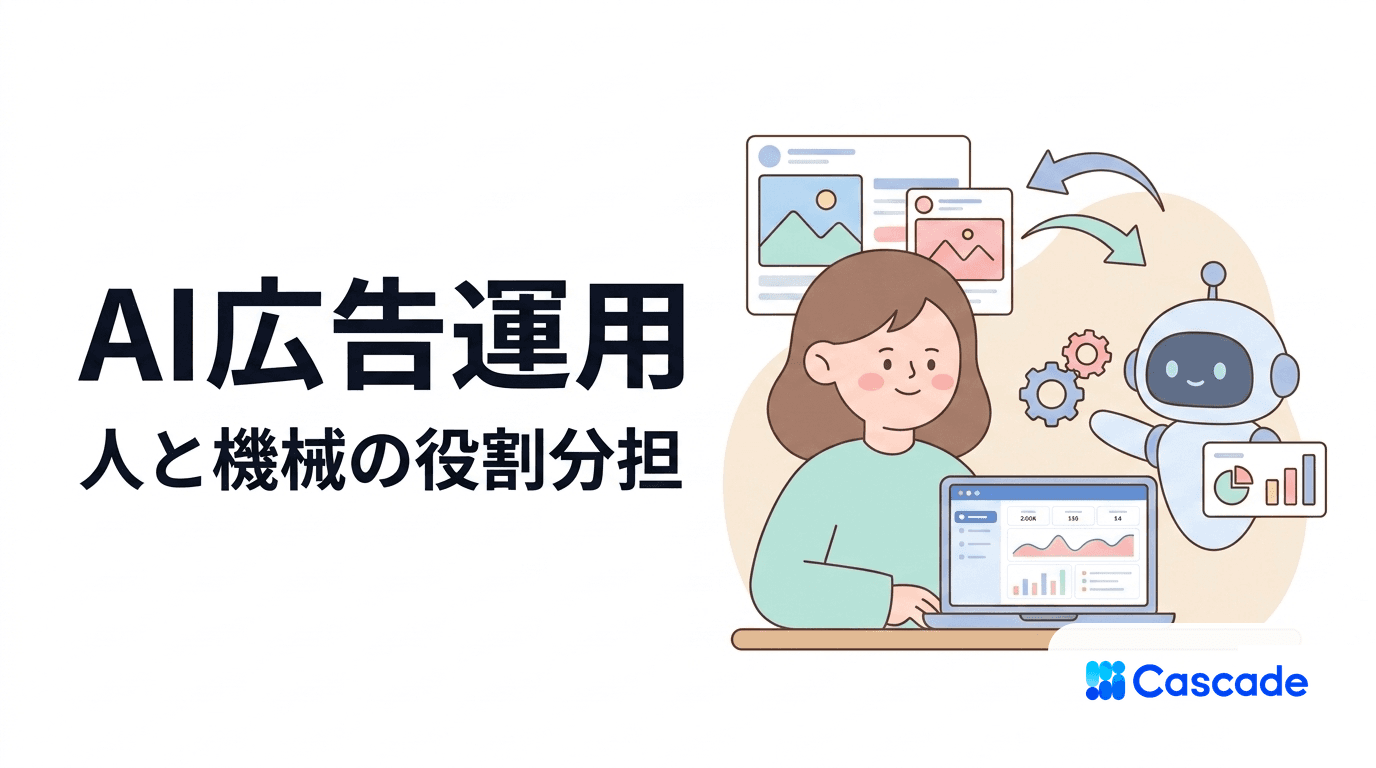
AI's Role (Execution): It is responsible for "execution", which requires speed and accuracy that humans cannot achieve, handling vast data processing, 24/7 real-time bidding adjustments, and numerous creative tests.
Human's Role (Strategy and Oversight): It oversees "strategy and supervision", including KPI setting in line with business goals, brand strategy formulation, providing high-quality data (signals) to AI, and final quality control and ethical judgment of AI-generated creative.
This hybrid model is also economically rational. In one SaaS company example, the initial investment of 5 million yen and a monthly operational cost of 250,000 yen resulted in a suppression of the need to increase support staff by five, and a further reduction in cancellation rates by 23%. This hybrid model has achieved an astonishing return of 5.7 times the investment amount in just two years, proving to be very rational from a business perspective. Another manufacturing industry example also reported a return of 3.2 times the investment amount, indicating that this is not limited to specific industries.
Automation does not take away human jobs; it frees humans from tedious operations and becomes a "wing" to generate greater value.
--------------------------------------------------------------------------------
Conclusion: Becoming the New Era Marketer Who “Rides” AI
Advertising operations in 2025 are riding the wave of five major changes.
Autonomous operations by agentic AI
Generative AI becoming the mainstay in creative production
Improvement of AI's transparency and control
Overwhelming importance of first-party data
Role sophistication through cooperation between humans and AI
What is required of future advertising operators is not to fear AI. Rather, it is to deeply understand its characteristics and develop the skill to strategically "ride" it to achieve business objectives.
To respond to these complex and massive changes, appropriate tools are essential. The AI advertising operations automation tool "Cascade" is a platform designed precisely for the new era marketer. TheCascade integrates and analyzes data from multiple channels, such as Google Ads and Meta Ads, and provides optimization suggestions through AI, helping you become free from report preparation and detailed adjustment tasks, allowing you to focus on more strategic work.
As a partner leading in the AI era, see how Cascade can accelerate your business.
Introduction
Modern advertising operators are facing two massive changes: the rapid evolution of AI technology and the full-scale arrival of the Cookie era. It is now clear that conventional methods are no longer applicable.
In such a situation, it is required to accurately predict the future of advertising operations and take action immediately. In this article, we will thoroughly explain the five most important changes in advertising operations by 2025, using specific examples, focusing on Advertising Operations Automation AI strategies that can be applied starting tomorrow.
1. From "Waiting for Instructions" to "Autonomous Thinking": Agentic AI Completely Changes Operations
In 2025, the automation of advertising operations has undergone a fundamental paradigm shift. Traditional rule-based automation was a "waiting for instructions" system that executed pre-set commands. However, operations are now evolving into an "Agentic AI" that understands natural language instructions and autonomously performs everything from strategy formulation to execution.
Symbolizing this change is the "Ads Agent" announced by Amazon Ads.
With this tool, operators no longer need to manipulate complex management screens. By giving natural language instructions such as "Pause campaigns with low returns and adjust the budget to use it up by the deadline," AI handles complex setting changes on their behalf. Furthermore, in situations where advanced analysis is required, a feature called "AMC Skills with Ads Agent" transforms natural language questions into SQL queries, enabling deep data insights without expert knowledge.
This evolution means a shift in the role of operators from "managing screen operators" to "strategic commanders" who accurately convey business objectives to AI. However, it should be remembered that the performance of this powerful agent is maximized only with high-quality in-house data, as discussed later.

2. The "Playtime" is Over: Generative AI Takes Center Stage in Advertising Creativity
In 2025, generative AI established its position not just as a tool for idea generation but as a "practical main player" in advertising creative production. The production process that once took weeks can now be completed in hours or even minutes.
Specifically, the following functionalities have been put into practical use.
Fast Mass Production: Amazon's "Creative Agent" analyzes product detail pages, customer reviews, and brand store data, automatically generating text ads, banners, and videos that comply with brand guidelines in a matter of minutes to hours. It is also possible to test more than ten times the variations compared to traditional methods.
Multimodal Generation: Advanced editing tasks, such as converting still images into dynamic video ads and automatically inserting subtitles, are automated by AI.
Hyper-Personalization: Just like Meta's "Advantage+", AI can identify the environment in which ads are delivered (such as reels, stories, etc.) and rearrange them into the optimal format in real-time. This feature has reportedly increased the ROAS (Return On Advertising Spend) by an average of 22%.
Leading domestic companies are also accelerating this trend.
Company Name | Utilization Content |
Ito En | Created TV commercials using AI models. Generative AI was also adopted for package design. |
CyberAgent | Innovated advertising creativity using a non-existent model through "Extreme Prediction AI Human". |
Hakuhodo | Generated "virtual consumers" using generative AI to predict market reactions in advance. |
These examples demonstrate that generative AI is not just about increasing the efficiency of the production process. Generative AI has become a foundational technology that permeates the entire marketing value chain, from Hakuhodo's "virtual consumers" for market research to CyberAgent's "Extreme Prediction AI Human" for creative production, and even to Ito En's package design.
3. Light Shines on the Black Box: AI's "Transparency" and "Control" Improve
As automation by AI progresses, concerns about the black box of "not knowing what AI is doing" have arisen. However, the trend changed significantly in 2025. The platforms responded to operators' concerns by improving AI's "transparency" and "control".
A representative example is Google Ads' "Performance Max (P-MAX)". This feature, once criticized as a black box, has undergone significant updates as follows.

Significant Expansion of Excluded Keywords: The upper limit for settings per campaign has increased from the previous 100 to 10,000. This allows for a thorough exclusion of keywords that may harm the brand image, significantly enhancing brand safety.
Release of Channel-Specific Reporting: Results, which could only be viewed collectively until now, can now be checked by channel, such as YouTube, search, and display. This allows for identifying channels with low investment return and achieving more strategic budget allocation.
Introduction of High-Value New Customer Acquisition Mode: A new feature that trains AI with their high LTV customer data to strengthen bidding towards similar high-quality prospects. In one furniture e-commerce case, it was reported that the customer lifetime value increased by 23%.
Transparency of Search Theme Function: It now allows distinguishing whether the search terms displaying ads are based on AI predictions (indicated in the source column as "URL, page content, assets, etc.") or on search themes set by operators (indicated in the source column as "search theme").
The increase in user-controlled elements is a significant change. This shows that advertising operations are shifting from "complete automation" to "strategic automation", where humans set AI's guardrails (behavioral boundaries) and provide strategic direction. The expansions of excluded keywords and targeting settings for high-value customers introduced here are tools that specifically realize the new role of "humans setting AI's guardrails" outlined later.
4. Survival Strategy in the Post-Cookie Era: "High-Quality In-House Data" Determines AI Performance
In 2025, the abolition of third-party cookies was completed, making the dual challenge of privacy protection and advertising precision the top priority for marketers. With conventional methods of tracking individual users becoming obsolete, the source of competitive advantage is clear. It lies in the "first-party data" that maximizes AI performance.
To survive in an environment that does not rely on cookies, the following measures have become the default.
Server-Side Measurement: By measuring data directly from the server without being affected by browser limitations, it reduces measurement errors by approximately 40%.
Utilization of First-Party Data: Using customer data collected in-house (CRM, POS, membership information, etc.) to maintain and improve targeting accuracy.
Contextual Advertising: A method where AI understands the context and content of the viewed page and delivers highly relevant ads.
Conversion API: Sending conversion data directly from the company's server to the advertising platform without going through the browser, avoiding the impact of cookie regulations.
From a professional perspective, this embodies the principle of "Garbage In, Garbage Out". Even a powerful agentic AI like Amazon's "Ads Agent" introduced in Chapter 1 will optimize in the wrong direction if fed with incomplete and low-quality data. Building a high-quality data foundation is one of the most important tasks for modern marketers.
5. Jobs Will Not Disappear; Rather, They Will Become More Sophisticated: A New "Strong Partnership" Between Humans and AI
The fear of "losing jobs to AI" has become a thing of the past. In 2025, the advertising operations field has shifted to an era of "cooperation between humans and AI" where roles are changing and higher skills are required.
The new division of roles between humans and AI will be as follows.
AI's Role (Execution): It is responsible for "execution", which requires speed and accuracy that humans cannot achieve, handling vast data processing, 24/7 real-time bidding adjustments, and numerous creative tests.
Human's Role (Strategy and Oversight): It oversees "strategy and supervision", including KPI setting in line with business goals, brand strategy formulation, providing high-quality data (signals) to AI, and final quality control and ethical judgment of AI-generated creative.
This hybrid model is also economically rational. In one SaaS company example, the initial investment of 5 million yen and a monthly operational cost of 250,000 yen resulted in a suppression of the need to increase support staff by five, and a further reduction in cancellation rates by 23%. This hybrid model has achieved an astonishing return of 5.7 times the investment amount in just two years, proving to be very rational from a business perspective. Another manufacturing industry example also reported a return of 3.2 times the investment amount, indicating that this is not limited to specific industries.
Automation does not take away human jobs; it frees humans from tedious operations and becomes a "wing" to generate greater value.
--------------------------------------------------------------------------------
Conclusion: Becoming the New Era Marketer Who “Rides” AI
Advertising operations in 2025 are riding the wave of five major changes.
Autonomous operations by agentic AI
Generative AI becoming the mainstay in creative production
Improvement of AI's transparency and control
Overwhelming importance of first-party data
Role sophistication through cooperation between humans and AI
What is required of future advertising operators is not to fear AI. Rather, it is to deeply understand its characteristics and develop the skill to strategically "ride" it to achieve business objectives.
To respond to these complex and massive changes, appropriate tools are essential. The AI advertising operations automation tool "Cascade" is a platform designed precisely for the new era marketer. TheCascade integrates and analyzes data from multiple channels, such as Google Ads and Meta Ads, and provides optimization suggestions through AI, helping you become free from report preparation and detailed adjustment tasks, allowing you to focus on more strategic work.
As a partner leading in the AI era, see how Cascade can accelerate your business.
© 2025 Cascade Inc, All Rights Reserved.