ROAS Optimization: Five Strategies to Protect Profit
ROAS Optimization: Five Strategies to Protect Profit
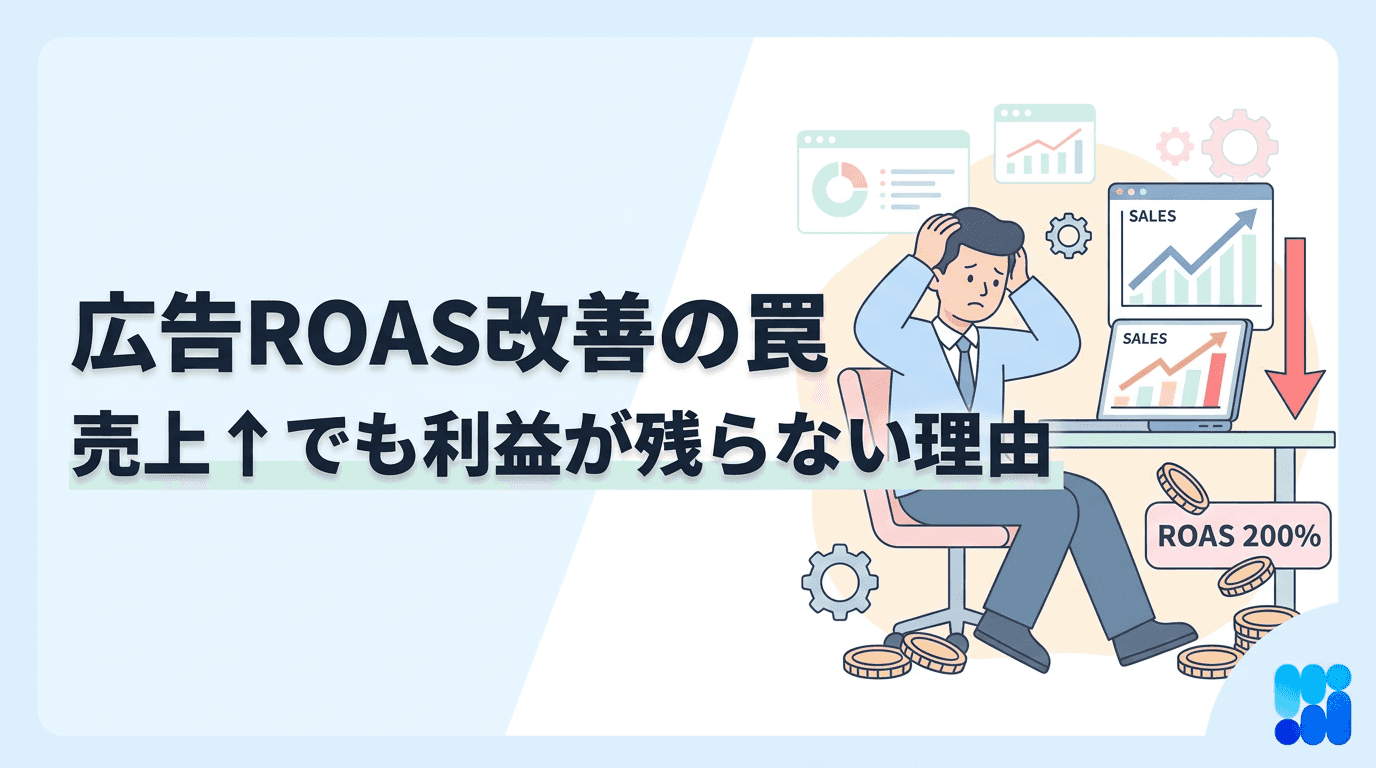
The "ROAS Trap" Many Marketers Fall Into
Sales from ads are increasing, yet profits somehow do not remain in hand. This issue that many marketers face suggests a deep-rooted problem in advertising operations.
Return on Ad Spend (ROAS) is an extremely important metric for measuring the success of advertising campaigns. However, there is a "trap" lurking in blindly trusting this number and solely pursuing ROAS improvement.
This article will delve deeper than the superficial understanding of ROAS and explain five strategic ways of thinking to maximize overall business profit. Let’s acquire an essential approach that leads to sustainable growth, not just numerical improvement.
1. High ROAS ≠ Success! Understand the Fatal Difference from ROI, Which Measures Profit
The first step in improving ROAS is to accurately understand the limitations of this metric. A common source of confusion among many marketers is the difference from ROI (Return on Investment).
ROAS indicates how much revenue is generated in relation to ad expenditure.
ROAS (%) = (Sales from Ads ÷ Ad Spend) × 100
For example, with an ad spend of ¥100,000 and sales of ¥500,000, the ROAS would be 500%. This means "¥5 in sales has been generated for every ¥1 spent on ads" and indicates the efficiency of the advertising strategy.
On the other hand, ROI indicates how much profit has been made in relation to the amount invested.
ROI (%) = (Profit ÷ Investment) × 100
This difference between "sales" and "profit" represents a fatal gap that can determine the success or failure of a business. This is because even with a high ROAS, if the profit margin of the product is low, the business could be incurring losses.
For instance, let’s compare two products A and B that achieved the same ROAS (200%) by spending the same amount on advertising (¥100,000) and selling 20 items at the same price (¥10,000).
Product A: Profit Margin 20% (Cost ¥8,000)
Sales: ¥200,000
Total Profit: (¥10,000 - ¥8,000) × 20 = ¥40,000
Final Profit/Loss: Total Profit ¥40,000 - Ad Spend ¥100,000 = -¥60,000 Loss
Product B: Profit Margin 70% (Cost ¥3,000)
Sales: ¥200,000
Total Profit: (¥10,000 - ¥3,000) × 20 = ¥140,000
Final Profit/Loss: Total Profit ¥140,000 - Ad Spend ¥100,000 = +¥40,000 Profit
Thus, even with the same ROAS of 200%, the profitability of the business varies greatly due to differences in profit margins.
ROAS is a metric for measuring the "efficiency" of advertising, not for measuring the "profitability" of the business. A perspective of ROI is indispensable for evaluating ultimate profit.
True improvement in ROAS is not merely about increasing sales efficiency but aiming for advertising operations that contribute to the overall profit of the business.
2. Don’t Set Target ROAS on a Whim! Calculate "Break-Even ROAS" from Your Profit Margin
A vague goal setting like "Let’s aim for a target ROAS of 500%" can endanger the business. The ROAS to aim for greatly varies depending on the business's profit structure, making it essential to set logically based on your own data.
Here, the concept of Break-Even ROAS becomes important. This indicates the minimum ROAS level necessary to avoid losses, even when ad spending is incurred.
Break-Even ROAS can be calculated using the following formulas.
Break-Even ROAS (%) = 1 ÷ Profit Margin (%)
Or
Break-Even ROAS (%) = Customer Price ÷ (Customer Price - Cost) × 100
Let’s calculate it in practice.
Assumptions
Product Price (Customer Price): ¥8,000
Cost (Product Cost + Variable Costs): ¥4,800
Step 1: Calculate Profit Margin
Profit Amount: ¥8,000 - ¥4,800 = ¥3,200
Profit Margin: ¥3,200 ÷ ¥8,000 = 40%
Step 2: Calculate Break-Even ROAS
Break-Even ROAS = 1 ÷ 0.40 (40%) = 2.5 → 250%
This calculation result means, "In the case of this product, if ROAS falls below 250%, the more sales there are from ads, the larger the loss will be," indicating that the absolute minimum line in advertising operations is 250%, based on data.
Break-Even ROAS serves as the minimum line to prevent losses. The actual target ROAS needs to be set by adding the desired profit to this figure.
3. Look Beyond Ads: Improving ROAS Requires Raising CVR (Conversion Rate)
Even with the best targeting and attractive ad creatives, if users do not make a purchase on the landing page (LP) they ultimately reach, all efforts will be in vain. Many reasons for low ROAS stem from pouring ad expenditure into a "leaky bucket (= low CVR LP)".
Improving CVR (Conversion Rate) raises "sales from ads," the numerator in the ROAS calculation formula (Sales from Ads ÷ Ad Spend), directly without increasing the denominator, leading to tremendous effects on ROAS improvement.
To improve ROAS, let’s look outside the ad management screen and engage in the following LP improvement measures.
Entry Form Optimization (EFO): Reduce input fields or add features that save information during input, preventing dropout on forms. Minimizing user effort is fundamental to improving CVR.
Install Exit Prevention Pop-ups: Presenting limited-time coupons or perks to retain users who attempt to leave the page. The final push can significantly affect sales.
Increase Conversion Points: Add links (CTA buttons) to directly transition to product detail pages or carts, shortening the steps to purchase. Designing pathways that allow users to take the next action „without hesitation as soon as they think,„ I want it,” is crucial.
Optimize LP Loading Speed: The speed at which a page loads directly impacts CVR. In some cases, simply shortening the LP loading speed from 3 seconds to 1 second has been reported to increase CVR by 1.5 times, ultimately improving ROAS by 200%.
Optimizing ROAS is not just the responsibility of ad operators. It is a challenge for the entire business to design the entire customer experience from when a user clicks on the ad until they complete a purchase.
4. Maximize Acquired Value: Elevate Customer Price and LTV (Customer Lifetime Value)
Another powerful approach to improve ROAS is to increase the value obtained from a single conversion itself. This involves two perspectives: short-term "Customer Price" and long-term "LTV".
Introduce Upselling and Cross-Selling
By raising the amount of a single purchase (Customer Price), you can increase sales without changing ad expenditure, consequently improving ROAS.
Upselling: Proposing higher-priced models or more feature-rich plans than the product the customer is considering.
Cross-selling: Suggesting other products related to what the customer is looking to buy, encouraging "bundle buying".
By incorporating these measures into the cart page and product pages of e-commerce sites, it is possible to efficiently raise Customer Price.
Encourage Repeat Purchases and Build Long-Term Relationships
The ultimate strategy for improving ROAS is to enhance LTV (Life Time Value). LTV refers to the total profit a single customer generates for a company over their lifetime.
With a perspective on LTV, the flexibility of advertising strategies increases dramatically. This is because businesses with high LTV can recover profits from repeat purchases even if the ROAS during the initial purchase acquisition of new customers is low (even if in the red). Consequently, it becomes possible to take an aggressive strategy to acquire valuable customers, even if it means spending more on advertising than competitors who only look at short-term ROAS.
Even if short-term ROAS is low, if LTV is high, that ad investment can be considered successful. The perspective of LTV becomes a strategic weapon to gain an advantage over competitors.
5. Eliminate Wasteful Costs: Targeting Precision and Keywords Selection Techniques
Alongside measures to increase sales, it is also vital to thoroughly eliminate waste in ad expenditure, which is the denominator of ROAS. Preventing "leakage" in the advertising budget is among the quickest ways to improve ROAS.
Review Targeting and Concentrate on "Highly Likely Buyers"
Advertising only has meaning when it reaches the intended audience. Regularly review basic targeting settings such as age, gender, interests, and concentrate the budget on customer segments most likely to purchase your products or services. For instance, analyzing delivery areas and times is fundamental. For business-store operations, focusing delivery on the trade area, and for B2B services, targeting company operating hours can minimize unrelated impressions and clicks, efficiently directing the budget to the most impactful moments.
Particularly, retargeting is an extremely powerful technique. Users who have visited the site or placed items in the cart already have high interest. By delivering ads to them again, you can expect a conversion rate and ROAS significantly higher than targeting new users.
Use Exclusion Keywords Settings to Prevent Wasteful Clicks in Advance
In listing ads (search ads), the biggest cause of wasted ad expenditure is showing ads and being clicked on irrelevant search phrases that do not lead to conversions.
This can be prevented with "exclusion keywords" settings. By analyzing user search intentions and preemptively excluding keywords that indicate low purchase intent or are unrelated, you can prevent unnecessary costs from arising.
Examples of Exclusion Keywords: "Free","Used","Rental","How to","What is","Repair"
These precise targeting and exclusion settings are fundamental yet critical techniques to stop financial "leakage" in advertising budgets and concentrate resources in productive areas.
Conclusion: Using ROAS as a Compass, Shifting Towards an Advertising Strategy That Maximizes Profit
True success in advertising operations is not merely chasing the number ROAS. While using ROAS as an important compass, create strategies that contribute to the overall growth of the business with a multifaceted perspective on profit (ROI), customer lifetime value (LTV), and conversion rate (CVR).
Let’s review the five strategic thoughts explained in this article once again.
Understand the difference between ROAS and ROI, and think based on profit
Calculate Break-Even ROAS and set data-driven goals
Improve CVR of LP, which lies outside of ads
Increase customer price and LTV, securing long-term profits
Eliminate wasteful advertising costs, maximizing investment efficiency
Many may want to conduct these complex analyses and optimizations more efficiently and in a data-driven manner.
The AI advertising operation automation tool "Cascade" is a platform designed to automate advanced analyses like those explained in this article and maximize the ROI of advertising investments. The AI automatically identifies good and poor-performing ads and proposes optimal budget allocation, significantly reducing the hours required for analytical tasks and offering an environment where marketers can focus on more strategic operations.
If you feel limited by manual analysis and want to accelerate ROAS improvement through AI-driven analysis and budget optimization, be sure to check out Cascade for details.
The "ROAS Trap" Many Marketers Fall Into
Sales from ads are increasing, yet profits somehow do not remain in hand. This issue that many marketers face suggests a deep-rooted problem in advertising operations.
Return on Ad Spend (ROAS) is an extremely important metric for measuring the success of advertising campaigns. However, there is a "trap" lurking in blindly trusting this number and solely pursuing ROAS improvement.
This article will delve deeper than the superficial understanding of ROAS and explain five strategic ways of thinking to maximize overall business profit. Let’s acquire an essential approach that leads to sustainable growth, not just numerical improvement.
1. High ROAS ≠ Success! Understand the Fatal Difference from ROI, Which Measures Profit
The first step in improving ROAS is to accurately understand the limitations of this metric. A common source of confusion among many marketers is the difference from ROI (Return on Investment).
ROAS indicates how much revenue is generated in relation to ad expenditure.
ROAS (%) = (Sales from Ads ÷ Ad Spend) × 100
For example, with an ad spend of ¥100,000 and sales of ¥500,000, the ROAS would be 500%. This means "¥5 in sales has been generated for every ¥1 spent on ads" and indicates the efficiency of the advertising strategy.
On the other hand, ROI indicates how much profit has been made in relation to the amount invested.
ROI (%) = (Profit ÷ Investment) × 100
This difference between "sales" and "profit" represents a fatal gap that can determine the success or failure of a business. This is because even with a high ROAS, if the profit margin of the product is low, the business could be incurring losses.
For instance, let’s compare two products A and B that achieved the same ROAS (200%) by spending the same amount on advertising (¥100,000) and selling 20 items at the same price (¥10,000).
Product A: Profit Margin 20% (Cost ¥8,000)
Sales: ¥200,000
Total Profit: (¥10,000 - ¥8,000) × 20 = ¥40,000
Final Profit/Loss: Total Profit ¥40,000 - Ad Spend ¥100,000 = -¥60,000 Loss
Product B: Profit Margin 70% (Cost ¥3,000)
Sales: ¥200,000
Total Profit: (¥10,000 - ¥3,000) × 20 = ¥140,000
Final Profit/Loss: Total Profit ¥140,000 - Ad Spend ¥100,000 = +¥40,000 Profit
Thus, even with the same ROAS of 200%, the profitability of the business varies greatly due to differences in profit margins.
ROAS is a metric for measuring the "efficiency" of advertising, not for measuring the "profitability" of the business. A perspective of ROI is indispensable for evaluating ultimate profit.
True improvement in ROAS is not merely about increasing sales efficiency but aiming for advertising operations that contribute to the overall profit of the business.
2. Don’t Set Target ROAS on a Whim! Calculate "Break-Even ROAS" from Your Profit Margin
A vague goal setting like "Let’s aim for a target ROAS of 500%" can endanger the business. The ROAS to aim for greatly varies depending on the business's profit structure, making it essential to set logically based on your own data.
Here, the concept of Break-Even ROAS becomes important. This indicates the minimum ROAS level necessary to avoid losses, even when ad spending is incurred.
Break-Even ROAS can be calculated using the following formulas.
Break-Even ROAS (%) = 1 ÷ Profit Margin (%)
Or
Break-Even ROAS (%) = Customer Price ÷ (Customer Price - Cost) × 100
Let’s calculate it in practice.
Assumptions
Product Price (Customer Price): ¥8,000
Cost (Product Cost + Variable Costs): ¥4,800
Step 1: Calculate Profit Margin
Profit Amount: ¥8,000 - ¥4,800 = ¥3,200
Profit Margin: ¥3,200 ÷ ¥8,000 = 40%
Step 2: Calculate Break-Even ROAS
Break-Even ROAS = 1 ÷ 0.40 (40%) = 2.5 → 250%
This calculation result means, "In the case of this product, if ROAS falls below 250%, the more sales there are from ads, the larger the loss will be," indicating that the absolute minimum line in advertising operations is 250%, based on data.
Break-Even ROAS serves as the minimum line to prevent losses. The actual target ROAS needs to be set by adding the desired profit to this figure.
3. Look Beyond Ads: Improving ROAS Requires Raising CVR (Conversion Rate)
Even with the best targeting and attractive ad creatives, if users do not make a purchase on the landing page (LP) they ultimately reach, all efforts will be in vain. Many reasons for low ROAS stem from pouring ad expenditure into a "leaky bucket (= low CVR LP)".
Improving CVR (Conversion Rate) raises "sales from ads," the numerator in the ROAS calculation formula (Sales from Ads ÷ Ad Spend), directly without increasing the denominator, leading to tremendous effects on ROAS improvement.
To improve ROAS, let’s look outside the ad management screen and engage in the following LP improvement measures.
Entry Form Optimization (EFO): Reduce input fields or add features that save information during input, preventing dropout on forms. Minimizing user effort is fundamental to improving CVR.
Install Exit Prevention Pop-ups: Presenting limited-time coupons or perks to retain users who attempt to leave the page. The final push can significantly affect sales.
Increase Conversion Points: Add links (CTA buttons) to directly transition to product detail pages or carts, shortening the steps to purchase. Designing pathways that allow users to take the next action „without hesitation as soon as they think,„ I want it,” is crucial.
Optimize LP Loading Speed: The speed at which a page loads directly impacts CVR. In some cases, simply shortening the LP loading speed from 3 seconds to 1 second has been reported to increase CVR by 1.5 times, ultimately improving ROAS by 200%.
Optimizing ROAS is not just the responsibility of ad operators. It is a challenge for the entire business to design the entire customer experience from when a user clicks on the ad until they complete a purchase.
4. Maximize Acquired Value: Elevate Customer Price and LTV (Customer Lifetime Value)
Another powerful approach to improve ROAS is to increase the value obtained from a single conversion itself. This involves two perspectives: short-term "Customer Price" and long-term "LTV".
Introduce Upselling and Cross-Selling
By raising the amount of a single purchase (Customer Price), you can increase sales without changing ad expenditure, consequently improving ROAS.
Upselling: Proposing higher-priced models or more feature-rich plans than the product the customer is considering.
Cross-selling: Suggesting other products related to what the customer is looking to buy, encouraging "bundle buying".
By incorporating these measures into the cart page and product pages of e-commerce sites, it is possible to efficiently raise Customer Price.
Encourage Repeat Purchases and Build Long-Term Relationships
The ultimate strategy for improving ROAS is to enhance LTV (Life Time Value). LTV refers to the total profit a single customer generates for a company over their lifetime.
With a perspective on LTV, the flexibility of advertising strategies increases dramatically. This is because businesses with high LTV can recover profits from repeat purchases even if the ROAS during the initial purchase acquisition of new customers is low (even if in the red). Consequently, it becomes possible to take an aggressive strategy to acquire valuable customers, even if it means spending more on advertising than competitors who only look at short-term ROAS.
Even if short-term ROAS is low, if LTV is high, that ad investment can be considered successful. The perspective of LTV becomes a strategic weapon to gain an advantage over competitors.
5. Eliminate Wasteful Costs: Targeting Precision and Keywords Selection Techniques
Alongside measures to increase sales, it is also vital to thoroughly eliminate waste in ad expenditure, which is the denominator of ROAS. Preventing "leakage" in the advertising budget is among the quickest ways to improve ROAS.
Review Targeting and Concentrate on "Highly Likely Buyers"
Advertising only has meaning when it reaches the intended audience. Regularly review basic targeting settings such as age, gender, interests, and concentrate the budget on customer segments most likely to purchase your products or services. For instance, analyzing delivery areas and times is fundamental. For business-store operations, focusing delivery on the trade area, and for B2B services, targeting company operating hours can minimize unrelated impressions and clicks, efficiently directing the budget to the most impactful moments.
Particularly, retargeting is an extremely powerful technique. Users who have visited the site or placed items in the cart already have high interest. By delivering ads to them again, you can expect a conversion rate and ROAS significantly higher than targeting new users.
Use Exclusion Keywords Settings to Prevent Wasteful Clicks in Advance
In listing ads (search ads), the biggest cause of wasted ad expenditure is showing ads and being clicked on irrelevant search phrases that do not lead to conversions.
This can be prevented with "exclusion keywords" settings. By analyzing user search intentions and preemptively excluding keywords that indicate low purchase intent or are unrelated, you can prevent unnecessary costs from arising.
Examples of Exclusion Keywords: "Free","Used","Rental","How to","What is","Repair"
These precise targeting and exclusion settings are fundamental yet critical techniques to stop financial "leakage" in advertising budgets and concentrate resources in productive areas.
Conclusion: Using ROAS as a Compass, Shifting Towards an Advertising Strategy That Maximizes Profit
True success in advertising operations is not merely chasing the number ROAS. While using ROAS as an important compass, create strategies that contribute to the overall growth of the business with a multifaceted perspective on profit (ROI), customer lifetime value (LTV), and conversion rate (CVR).
Let’s review the five strategic thoughts explained in this article once again.
Understand the difference between ROAS and ROI, and think based on profit
Calculate Break-Even ROAS and set data-driven goals
Improve CVR of LP, which lies outside of ads
Increase customer price and LTV, securing long-term profits
Eliminate wasteful advertising costs, maximizing investment efficiency
Many may want to conduct these complex analyses and optimizations more efficiently and in a data-driven manner.
The AI advertising operation automation tool "Cascade" is a platform designed to automate advanced analyses like those explained in this article and maximize the ROI of advertising investments. The AI automatically identifies good and poor-performing ads and proposes optimal budget allocation, significantly reducing the hours required for analytical tasks and offering an environment where marketers can focus on more strategic operations.
If you feel limited by manual analysis and want to accelerate ROAS improvement through AI-driven analysis and budget optimization, be sure to check out Cascade for details.
\FreeDownload Now/
\FreeDownload Now/
\FreeDownload Now/
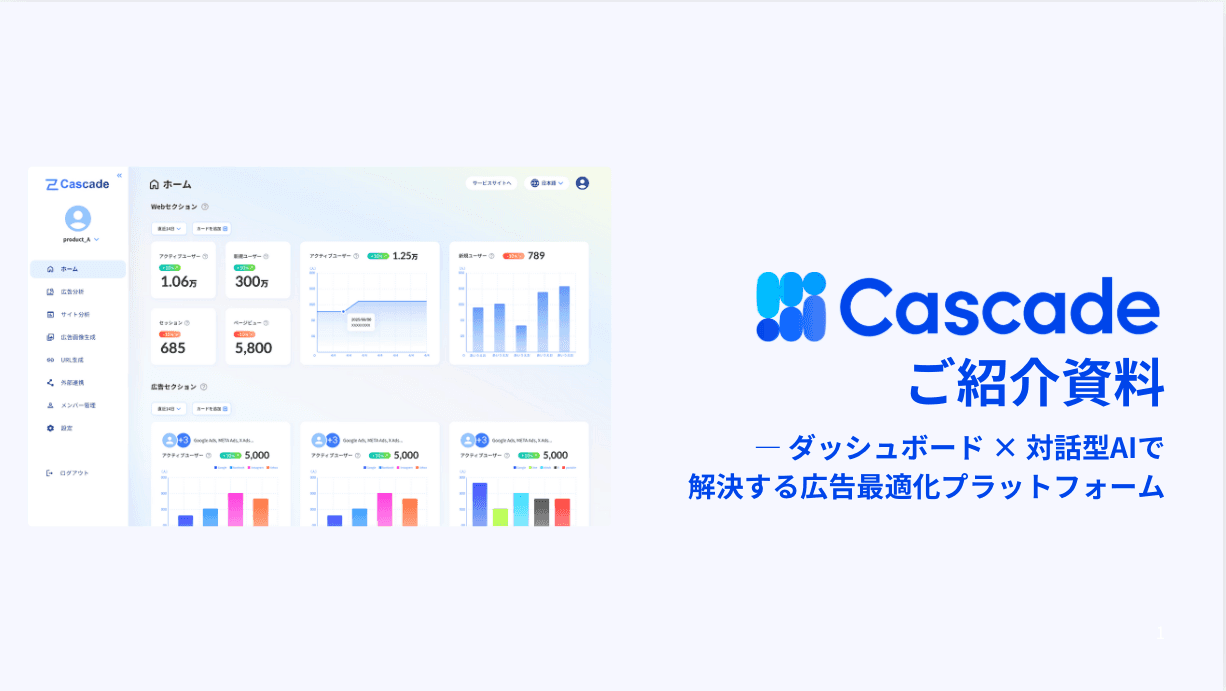
Table of Contents

© 2025 Cascade Inc, All Rights Reserved.

© 2025 Cascade Inc, All Rights Reserved.
© 2025 Cascade Inc, All Rights Reserved.