Listing Ads Agency vs Automation Tools|Which is Optimal?
Listing Ads Agency vs Automation Tools|Which is Optimal?
How to operate listing ads. This is a concern faced by many marketers and business leaders. If you hire an agency to manage your listing ads, you can leverage the expertise of specialists, but the commission costs add up. On the other hand, by introducing automation tools, you may be able to reduce costs, but your company must handle strategic planning. Furthermore, in recent years, with the evolution of AI technology, a third option called "AI agent type" has emerged. This article fairly compares the differences between outsourcing listing ad operations and using automation tools from the perspectives of cost trends, advantages, and disadvantages, providing materials to help identify the best option for your company.
What is the difference between "outsourcing" and "automation tools" for listing ads?
The methods of operating listing ads can be broadly divided into "outsourcing (entrusting to an agency)" and "automation tools (streamlining with mechanisms)." Let's first clarify the basic structures and differences of each.
What is outsourcing (agency)? Basic structure of the service
Outsourcing for listing ads refers to the service of entrusting an advertising operation specialist company (agency) with operational tasks such as keyword selection, bid adjustment, ad copy creation, and reporting. Advertisers pay an operational fee in addition to the advertising costs, and the agency's staff handle the day-to-day operations.
The scope of outsourcing services varies by agency, but generally includes the following tasks.
Account design and initial setup: Designing campaign structures, selecting keywords, creating ad copy
Daily operations: Adjusting bid amounts, optimizing budget allocation, adding negative keywords
Reporting and improvement proposals: Creating monthly reports, suggesting improvement measures based on data analysis
Strategic consulting: Developing medium- to long-term advertising strategies based on market trends
As of 2026, the role of outsourcing companies is also changing. More agencies are incorporating creative production using generative AI and optimizing real-time automated distribution, evolving from mere "advertising placement outsourcing agents" to "strategic partners utilizing AI and data."
What are automation tools? What they can and cannot do
Automation tools are products that streamline some or most of the operational tasks for listing ads using software. They enable automation of tasks traditionally performed by humans, such as automatic bid adjustments, automatic report generation, and budget management alerts.
What automation tools can do:
Automatic bid optimization
Automatic report creation and scheduled delivery
Progress management of budgets and alert notifications
Performance analysis of keywords and ad copy
Rule-based operational actions (e.g., lowering bids if CPA (cost per acquisition) exceeds a certain amount)
What automation tools struggle with:
Developing advertising strategies that view the entire business
Making flexible decisions in response to changes in the market environment
Designing creative concepts
Developing integrated strategies with other channels (SNS advertising, SEO, etc.)
Fundamental differences: "Delegating to people" vs "Operating through systems"
The fundamental difference between outsourcing and automation tools lies in whether the operational entity is "people" or "systems."
Comparison Item | Outsourcing (Agency) | Automation Tools |
|---|---|---|
Operational Entity | Agency's operational staff | In-house staff + tools |
Strategic Planning | Handled by the agency | Handled in-house |
Daily Operations | Executed by the agency | Automated by tools + monitored in-house |
In-house Knowledge Accumulation | Not easily accumulated | Easily accumulated |
Sense of Speed | Depends on agency's response speed | Immediate response possible |
Cost Structure | Linked to advertising costs (variable costs) | Often fixed monthly (fixed costs) |
Outsourcing is a model of "achieving results by relying on experts", while automation tools represent a model of "building systems in-house and operating efficiently." It's not about which is superior, but about making the right choice based on your company's resources, skills, and budget.
Cost trends and pricing structures for outsourced listing ads
Understanding the overall picture of costs is essential when considering outsourcing the operation of listing ads. Here, we will organize the fee trends and pricing structures at the 2026 time point.
The fee rate is about 20% of advertising costs
The outsourcing fee for listing ads is generally around 20% of the advertising costs in the industry. For example, if the monthly advertising cost is 500,000 yen, the fee would be about 100,000 yen, resulting in a total expenditure of 600,000 yen per month.
Also, many agencies set a minimum fee of around 50,000 yen per month. This means it is important to note that even for low advertising costs, a certain amount of fees will still apply.
In reality, outsourcing for listing ads often starts with a monthly advertising cost between 300,000 and 500,000 yen, and budget expansion is common once results begin to show.
Four types of fee structures (percentage-based, fixed fee, tiered, performance-based)
Agencies typically have four main types of fee structures. Choosing a structure that aligns with your advertising cost scale and performance goals is the first step towards cost optimization.
Fee Structure | System | Advantages | Disadvantages |
|---|---|---|---|
Percentage-based | A certain percentage of advertising costs (generally 20%) | Easy to compare with industry standards | Costs increase in proportion to rise in advertising spending |
Fixed Fee | Monthly fixed amount (e.g., 150,000 yen per month) | Budget is predictable | Can become costly even for small advertising budgets |
Tiered | Rate changes according to ranges of advertising costs | Offers scale advantages for large operations | Fee structure can become complicated |
Performance-based | Calculated based on CPA × number of conversions | High level of satisfaction due to linkage to results | Agreement on the definition of conversions (CV) is necessary |
The percentage-based model is the most common, but for larger budgets, the tiered structure may become advantageous.
Initial costs, minimum contract periods, and hidden costs
In addition to fees, outsourcing listing ads may incur the following costs.
Initial costs: Typically 0 to 100,000 yen. These may be billed for account setup or keyword research.
Minimum contract period: Many agencies tend to set this at 3 months. Terminating early may incur penalty fees.
Hidden costs: Costs such as LP creation fees, additional ad creative production costs, and tool usage fees may arise later and are often not detailed in initial estimates.
Cost trends and cost structure of automation tools
The cost structure of automation tools is based on different logic than that of outsourcing.
Fixed monthly vs advertising cost-linked
The pricing framework for automation tools can be broadly categorized into two types.
Fixed Monthly Model: Some tools, such as Optmyzr, are available at a fixed monthly rate regardless of the scale of advertising costs.
Advertising Cost-linked Model: This model is adopted by tools like Cascade, where a certain percentage of advertising costs is paid as a tool usage fee.
Tool Name | Features | Pricing Model |
|---|---|---|
Cascade | Can create new ads with just a few minutes of daily operation. User-friendly for beginners | Advertising cost-linked |
Optmyzr | High-performance optimization engine | Fixed monthly |
Lisket | Strong at automating report generation and budget management | Fixed monthly |
Cost comparison simulation between outsourcing and automation tools
We will simulate for three patterns: monthly advertising costs of 500,000 yen, 1,000,000 yen, and 3,000,000 yen.
Monthly Advertising Cost | Outsourcing Fee (20%) | Tool (Fixed Monthly: 50,000 yen) | Tool (Advertising Cost Linked: 10%) |
|---|---|---|---|
500,000 yen | 100,000 yen | 50,000 yen | 50,000 yen |
1,000,000 yen | 200,000 yen | 50,000 yen | 100,000 yen |
3,000,000 yen | 600,000 yen | 50,000 yen | 300,000 yen |
If the monthly advertising cost is 3,000,000 yen, the cost difference between outsourcing and fixed monthly automation tools is 550,000 yen, equating to a difference of 6,600,000 yen annually. However, when using automation tools, the labor costs of in-house operators should be included in total cost comparisons.
Companies suitable for outsourcing vs companies not suitable
Three cases suitable for outsourcing
1. If your company lacks knowledge of listing ads
In companies without experienced advertising operators, implementing automation tools may not provide clarity on "what and how to set up." Agencies can handle the launch from scratch.
2. If you are overwhelmed with tasks other than advertising
In cases where marketing personnel are few and manage multiple channels, it allows in-house resources to focus on other duties.
3. If a large advertising budget requires an advanced strategy
In cases where the monthly advertising costs exceed several million yen, insights from experienced agencies can directly contribute to maximizing ROI.
Disadvantages of outsourcing and common failures
Inconsistent quality of personnel: Sometimes inexperienced operators are assigned
Slow response speed: May not respond immediately to urgent campaign changes
Lack of knowledge accumulation in-house: Difficult to transition operations back in-house at the end of the contract
Fixed fee costs: Even if ROAS (Return on Advertising Spend) improves, the fee rate remains unchanged
Companies suitable for automation tools vs companies not suitable
Three cases suitable for automation tools
1. If your company already has basic skills in advertising operations
If personnel with foundational knowledge of listing ads are in place, operations can be efficiently streamlined using tools while making strategic decisions in-house.
2. If you want to scale while keeping costs down
As advertising costs increase, the cost discrepancy with outsourcing widens. Utilizing fixed monthly tools ensures that tool costs remain stable even as advertising budgets expand.
3. If you want to accelerate the PDCA cycle
By eliminating the need for agency interaction, the speed of executing measures increases, enabling a rapid PDCA (Plan-Do-Check-Act) improvement cycle.
Pitfalls of automation tools
Setting it and forgetting it: Performance may gradually decline if left unattended
Complexity in tool integration: Combining multiple tools can complicate operation
Learning costs arise: There is a risk of continuity loss if personnel transfer or leave
Difficulty in responding to unexpected situations: Decisions may be delayed in situations that cannot be addressed by rules
The third option: A new approach called AI agent type
Should companies choose to outsource or use automation tools? A new category of advertising operation solutions called "AI agent type" has emerged for businesses struggling with this dilemma.
Balancing "strategic nature" of outsourcing and "cost efficiency" of automation tools
The AI agent type aims to autonomously run the PDCA cycle of data analysis, measure planning, execution, and effectiveness verification simply by setting goals. The idea is that AI takes on the "strategic judgment and execution" previously provided by outsourcing.
For example, in services like Cascade, it aims to fully automate advertising operations through AI technology, significantly reducing manual tasks and improving operational efficiency.
Challenges solved by the AI agent type
Challenge | In the case of outsourcing | In the case of automation tools | In the case of AI agent type |
|---|---|---|---|
Cost | 20% of advertising costs continues to incur | Low cost, but tool fees + personnel costs | Only tool costs for strategic operation |
Strategic planning | Handled by the agency | Needs to be handled in-house | AI proposes and executes |
Response speed | Depends on business hours | Immediate but requires human judgment | Autonomous and immediate response 24/7 |
Knowledge accumulation | Difficult to retain in-house | Prone to individual reliance | Accumulated as data internally |
However, the AI agent type is still an evolving field. It is important to determine the best option based on your company's operational scale, advertising costs, and internal structure.
A flowchart for determining the best choice for your company
Conclusion
We have compared three options for listing ad operations: "outsourcing," "automation tools," and "AI agent type."
Cases suitable for outsourcing:
If you lack expertise in advertising operations and want to leverage professional help
If you want to delegate everything, including strategic planning
If you need advanced optimization with a large budget
Cases suitable for automation tools:
If you have sufficient basic operational skills in-house and want to reduce costs
If you want to rapidly execute the PDCA cycle and accumulate knowledge in-house
Cases suitable for AI agent type:
If you want to reduce the costs of outsourcing but are concerned about strategy with just tools
If you want to minimize operational effort while seeking high results
The key point is to select the optimal solution based on the current situation of your company, including the scale of advertising costs, internal human resources and skills, and the time allocated for operations. Start with outsourcing, then shift to automation tools once knowledge is accumulated, or progressively consider implementing AI agent types. Such phased approaches are also realistic strategies.
First, clarify your company's challenges, and use the flowchart and comparison table in this article to take the first step.
How to operate listing ads. This is a concern faced by many marketers and business leaders. If you hire an agency to manage your listing ads, you can leverage the expertise of specialists, but the commission costs add up. On the other hand, by introducing automation tools, you may be able to reduce costs, but your company must handle strategic planning. Furthermore, in recent years, with the evolution of AI technology, a third option called "AI agent type" has emerged. This article fairly compares the differences between outsourcing listing ad operations and using automation tools from the perspectives of cost trends, advantages, and disadvantages, providing materials to help identify the best option for your company.
What is the difference between "outsourcing" and "automation tools" for listing ads?
The methods of operating listing ads can be broadly divided into "outsourcing (entrusting to an agency)" and "automation tools (streamlining with mechanisms)." Let's first clarify the basic structures and differences of each.
What is outsourcing (agency)? Basic structure of the service
Outsourcing for listing ads refers to the service of entrusting an advertising operation specialist company (agency) with operational tasks such as keyword selection, bid adjustment, ad copy creation, and reporting. Advertisers pay an operational fee in addition to the advertising costs, and the agency's staff handle the day-to-day operations.
The scope of outsourcing services varies by agency, but generally includes the following tasks.
Account design and initial setup: Designing campaign structures, selecting keywords, creating ad copy
Daily operations: Adjusting bid amounts, optimizing budget allocation, adding negative keywords
Reporting and improvement proposals: Creating monthly reports, suggesting improvement measures based on data analysis
Strategic consulting: Developing medium- to long-term advertising strategies based on market trends
As of 2026, the role of outsourcing companies is also changing. More agencies are incorporating creative production using generative AI and optimizing real-time automated distribution, evolving from mere "advertising placement outsourcing agents" to "strategic partners utilizing AI and data."
What are automation tools? What they can and cannot do
Automation tools are products that streamline some or most of the operational tasks for listing ads using software. They enable automation of tasks traditionally performed by humans, such as automatic bid adjustments, automatic report generation, and budget management alerts.
What automation tools can do:
Automatic bid optimization
Automatic report creation and scheduled delivery
Progress management of budgets and alert notifications
Performance analysis of keywords and ad copy
Rule-based operational actions (e.g., lowering bids if CPA (cost per acquisition) exceeds a certain amount)
What automation tools struggle with:
Developing advertising strategies that view the entire business
Making flexible decisions in response to changes in the market environment
Designing creative concepts
Developing integrated strategies with other channels (SNS advertising, SEO, etc.)
Fundamental differences: "Delegating to people" vs "Operating through systems"
The fundamental difference between outsourcing and automation tools lies in whether the operational entity is "people" or "systems."
Comparison Item | Outsourcing (Agency) | Automation Tools |
|---|---|---|
Operational Entity | Agency's operational staff | In-house staff + tools |
Strategic Planning | Handled by the agency | Handled in-house |
Daily Operations | Executed by the agency | Automated by tools + monitored in-house |
In-house Knowledge Accumulation | Not easily accumulated | Easily accumulated |
Sense of Speed | Depends on agency's response speed | Immediate response possible |
Cost Structure | Linked to advertising costs (variable costs) | Often fixed monthly (fixed costs) |
Outsourcing is a model of "achieving results by relying on experts", while automation tools represent a model of "building systems in-house and operating efficiently." It's not about which is superior, but about making the right choice based on your company's resources, skills, and budget.
Cost trends and pricing structures for outsourced listing ads
Understanding the overall picture of costs is essential when considering outsourcing the operation of listing ads. Here, we will organize the fee trends and pricing structures at the 2026 time point.
The fee rate is about 20% of advertising costs
The outsourcing fee for listing ads is generally around 20% of the advertising costs in the industry. For example, if the monthly advertising cost is 500,000 yen, the fee would be about 100,000 yen, resulting in a total expenditure of 600,000 yen per month.
Also, many agencies set a minimum fee of around 50,000 yen per month. This means it is important to note that even for low advertising costs, a certain amount of fees will still apply.
In reality, outsourcing for listing ads often starts with a monthly advertising cost between 300,000 and 500,000 yen, and budget expansion is common once results begin to show.
Four types of fee structures (percentage-based, fixed fee, tiered, performance-based)
Agencies typically have four main types of fee structures. Choosing a structure that aligns with your advertising cost scale and performance goals is the first step towards cost optimization.
Fee Structure | System | Advantages | Disadvantages |
|---|---|---|---|
Percentage-based | A certain percentage of advertising costs (generally 20%) | Easy to compare with industry standards | Costs increase in proportion to rise in advertising spending |
Fixed Fee | Monthly fixed amount (e.g., 150,000 yen per month) | Budget is predictable | Can become costly even for small advertising budgets |
Tiered | Rate changes according to ranges of advertising costs | Offers scale advantages for large operations | Fee structure can become complicated |
Performance-based | Calculated based on CPA × number of conversions | High level of satisfaction due to linkage to results | Agreement on the definition of conversions (CV) is necessary |
The percentage-based model is the most common, but for larger budgets, the tiered structure may become advantageous.
Initial costs, minimum contract periods, and hidden costs
In addition to fees, outsourcing listing ads may incur the following costs.
Initial costs: Typically 0 to 100,000 yen. These may be billed for account setup or keyword research.
Minimum contract period: Many agencies tend to set this at 3 months. Terminating early may incur penalty fees.
Hidden costs: Costs such as LP creation fees, additional ad creative production costs, and tool usage fees may arise later and are often not detailed in initial estimates.
Cost trends and cost structure of automation tools
The cost structure of automation tools is based on different logic than that of outsourcing.
Fixed monthly vs advertising cost-linked
The pricing framework for automation tools can be broadly categorized into two types.
Fixed Monthly Model: Some tools, such as Optmyzr, are available at a fixed monthly rate regardless of the scale of advertising costs.
Advertising Cost-linked Model: This model is adopted by tools like Cascade, where a certain percentage of advertising costs is paid as a tool usage fee.
Tool Name | Features | Pricing Model |
|---|---|---|
Cascade | Can create new ads with just a few minutes of daily operation. User-friendly for beginners | Advertising cost-linked |
Optmyzr | High-performance optimization engine | Fixed monthly |
Lisket | Strong at automating report generation and budget management | Fixed monthly |
Cost comparison simulation between outsourcing and automation tools
We will simulate for three patterns: monthly advertising costs of 500,000 yen, 1,000,000 yen, and 3,000,000 yen.
Monthly Advertising Cost | Outsourcing Fee (20%) | Tool (Fixed Monthly: 50,000 yen) | Tool (Advertising Cost Linked: 10%) |
|---|---|---|---|
500,000 yen | 100,000 yen | 50,000 yen | 50,000 yen |
1,000,000 yen | 200,000 yen | 50,000 yen | 100,000 yen |
3,000,000 yen | 600,000 yen | 50,000 yen | 300,000 yen |
If the monthly advertising cost is 3,000,000 yen, the cost difference between outsourcing and fixed monthly automation tools is 550,000 yen, equating to a difference of 6,600,000 yen annually. However, when using automation tools, the labor costs of in-house operators should be included in total cost comparisons.
Companies suitable for outsourcing vs companies not suitable
Three cases suitable for outsourcing
1. If your company lacks knowledge of listing ads
In companies without experienced advertising operators, implementing automation tools may not provide clarity on "what and how to set up." Agencies can handle the launch from scratch.
2. If you are overwhelmed with tasks other than advertising
In cases where marketing personnel are few and manage multiple channels, it allows in-house resources to focus on other duties.
3. If a large advertising budget requires an advanced strategy
In cases where the monthly advertising costs exceed several million yen, insights from experienced agencies can directly contribute to maximizing ROI.
Disadvantages of outsourcing and common failures
Inconsistent quality of personnel: Sometimes inexperienced operators are assigned
Slow response speed: May not respond immediately to urgent campaign changes
Lack of knowledge accumulation in-house: Difficult to transition operations back in-house at the end of the contract
Fixed fee costs: Even if ROAS (Return on Advertising Spend) improves, the fee rate remains unchanged
Companies suitable for automation tools vs companies not suitable
Three cases suitable for automation tools
1. If your company already has basic skills in advertising operations
If personnel with foundational knowledge of listing ads are in place, operations can be efficiently streamlined using tools while making strategic decisions in-house.
2. If you want to scale while keeping costs down
As advertising costs increase, the cost discrepancy with outsourcing widens. Utilizing fixed monthly tools ensures that tool costs remain stable even as advertising budgets expand.
3. If you want to accelerate the PDCA cycle
By eliminating the need for agency interaction, the speed of executing measures increases, enabling a rapid PDCA (Plan-Do-Check-Act) improvement cycle.
Pitfalls of automation tools
Setting it and forgetting it: Performance may gradually decline if left unattended
Complexity in tool integration: Combining multiple tools can complicate operation
Learning costs arise: There is a risk of continuity loss if personnel transfer or leave
Difficulty in responding to unexpected situations: Decisions may be delayed in situations that cannot be addressed by rules
The third option: A new approach called AI agent type
Should companies choose to outsource or use automation tools? A new category of advertising operation solutions called "AI agent type" has emerged for businesses struggling with this dilemma.
Balancing "strategic nature" of outsourcing and "cost efficiency" of automation tools
The AI agent type aims to autonomously run the PDCA cycle of data analysis, measure planning, execution, and effectiveness verification simply by setting goals. The idea is that AI takes on the "strategic judgment and execution" previously provided by outsourcing.
For example, in services like Cascade, it aims to fully automate advertising operations through AI technology, significantly reducing manual tasks and improving operational efficiency.
Challenges solved by the AI agent type
Challenge | In the case of outsourcing | In the case of automation tools | In the case of AI agent type |
|---|---|---|---|
Cost | 20% of advertising costs continues to incur | Low cost, but tool fees + personnel costs | Only tool costs for strategic operation |
Strategic planning | Handled by the agency | Needs to be handled in-house | AI proposes and executes |
Response speed | Depends on business hours | Immediate but requires human judgment | Autonomous and immediate response 24/7 |
Knowledge accumulation | Difficult to retain in-house | Prone to individual reliance | Accumulated as data internally |
However, the AI agent type is still an evolving field. It is important to determine the best option based on your company's operational scale, advertising costs, and internal structure.
A flowchart for determining the best choice for your company
Conclusion
We have compared three options for listing ad operations: "outsourcing," "automation tools," and "AI agent type."
Cases suitable for outsourcing:
If you lack expertise in advertising operations and want to leverage professional help
If you want to delegate everything, including strategic planning
If you need advanced optimization with a large budget
Cases suitable for automation tools:
If you have sufficient basic operational skills in-house and want to reduce costs
If you want to rapidly execute the PDCA cycle and accumulate knowledge in-house
Cases suitable for AI agent type:
If you want to reduce the costs of outsourcing but are concerned about strategy with just tools
If you want to minimize operational effort while seeking high results
The key point is to select the optimal solution based on the current situation of your company, including the scale of advertising costs, internal human resources and skills, and the time allocated for operations. Start with outsourcing, then shift to automation tools once knowledge is accumulated, or progressively consider implementing AI agent types. Such phased approaches are also realistic strategies.
First, clarify your company's challenges, and use the flowchart and comparison table in this article to take the first step.
\FreeDownload Now/
\FreeDownload Now/
\FreeDownload Now/
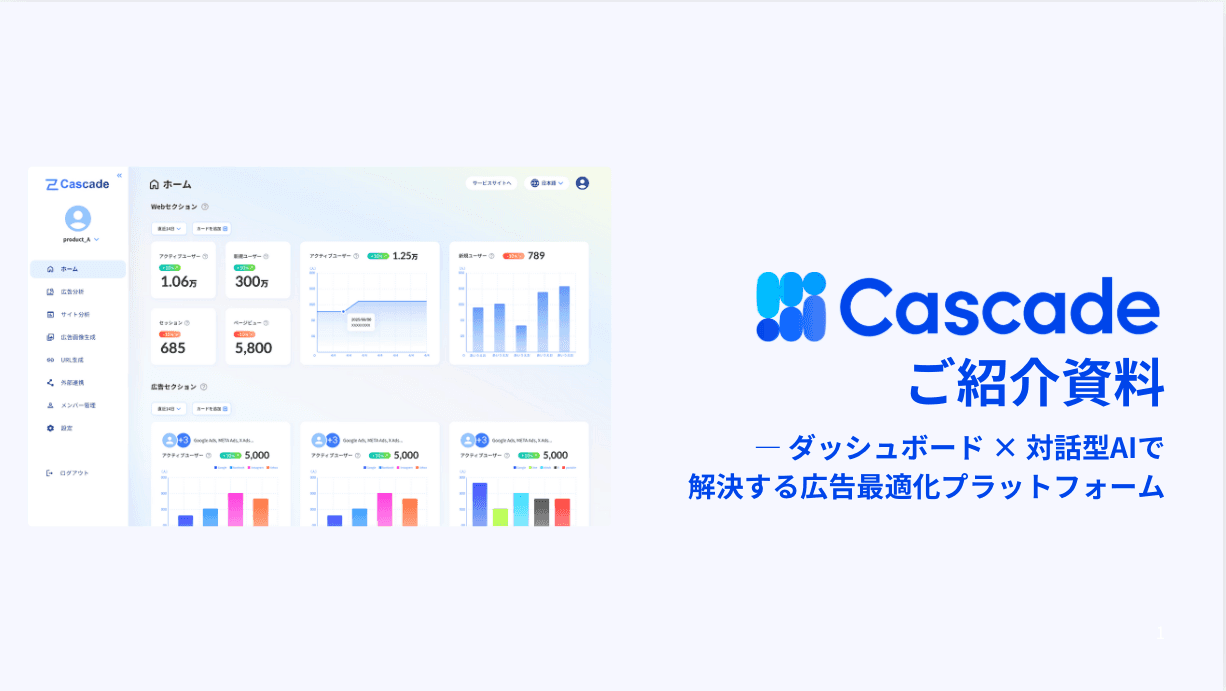
Table of Contents

© 2025 Cascade Inc, All Rights Reserved.

© 2025 Cascade Inc, All Rights Reserved.
© 2025 Cascade Inc, All Rights Reserved.