Ecommerce in 2026: 5 Make-or-Break Factors Beyond Trends (Compliance, Security, AI, Returns, Platforms)
Ecommerce in 2026: 5 Make-or-Break Factors Beyond Trends (Compliance, Security, AI, Returns, Platforms)
Surviving in an Era Where Merely Following Trends is Not Enough
The global e-commerce market continues to expand explosively, projected to reach $6.86 trillion by 2025 and approach $7.96 trillion by 2027. However, behind this growth, Japanese e-commerce businesses are facing unprecedentedly complex challenges from 2025 to 2026. Simply chasing after EC Trends 2026 is becoming increasingly difficult for business continuity. This is due to "tectonic shifts" that undermine the core of operations, including stricter regulations, advanced cyber security threats, and advancements in AI technology.
This article will delve deeply into five essential and often overlooked factors that differentiate success from failure in the e-commerce business, not merely introducing trends. We will provide insights to help fortify businesses for the future.
1. Compliance: From Defense to Offense - How the Revised Specified Commercial Transactions Act Changes Customer Experience
With the Consumer Affairs Agency establishing a "Digital Team" utilizing AI and strengthening the monitoring system for e-commerce sites, compliance with the Specified Commercial Transactions Act is no longer just a matter of legal risk management. It is a management challenge that fundamentally reassesses the relationship with customers, and providing transparent information elevates to an "offensive" strategy to win customer trust. In particular, the following inappropriate methods, referred to as "dark patterns," are under strict surveillance.
Unclear Final Confirmation Screen - Techniques that intentionally hide the fact that it is a subscription contract, or display it in small text or light colors. The revised Specified Commercial Transactions Act mandates that each payment and total amount, along with cancellation conditions, be clearly displayed in a way that consumers can understand at a glance on the final confirmation screen.
Excessively Complex Cancellation Procedures - While claiming that cancellations can be easily made on the e-commerce site, it actually requires mandatory phone contact or involves multiple cumbersome steps, akin to a "roach trap" design. Such actions are considered deliberate attempts to bind consumers to a contract and are subject to strict penalties.
False Advertising - Advertisements claiming effects without scientific evidence, such as "just apply it and wrinkles disappear." These are classified as "misleading representations" that induce consumer misunderstanding and significantly damage corporate trust.
Ensuring transparency in price representation and simplifying cancellation procedures is now an indispensable requirement for winning customer trust that goes beyond mere legal obligations. Sincere conduct enhances a brand's reputation and ultimately leads directly to an increase in LTV (Customer Lifetime Value).
2. The Frontline of Security Shifts to "The Moment of Input" - The Critical Importance of Web Skimming Countermeasures
The traditional security measure of "not storing credit card information on the server" will be critically inadequate after 2025. The battlefield for cyber attacks has completely shifted from internal servers to customers’ browsers—the very moment information is entered.
The new threat is called "web skimming." This involves embedding malicious code on the payment pages of e-commerce sites, which simultaneously sends customers' credit card information to attackers' servers the moment it is entered into the form. As a result, even if e-commerce businesses do not retain card information, data can still be stolen, making server-side defenses utterly ineffective.
In the incident involving "Surugaya" in 2025, the payment application was tampered with, and exactly this technique resulted in the theft of customers' card information during input. Over 30,000 payment records may have been compromised in this incident. If such an event occurs, not only could there be damages amounting to millions to billions of yen, but the trust built with customers can collapse in an instant.
Essential Checklist for Multi-layered Defense
Introduction of WAF (Web Application Firewall) and 24/7 Monitoring: Blocks malicious communications at the application level.
Continuous Operation of Website Tampering Detection System: Immediately detects unexpected changes in source code.
Compliance with the Latest PCI DSS 4.0: Enhances management of scripts executed on the client side to prevent unauthorized actions.
Necessary Access Restrictions to Management Screens Based on Zero Trust and Enforcing Multi-Factor Authentication (MFA): Minimizes internal breach risks.
Executives must recognize that the consequences of security incidents can be a catastrophic blow that shakes the very survival of a brand, far exceeding mere financial losses.
3. AI Transforms from "Customer Service" to "Management Advisor" - New Competitive Advantages Brought by Business Automation
The use of AI in e-commerce has moved beyond simple product recommendations and basic chatbots to become "management advisors" supporting backend operations from 2025 to 2026. This change is being led by advanced platforms like Shopify.
For instance, AI tools integrated with Shopify, such as Shopify Magic, can automatically generate enticing product descriptions in just seconds, dramatically improving the efficiency of marketers’ tasks. Even more powerful is the business automation tool Shopify Flow. It allows for the automation of routine tasks, such as "notify the person in charge when stock falls below 10" and "automatically tag high-value orders with fraud risk" without any programming knowledge.
The core value of this evolution is not merely cost reduction. It frees valuable personnel from repetitive tasks like order processing and inventory checks, allowing them to focus on strategic brand planning, creative marketing initiatives, and developing deep relationships with customers—high-value tasks that only humans can execute. The impact of this AI-driven transformation enhances corporate competitiveness, significantly reducing labor costs and minimizing human errors while facilitating rapid product launches.
4. Redefining Customer Experience (CX): OMO, Personalization, and "Return" Strategies
It is now a common understanding that OMO (Online-Merge-Offline) and personalization are key to enhancing customer experience (CX). However, as these areas mature, the main battlefield for CX from 2026 onward is shifting towards the often-overlooked "return process."
Statistics indicate that the return rate for online sales is as high as approximately 15.8%. In the US market alone, this is projected to reach an astronomical scale of $849.9 billion annually by 2025, representing a hidden cost that cannot be ignored by e-commerce businesses. However, reframing this challenge not as a cost center but rather as a strategic investment opportunity will build competitive advantage in 2026.
A seamless, smooth, and reassuring return experience fosters trust in the brand, and the comfort of knowing "it’s okay if it doesn’t fit" lowers the barrier for first-time purchases, ultimately improving conversion rates. Moreover, efficiently reselling and reusing returned products not only protects profit margins but also becomes a factor increasing brand value from a sustainability perspective by reducing waste.
As "free shipping" becomes commonplace, clearly promoting a "hassle-free return guarantee" can be a powerful marketing message that encourages customer purchases. Strategic investments in return logistics and policies are crucial measures for enhancing LTV.
5. Platform Selection: From "Feature Comparison" to "Investment in the Future"
Choosing an e-commerce platform is not merely a checklist comparison of features. It is an investment in the future that determines your company’s growth strategy for the next 5 to 10 years. This strategic choice is distilled into the question of whether to adopt the "domestic-focused, all-inclusive" philosophy represented by MakeShop or the "global standard, scalable" philosophy exemplified by Shopify.
Deep dependency on a specific platform carries the risk of "vendor lock-in." This means entrusting your company’s future to that vendor's technological roadmap, which can limit responses to future business expansion or technological advancements.
Strategic Approach | Domestic Focused, Stability Oriented | Global Standard, Growth Oriented |
Examples | MakeShop, Domestic E-commerce Packages | Shopify, Cloud E-commerce |
Strengths | Standard features suited to Japanese business practices, robust Japanese language support | High scalability, rapid response to the latest technologies, strengths in cross-border e-commerce |
Considerations | Unique customizations or constraints on overseas expansion may arise | Adding apps or collaboration with experts may be necessary |
The criteria for selecting a platform should be based on "the vision for the future" rather than "existing features." Questions such as "Will there be a possibility of challenging cross-border e-commerce in the future?" and "Is a foundation needed that can flexibly respond to unknown AI or API integration technologies that may emerge in a few years?" will lead you to the most suitable platform for your company.
Conclusion: A Compass for Winning in 2026
To succeed in the 2026 e-commerce market, merely following superficial trends is insufficient. The five contents explained in this article, including "Integration of Compliance into Customer Experience," "Transitioning Security Frontlines to Client Side," "Utilization of AI as a Management Advisor," "Strategic Tool for Return Management," and "Platform Selection as an Investment in the Future," will serve as essential guides. The key to success lies in capturing technology, regulation, and outstanding operations as a unified whole to build a robust brand deeply trusted by customers.
However, continuously optimizing daily marketing and advertising operations while responding to these complex changes poses major challenges for many companies.
The marketing and advertising optimization platform utilizing AI, Cascade, has been developed specifically to navigate through this age of complexity. Cascade addresses the wide-ranging challenges faced by e-commerce operators in a data-driven manner, supporting sustainable growth. In this new era of e-commerce, please consider trying out the potential of Cascade to guide your business to the next stage.
Surviving in an Era Where Merely Following Trends is Not Enough
The global e-commerce market continues to expand explosively, projected to reach $6.86 trillion by 2025 and approach $7.96 trillion by 2027. However, behind this growth, Japanese e-commerce businesses are facing unprecedentedly complex challenges from 2025 to 2026. Simply chasing after EC Trends 2026 is becoming increasingly difficult for business continuity. This is due to "tectonic shifts" that undermine the core of operations, including stricter regulations, advanced cyber security threats, and advancements in AI technology.
This article will delve deeply into five essential and often overlooked factors that differentiate success from failure in the e-commerce business, not merely introducing trends. We will provide insights to help fortify businesses for the future.
1. Compliance: From Defense to Offense - How the Revised Specified Commercial Transactions Act Changes Customer Experience
With the Consumer Affairs Agency establishing a "Digital Team" utilizing AI and strengthening the monitoring system for e-commerce sites, compliance with the Specified Commercial Transactions Act is no longer just a matter of legal risk management. It is a management challenge that fundamentally reassesses the relationship with customers, and providing transparent information elevates to an "offensive" strategy to win customer trust. In particular, the following inappropriate methods, referred to as "dark patterns," are under strict surveillance.
Unclear Final Confirmation Screen - Techniques that intentionally hide the fact that it is a subscription contract, or display it in small text or light colors. The revised Specified Commercial Transactions Act mandates that each payment and total amount, along with cancellation conditions, be clearly displayed in a way that consumers can understand at a glance on the final confirmation screen.
Excessively Complex Cancellation Procedures - While claiming that cancellations can be easily made on the e-commerce site, it actually requires mandatory phone contact or involves multiple cumbersome steps, akin to a "roach trap" design. Such actions are considered deliberate attempts to bind consumers to a contract and are subject to strict penalties.
False Advertising - Advertisements claiming effects without scientific evidence, such as "just apply it and wrinkles disappear." These are classified as "misleading representations" that induce consumer misunderstanding and significantly damage corporate trust.
Ensuring transparency in price representation and simplifying cancellation procedures is now an indispensable requirement for winning customer trust that goes beyond mere legal obligations. Sincere conduct enhances a brand's reputation and ultimately leads directly to an increase in LTV (Customer Lifetime Value).
2. The Frontline of Security Shifts to "The Moment of Input" - The Critical Importance of Web Skimming Countermeasures
The traditional security measure of "not storing credit card information on the server" will be critically inadequate after 2025. The battlefield for cyber attacks has completely shifted from internal servers to customers’ browsers—the very moment information is entered.
The new threat is called "web skimming." This involves embedding malicious code on the payment pages of e-commerce sites, which simultaneously sends customers' credit card information to attackers' servers the moment it is entered into the form. As a result, even if e-commerce businesses do not retain card information, data can still be stolen, making server-side defenses utterly ineffective.
In the incident involving "Surugaya" in 2025, the payment application was tampered with, and exactly this technique resulted in the theft of customers' card information during input. Over 30,000 payment records may have been compromised in this incident. If such an event occurs, not only could there be damages amounting to millions to billions of yen, but the trust built with customers can collapse in an instant.
Essential Checklist for Multi-layered Defense
Introduction of WAF (Web Application Firewall) and 24/7 Monitoring: Blocks malicious communications at the application level.
Continuous Operation of Website Tampering Detection System: Immediately detects unexpected changes in source code.
Compliance with the Latest PCI DSS 4.0: Enhances management of scripts executed on the client side to prevent unauthorized actions.
Necessary Access Restrictions to Management Screens Based on Zero Trust and Enforcing Multi-Factor Authentication (MFA): Minimizes internal breach risks.
Executives must recognize that the consequences of security incidents can be a catastrophic blow that shakes the very survival of a brand, far exceeding mere financial losses.
3. AI Transforms from "Customer Service" to "Management Advisor" - New Competitive Advantages Brought by Business Automation
The use of AI in e-commerce has moved beyond simple product recommendations and basic chatbots to become "management advisors" supporting backend operations from 2025 to 2026. This change is being led by advanced platforms like Shopify.
For instance, AI tools integrated with Shopify, such as Shopify Magic, can automatically generate enticing product descriptions in just seconds, dramatically improving the efficiency of marketers’ tasks. Even more powerful is the business automation tool Shopify Flow. It allows for the automation of routine tasks, such as "notify the person in charge when stock falls below 10" and "automatically tag high-value orders with fraud risk" without any programming knowledge.
The core value of this evolution is not merely cost reduction. It frees valuable personnel from repetitive tasks like order processing and inventory checks, allowing them to focus on strategic brand planning, creative marketing initiatives, and developing deep relationships with customers—high-value tasks that only humans can execute. The impact of this AI-driven transformation enhances corporate competitiveness, significantly reducing labor costs and minimizing human errors while facilitating rapid product launches.
4. Redefining Customer Experience (CX): OMO, Personalization, and "Return" Strategies
It is now a common understanding that OMO (Online-Merge-Offline) and personalization are key to enhancing customer experience (CX). However, as these areas mature, the main battlefield for CX from 2026 onward is shifting towards the often-overlooked "return process."
Statistics indicate that the return rate for online sales is as high as approximately 15.8%. In the US market alone, this is projected to reach an astronomical scale of $849.9 billion annually by 2025, representing a hidden cost that cannot be ignored by e-commerce businesses. However, reframing this challenge not as a cost center but rather as a strategic investment opportunity will build competitive advantage in 2026.
A seamless, smooth, and reassuring return experience fosters trust in the brand, and the comfort of knowing "it’s okay if it doesn’t fit" lowers the barrier for first-time purchases, ultimately improving conversion rates. Moreover, efficiently reselling and reusing returned products not only protects profit margins but also becomes a factor increasing brand value from a sustainability perspective by reducing waste.
As "free shipping" becomes commonplace, clearly promoting a "hassle-free return guarantee" can be a powerful marketing message that encourages customer purchases. Strategic investments in return logistics and policies are crucial measures for enhancing LTV.
5. Platform Selection: From "Feature Comparison" to "Investment in the Future"
Choosing an e-commerce platform is not merely a checklist comparison of features. It is an investment in the future that determines your company’s growth strategy for the next 5 to 10 years. This strategic choice is distilled into the question of whether to adopt the "domestic-focused, all-inclusive" philosophy represented by MakeShop or the "global standard, scalable" philosophy exemplified by Shopify.
Deep dependency on a specific platform carries the risk of "vendor lock-in." This means entrusting your company’s future to that vendor's technological roadmap, which can limit responses to future business expansion or technological advancements.
Strategic Approach | Domestic Focused, Stability Oriented | Global Standard, Growth Oriented |
Examples | MakeShop, Domestic E-commerce Packages | Shopify, Cloud E-commerce |
Strengths | Standard features suited to Japanese business practices, robust Japanese language support | High scalability, rapid response to the latest technologies, strengths in cross-border e-commerce |
Considerations | Unique customizations or constraints on overseas expansion may arise | Adding apps or collaboration with experts may be necessary |
The criteria for selecting a platform should be based on "the vision for the future" rather than "existing features." Questions such as "Will there be a possibility of challenging cross-border e-commerce in the future?" and "Is a foundation needed that can flexibly respond to unknown AI or API integration technologies that may emerge in a few years?" will lead you to the most suitable platform for your company.
Conclusion: A Compass for Winning in 2026
To succeed in the 2026 e-commerce market, merely following superficial trends is insufficient. The five contents explained in this article, including "Integration of Compliance into Customer Experience," "Transitioning Security Frontlines to Client Side," "Utilization of AI as a Management Advisor," "Strategic Tool for Return Management," and "Platform Selection as an Investment in the Future," will serve as essential guides. The key to success lies in capturing technology, regulation, and outstanding operations as a unified whole to build a robust brand deeply trusted by customers.
However, continuously optimizing daily marketing and advertising operations while responding to these complex changes poses major challenges for many companies.
The marketing and advertising optimization platform utilizing AI, Cascade, has been developed specifically to navigate through this age of complexity. Cascade addresses the wide-ranging challenges faced by e-commerce operators in a data-driven manner, supporting sustainable growth. In this new era of e-commerce, please consider trying out the potential of Cascade to guide your business to the next stage.
\FreeDownload Now/
\FreeDownload Now/
\FreeDownload Now/
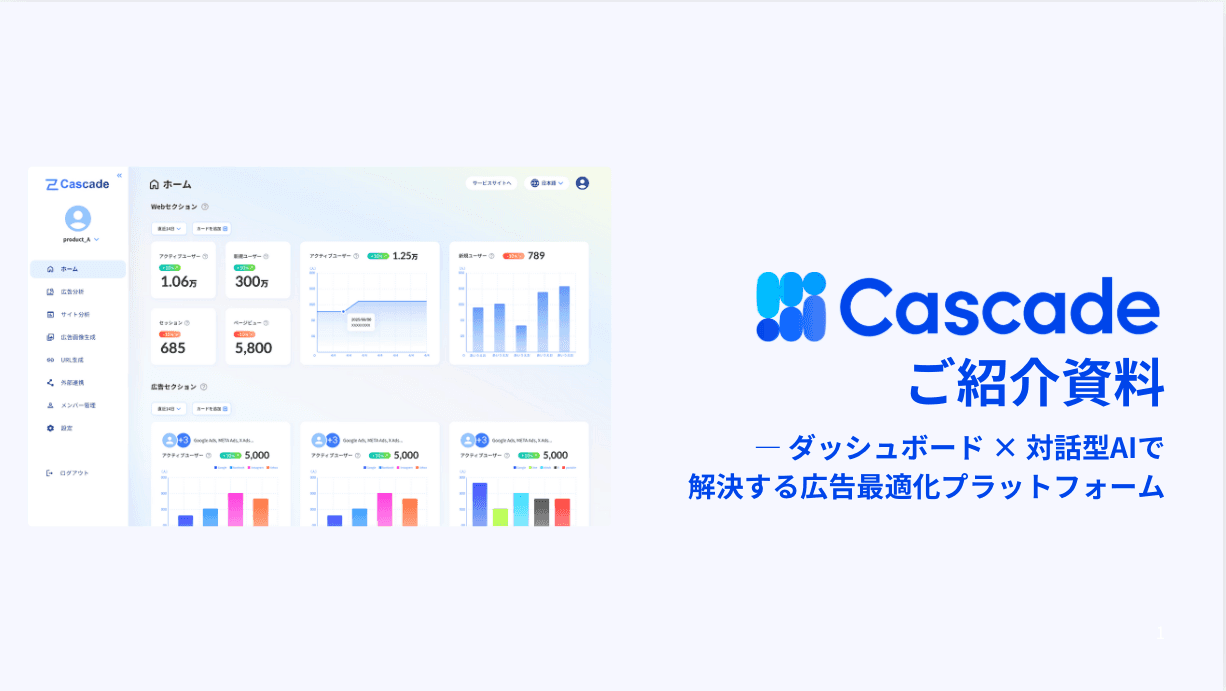
Table of Contents

© 2025 Cascade Inc, All Rights Reserved.

© 2025 Cascade Inc, All Rights Reserved.
© 2025 Cascade Inc, All Rights Reserved.