7 New Rules for AI-Powered Ad Ops: Stop Manual Tweaks
7 New Rules for AI-Powered Ad Ops: Stop Manual Tweaks

Every day, even though I'm finely adjusting advertising bids and keywords, somehow the results have plateaued. There are likely many advertising operators who share this concern.
The cause is not due to your lack of effort. In fact, a paradigm shift in advertising management through AI is happening. Today's Advertising Management AI systems are very sophisticated, and the role of humans has fundamentally changed from being a "tactical executor" who makes daily adjustments to a "strategist" who guides the AI in the right direction.
The seven new common sense points introduced in this article are not independent of each other. Without the compass of LTV (New Common Sense ②), it is impossible to grant AI the freedom (New Common Sense ③) to operate, and its results cannot even be accurately measured (New Common Sense ⑤) without an integrated data foundation (New Common Sense ⑦). These constitute an interconnected strategic framework for successfully navigating advertising management in the AI era.
By reading this article, you can become a true partner of AI and master how to accelerate business growth.
1. New Common Sense ①: Shift your work from “bid adjustments” to “strategic input”
In modern advertising management, the role of operations managers has fundamentally changed. The once mainstream manual selection of keywords and daily bid adjustments as "tactical execution" is now a thing of the past.
AI-driven systems, such as Google’s P-MAX (Performance Max) campaigns and smart auto-bidding, have become mainstream, and optimizing performance has become the standard practice entrusted to AI.
As a result, the role of operations managers has shifted to that of a "strategic manager" who inputs high-quality data to facilitate AI's learning. Your job is to provide the talented subordinate AI with the correct goals and resources (data) to maximize its capabilities.
2. New Common Sense ②: Do not chase immediate CPA, invest based on LTV (Customer Lifetime Value)
Many companies make the mistake of setting a maximum CPA (Cost Per Acquisition) based solely on the profit from the initial purchase. This short-sighted perspective greatly limits the potential of AI and causes missed opportunities.
For AI to explore a broader range of bidding opportunities and acquire customers with high long-term value, setting goals based on LTV (Customer Lifetime Value) is essential. The following calculation examples clearly show the difference.
Assumptions
Average purchase amount: ¥10,000
Average purchase frequency: 2 times/year
Average retention period: 2 years
Average profit margin: 20%
Maximum CPA without considering LTV
Calculation:
Average purchase amount × Average profit marginResult:
¥10,000 × 20% = ¥2,000
Maximum CPA when considering LTV
Calculation:
Average purchase amount × Average purchase frequency × Average retention period × Average profit marginResult:
¥10,000 × 2 times × 2 years × 20% = ¥8,000
Just by considering LTV, the allowable CPA can increase up to four times. This financial backing is the key to enabling AI to make bold investment decisions and achieve true ROI (Return on Investment) maximization.
However, this ambitious CPA target based on LTV can only be achieved if it allows AI the freedom to "explore" new customer segments. Next, I will explain the environmental setup necessary for this.
3. New Common Sense ③: Grant AI "freedom to explore" (allow temporary failures)
To maximize AI's performance, one must acknowledge the counterintuitive fact that excessive human intervention can actually hinder it. AI sometimes repeats tests that may seem inefficient in the process of exploring new conversion opportunities.
In Google ads' best practices, it is strongly recommended to remove the following three constraints to fully unleash AI's exploration capabilities.
Do not impose budget limits: Budget restrictions deprive AI of exploration opportunities. It is essential to secure a sufficient budget based on LTV.
Do not use a maximum CPC (bid limit): Bid limits can cause AI to miss out on valuable click opportunities.
Do not set high target ROAS in anticipation of AI’s exploration: Overly ambitious targets can narrow AI's behavioral range and hinder discovery of new opportunities.
AI may temporarily see a drop in advertising ROI as it identifies new valuable customers. However, the judgment to allow such "strategic failures" is crucial for long-term growth, and is a quality required of modern operations managers.
Providing AI with maximum freedom and accelerating its learning requires high-quality "audience signals" as the most powerful fuel.
4. New Common Sense ④: The most powerful lever is high-quality “audience signals”
The most powerful lever to dramatically enhance AI's targeting accuracy is the provision of "audience signals".
Meta’s custom audiences and Google P-MAX’s audience signal features are designed to teach AI “which users are more likely to become valuable customers.” Particularly, providing first-party data such as your customer lists or site visitor lists to AI is the most effective way to dramatically accelerate its learning. For example, specific and high-quality signals such as “users who visited a specific product page but did not make a purchase” or “users who watched a video for a certain duration” serve as the best training data for AI.
In fact, the data clearly demonstrates its effectiveness.
When retargeting ads are delivered to visitors of specific product pages on Meta, CTR (Click-Through Rate) can improve by an average of 2 to 3 times.
On Meta, delivering ads to audiences with high scores (those deemed by the platform as likely to convert) has been reported to reduce ad costs by up to **30%** in some cases.
By guiding AI with high-quality signals, it becomes necessary to accurately assess its results. Next, let’s look at the criteria for evaluation.
5. New Common Sense ⑤: Evaluate not just the last click, but all contributing channels
Before a customer makes a purchase, they are exposed to multiple ads, such as learning about a product through social media ads, comparing options through search ads, and finally visiting the site through a brand name search.
In the traditional "last-click model" (which evaluates only the last ad clicked), the contribution of ads that played an important role in the awareness stage is assessed as zero. This can lead to misallocation of budget and risks missing future customer nurturing opportunities.
What becomes crucial here is data-driven attribution (DDA). Data-driven attribution (DDA) is a system that leverages machine learning to analyze and evaluate how much each ad interaction contributed to conversions. This enables optimization across the entire conversion pathway.
Especially in campaigns like P-MAX, where ads are distributed across diverse channels like YouTube, display, and search, DDA serves as a "true metric" for accurately assessing complex results, significantly enhancing the precision of ad investments.
This precise evaluation highlights the most important element that operators should focus on, which is the value of creative content.
6. New Common Sense ⑥: AI enhances the value of “creative content”
“If AI automates operations, does that make creative content unimportant?” This line of thinking is a significant misconception. On the contrary, the opposite is true.
On platforms like Meta ads and P-MAX, while targeting and bids become highly automated, the decisive factor that stops users' scrolling and moves their hearts is the "visual creative" itself. Even if AI finds the optimal audience, if the creative lacks appeal, there will be no clicks.
The impact of high-quality creative is also clearly reflected in the data.
In P-MAX campaigns, advertisers who prepared high-quality diverse assets (text, images, videos) experienced an increase in conversion rates from "low" to "very high" while maintaining similar CPA, averaging a **6%** increase in conversions.
Especially by preparing multiple video assets (vertical, horizontal, square), there’s a potential for a **20%** increase in conversions on YouTube.
In the AI era, creative content is one of the most strategic elements that operations managers should focus on. And there is a foundation that supports all of these strategies.
7. New Common Sense ⑦: Every strategy begins with an “integrated data foundation (GA4)”
The advanced strategies previously discussed, such as LTV, DDA, and audience signals, all rely on an integrated data foundation. At the center of this is GA4 (Google Analytics 4).
By linking GA4 with Google Ads, detailed user behavior data on the website is connected with advertising performance data. This significantly enhances the quality and quantity of AI’s learning data, resulting in a dramatic improvement in optimization accuracy.
For example, by creating a segment in GA4 for “users who visited the site 3 or more times and added product A to the cart but did not purchase” and sending this as an audience signal to Google Ads, AI can learn extremely valuable prospective customer lists.
This data integration serves as an essential pipeline that bridges advanced financial strategies (LTV) and execution strategies (AI auto-bidding), becoming the starting point for all strategies in AI-era advertising management.
Conclusion: Do not “manage” AI, but “cultivate” it
The most important mission for advertising operations managers moving forward is not to micromanage AI, but to design and continuously provide the "strategic environment" in which AI can perform at its best.
The key is to:
Clear business objectives based on LTV
High-quality audience signals
Attractive creatives that move users' hearts
By continuously “providing” these strategic inputs to AI, we cultivate it as an excellent partner. Showing AI the correct direction and providing the best environment for learning will be the most important mission for advertising operations managers from here on.
Focusing on strategic business in the AI era
Cascade is an advertising and marketing optimization platform that automatically analyzes data from multiple channels and gives improvement suggestions such as “where are unnecessary costs” and “where should budgets be increased.” By leveraging Cascade, marketers can free themselves from analysis tasks and focus more on strategic operations such as creative development and LTV strategy formulation as discussed in this article.
If you are interested, please feel free to apply for a free trial or request materials.
Every day, even though I'm finely adjusting advertising bids and keywords, somehow the results have plateaued. There are likely many advertising operators who share this concern.
The cause is not due to your lack of effort. In fact, a paradigm shift in advertising management through AI is happening. Today's Advertising Management AI systems are very sophisticated, and the role of humans has fundamentally changed from being a "tactical executor" who makes daily adjustments to a "strategist" who guides the AI in the right direction.
The seven new common sense points introduced in this article are not independent of each other. Without the compass of LTV (New Common Sense ②), it is impossible to grant AI the freedom (New Common Sense ③) to operate, and its results cannot even be accurately measured (New Common Sense ⑤) without an integrated data foundation (New Common Sense ⑦). These constitute an interconnected strategic framework for successfully navigating advertising management in the AI era.
By reading this article, you can become a true partner of AI and master how to accelerate business growth.
1. New Common Sense ①: Shift your work from “bid adjustments” to “strategic input”
In modern advertising management, the role of operations managers has fundamentally changed. The once mainstream manual selection of keywords and daily bid adjustments as "tactical execution" is now a thing of the past.
AI-driven systems, such as Google’s P-MAX (Performance Max) campaigns and smart auto-bidding, have become mainstream, and optimizing performance has become the standard practice entrusted to AI.
As a result, the role of operations managers has shifted to that of a "strategic manager" who inputs high-quality data to facilitate AI's learning. Your job is to provide the talented subordinate AI with the correct goals and resources (data) to maximize its capabilities.
2. New Common Sense ②: Do not chase immediate CPA, invest based on LTV (Customer Lifetime Value)
Many companies make the mistake of setting a maximum CPA (Cost Per Acquisition) based solely on the profit from the initial purchase. This short-sighted perspective greatly limits the potential of AI and causes missed opportunities.
For AI to explore a broader range of bidding opportunities and acquire customers with high long-term value, setting goals based on LTV (Customer Lifetime Value) is essential. The following calculation examples clearly show the difference.
Assumptions
Average purchase amount: ¥10,000
Average purchase frequency: 2 times/year
Average retention period: 2 years
Average profit margin: 20%
Maximum CPA without considering LTV
Calculation:
Average purchase amount × Average profit marginResult:
¥10,000 × 20% = ¥2,000
Maximum CPA when considering LTV
Calculation:
Average purchase amount × Average purchase frequency × Average retention period × Average profit marginResult:
¥10,000 × 2 times × 2 years × 20% = ¥8,000
Just by considering LTV, the allowable CPA can increase up to four times. This financial backing is the key to enabling AI to make bold investment decisions and achieve true ROI (Return on Investment) maximization.
However, this ambitious CPA target based on LTV can only be achieved if it allows AI the freedom to "explore" new customer segments. Next, I will explain the environmental setup necessary for this.
3. New Common Sense ③: Grant AI "freedom to explore" (allow temporary failures)
To maximize AI's performance, one must acknowledge the counterintuitive fact that excessive human intervention can actually hinder it. AI sometimes repeats tests that may seem inefficient in the process of exploring new conversion opportunities.
In Google ads' best practices, it is strongly recommended to remove the following three constraints to fully unleash AI's exploration capabilities.
Do not impose budget limits: Budget restrictions deprive AI of exploration opportunities. It is essential to secure a sufficient budget based on LTV.
Do not use a maximum CPC (bid limit): Bid limits can cause AI to miss out on valuable click opportunities.
Do not set high target ROAS in anticipation of AI’s exploration: Overly ambitious targets can narrow AI's behavioral range and hinder discovery of new opportunities.
AI may temporarily see a drop in advertising ROI as it identifies new valuable customers. However, the judgment to allow such "strategic failures" is crucial for long-term growth, and is a quality required of modern operations managers.
Providing AI with maximum freedom and accelerating its learning requires high-quality "audience signals" as the most powerful fuel.
4. New Common Sense ④: The most powerful lever is high-quality “audience signals”
The most powerful lever to dramatically enhance AI's targeting accuracy is the provision of "audience signals".
Meta’s custom audiences and Google P-MAX’s audience signal features are designed to teach AI “which users are more likely to become valuable customers.” Particularly, providing first-party data such as your customer lists or site visitor lists to AI is the most effective way to dramatically accelerate its learning. For example, specific and high-quality signals such as “users who visited a specific product page but did not make a purchase” or “users who watched a video for a certain duration” serve as the best training data for AI.
In fact, the data clearly demonstrates its effectiveness.
When retargeting ads are delivered to visitors of specific product pages on Meta, CTR (Click-Through Rate) can improve by an average of 2 to 3 times.
On Meta, delivering ads to audiences with high scores (those deemed by the platform as likely to convert) has been reported to reduce ad costs by up to **30%** in some cases.
By guiding AI with high-quality signals, it becomes necessary to accurately assess its results. Next, let’s look at the criteria for evaluation.
5. New Common Sense ⑤: Evaluate not just the last click, but all contributing channels
Before a customer makes a purchase, they are exposed to multiple ads, such as learning about a product through social media ads, comparing options through search ads, and finally visiting the site through a brand name search.
In the traditional "last-click model" (which evaluates only the last ad clicked), the contribution of ads that played an important role in the awareness stage is assessed as zero. This can lead to misallocation of budget and risks missing future customer nurturing opportunities.
What becomes crucial here is data-driven attribution (DDA). Data-driven attribution (DDA) is a system that leverages machine learning to analyze and evaluate how much each ad interaction contributed to conversions. This enables optimization across the entire conversion pathway.
Especially in campaigns like P-MAX, where ads are distributed across diverse channels like YouTube, display, and search, DDA serves as a "true metric" for accurately assessing complex results, significantly enhancing the precision of ad investments.
This precise evaluation highlights the most important element that operators should focus on, which is the value of creative content.
6. New Common Sense ⑥: AI enhances the value of “creative content”
“If AI automates operations, does that make creative content unimportant?” This line of thinking is a significant misconception. On the contrary, the opposite is true.
On platforms like Meta ads and P-MAX, while targeting and bids become highly automated, the decisive factor that stops users' scrolling and moves their hearts is the "visual creative" itself. Even if AI finds the optimal audience, if the creative lacks appeal, there will be no clicks.
The impact of high-quality creative is also clearly reflected in the data.
In P-MAX campaigns, advertisers who prepared high-quality diverse assets (text, images, videos) experienced an increase in conversion rates from "low" to "very high" while maintaining similar CPA, averaging a **6%** increase in conversions.
Especially by preparing multiple video assets (vertical, horizontal, square), there’s a potential for a **20%** increase in conversions on YouTube.
In the AI era, creative content is one of the most strategic elements that operations managers should focus on. And there is a foundation that supports all of these strategies.
7. New Common Sense ⑦: Every strategy begins with an “integrated data foundation (GA4)”
The advanced strategies previously discussed, such as LTV, DDA, and audience signals, all rely on an integrated data foundation. At the center of this is GA4 (Google Analytics 4).
By linking GA4 with Google Ads, detailed user behavior data on the website is connected with advertising performance data. This significantly enhances the quality and quantity of AI’s learning data, resulting in a dramatic improvement in optimization accuracy.
For example, by creating a segment in GA4 for “users who visited the site 3 or more times and added product A to the cart but did not purchase” and sending this as an audience signal to Google Ads, AI can learn extremely valuable prospective customer lists.
This data integration serves as an essential pipeline that bridges advanced financial strategies (LTV) and execution strategies (AI auto-bidding), becoming the starting point for all strategies in AI-era advertising management.
Conclusion: Do not “manage” AI, but “cultivate” it
The most important mission for advertising operations managers moving forward is not to micromanage AI, but to design and continuously provide the "strategic environment" in which AI can perform at its best.
The key is to:
Clear business objectives based on LTV
High-quality audience signals
Attractive creatives that move users' hearts
By continuously “providing” these strategic inputs to AI, we cultivate it as an excellent partner. Showing AI the correct direction and providing the best environment for learning will be the most important mission for advertising operations managers from here on.
Focusing on strategic business in the AI era
Cascade is an advertising and marketing optimization platform that automatically analyzes data from multiple channels and gives improvement suggestions such as “where are unnecessary costs” and “where should budgets be increased.” By leveraging Cascade, marketers can free themselves from analysis tasks and focus more on strategic operations such as creative development and LTV strategy formulation as discussed in this article.
If you are interested, please feel free to apply for a free trial or request materials.
\FreeDownload Now/
\FreeDownload Now/
\FreeDownload Now/
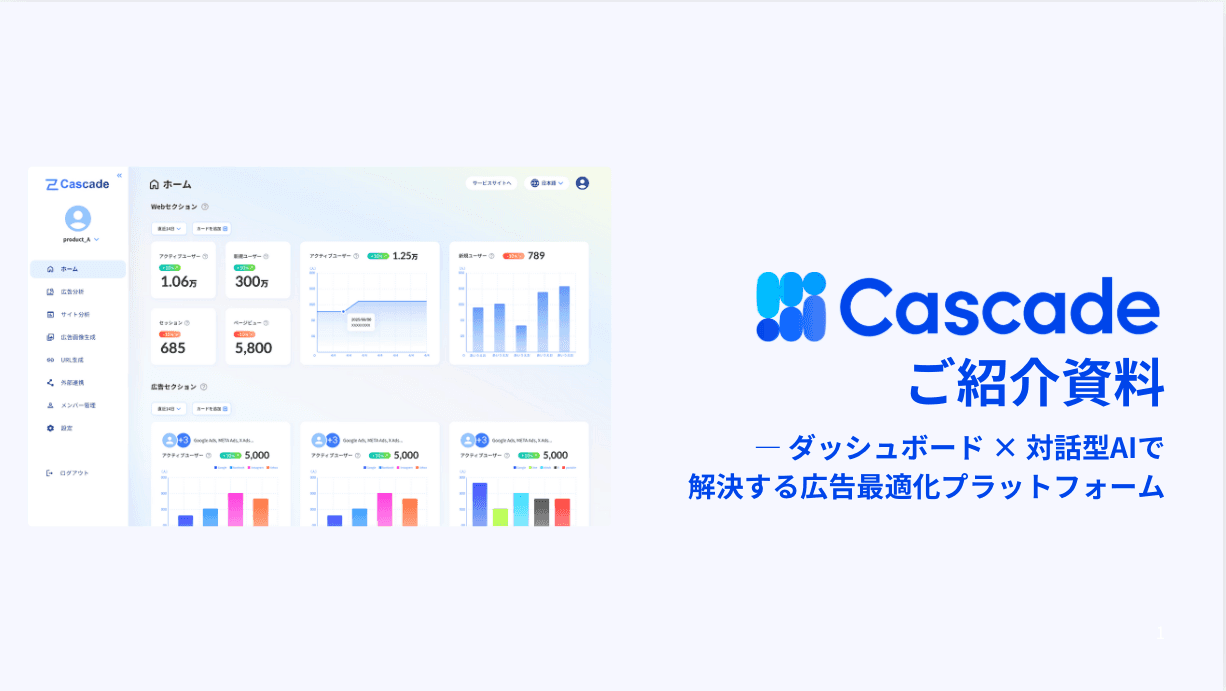
Table of Contents

© 2025 Cascade Inc, All Rights Reserved.

© 2025 Cascade Inc, All Rights Reserved.
© 2025 Cascade Inc, All Rights Reserved.