
What is CPA? A practical guide to calculation methods, improvement strategies, and goal setting.

CPA (Cost Per Acquisition) is a metric that represents the cost required to acquire one customer in ad operations. This article systematically explains practical knowledge you can use in the field of ad management, from how to calculate CPA to industry-specific target setting and actual improvement methods. We will also introduce operational points by budget scale in detail, from a monthly budget of ¥100,000 to ¥5,000,000.
What Is CPA? | Basic Definition of Cost Per Acquisition
CPA (Cost Per Acquisition) is a marketing metric that indicates the cost required to acquire one customer through advertising.
CPA is calculated as “Ad Spend ÷ Number of Conversions.” For example, if you acquire 100 conversions with a monthly ad spend of ¥300,000, CPA = ¥300,000 ÷ 100 = ¥3,000.
CPA is important because it allows you to directly measure profitability. By comparing it with unit price and LTV (Life Time Value), you can numerically judge whether your ad investment is appropriate.
CPA Formula and Specific Examples
Basic formula: CPA = Ad Spend ÷ Number of Conversions
EC example: Monthly ad spend ¥500,000, 200 orders → CPA = ¥2,500
BtoB example: Monthly ad spend ¥200,000, 40 inquiries → CPA = ¥5,000
App example: Monthly ad spend ¥1,000,000, 2,000 installs → CPA = ¥500
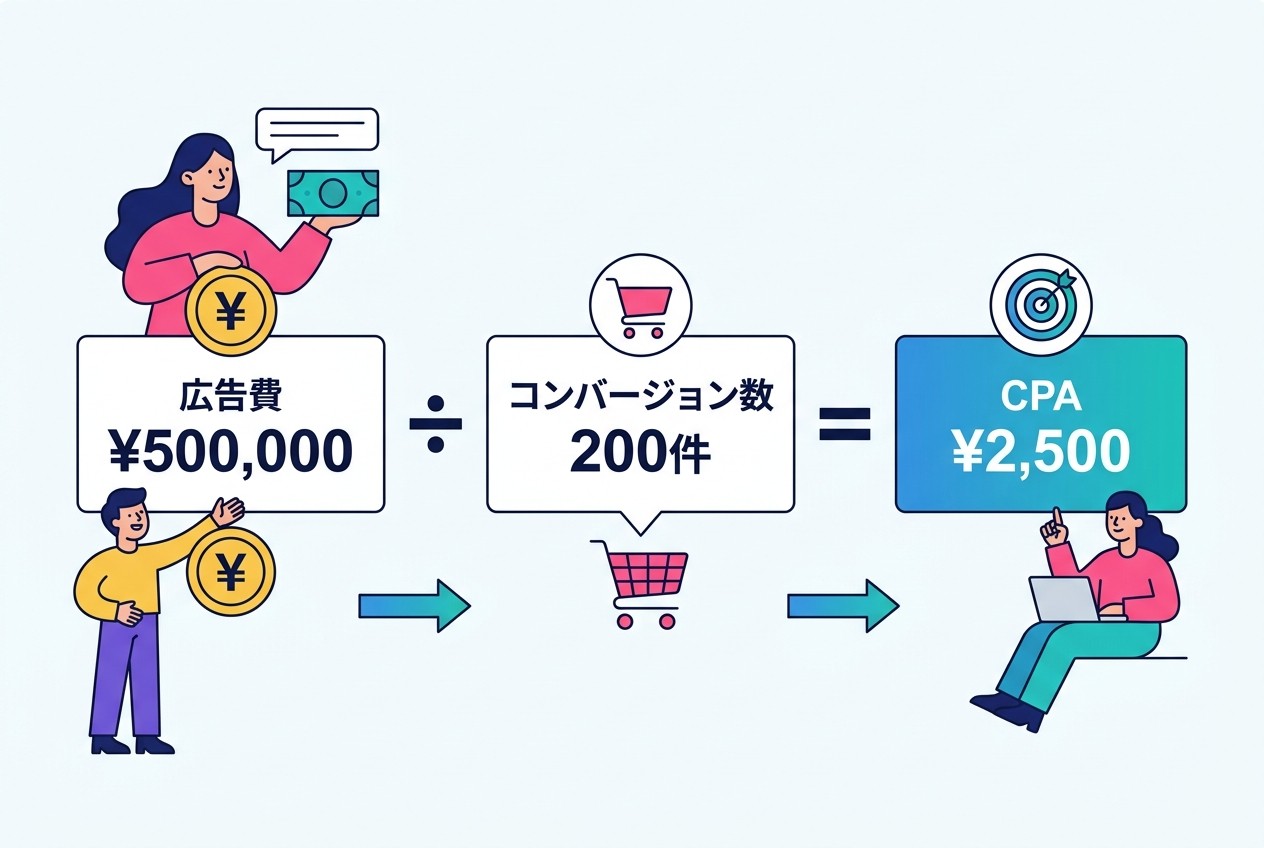
Basic CPA calculation structure and examples
Business Impact Indicated by CPA
What counts as a good or bad CPA varies greatly by industry. According to Dentsu’s “Advertising Expenditures in Japan 2025,” average CPA in the EC industry differs by more than 2x depending on product category.
Industry | Typical CPA Benchmark | Judgment Criteria |
|---|---|---|
Fashion EC | ¥1,000–¥3,000 | 10–15% of product unit price |
Consumer Electronics EC | ¥3,000–¥8,000 | 5–10% of product unit price |
BtoSaaS Services | ¥15,000–¥50,000 | 3–10x monthly fee |
Real Estate | ¥10,000–¥30,000 | 3–5% of closing commission |
Differences Between CPA and Related Metrics | Relationship with CPC, CVR, and ROAS
To use CPA properly, you need to understand its relationship with CPC (Cost Per Click), CVR (Conversion Rate), and ROAS (Return On Ad Spend).
Relationship Formula: CPA = CPC ÷ CVR
CPA can be expressed as a function of CPC and CVR. Specifically, since “CPA = CPC ÷ CVR,” there are two approaches to improving CPA:
Lower CPC: Adjust bid prices, improve quality score, and choose less competitive keywords
Increase CVR: Improve LP, enhance targeting accuracy, and optimize ad creatives
According to official Google Ads data (2025), it has been confirmed that a 1% CVR improvement has a CPA reduction impact equivalent to a 10% CPC reduction.
How to Use ROAS and CPA Differently
While ROAS indicates “revenue per ¥1 of ad spend,” CPA indicates “customer acquisition efficiency.” Use the two metrics in the following situations:
Metric | When to Prioritize | Formula | Judgment Criteria |
|---|---|---|---|
CPA | When prioritizing new customer acquisition | Ad Spend ÷ Number of CVs | Comparison with LTV |
ROAS | When prioritizing short-term profit | Revenue ÷ Ad Spend | Target ROAS setting |
For SMEs with monthly budgets under ¥500,000, operations that prioritize CPA over ROAS are more effective. The reason is that the data accumulation period is short, and long-term profitability judgments based on LTV are required.
Practical Methods for Setting CPA Targets by Industry
To set an appropriate CPA target, you need a calculation approach that considers industry characteristics and business phase.
LTV-Based CPA Target Setting
For sustainable ad operations, the relationship “CPA < LTV × 0.3” is important. This coefficient of 0.3 is a safety ratio that accounts for marketing costs other than ad spend (labor costs, system costs, etc.).
Specific calculation steps:
Calculate LTV: Average purchase amount × Purchase frequency × Retention period
Set target CPA: LTV × 0.2–0.4 (adjust by business phase)
Start operations: Set 120% of target CPA as the upper limit
Optimize: Gradually lower after 2 weeks of data accumulation
Related reading
This explains in detail how to analyze each stage of the customer acquisition process and identify bottlenecks that affect CPA.
Industry-Specific Target Setting Patterns
The logic for setting CPA targets varies significantly by industry. Based on Salesforce’s “State of Marketing 2025” research data, the characteristics of major industries are organized as follows:
Industry Category | Target CPA Calculation Basis | Adjustment Factors | Example Range |
|---|---|---|---|
One-time purchase EC | 20–30% of gross profit | Unit price, repeat rate | ¥500–¥5,000 |
Subscription | 3–8x monthly fee | Churn rate, upsell rate | ¥2,000–¥30,000 |
BtoB | 2–5% of deal value | Lead-to-meeting rate, consideration period | ¥5,000–¥100,000 |
App | 15–25% of in-app revenue | Payer rate, ARPPU | ¥100–¥2,000 |
Adjustment Methods by Business Phase
In the startup phase, many businesses prioritize awareness expansion and set target CPA at 40–50% of LTV. In contrast, companies in the mature phase tend to keep it at 20–30% to secure profits.
Guidelines for phase determination:
Startup phase: Fewer than 100 monthly CVs → Higher CPA tolerance
Growth phase: 100–1000 monthly CVs → Stepwise CPA optimization
Mature phase: More than 1000 monthly CVs → Strict CPA management
Specific Methods for Improving CPA | Phase-Based Approach
Improving CPA requires a step-by-step approach according to data volume and room for improvement.
Step 1: Refine Targeting and Keywords
The first step in CPA improvement is reducing wasted traffic. Identify low-CVR segments and stop delivery or lower bids.
Specific implementation steps:
Keyword analysis: Identify keywords with CVR at 50% or less of the overall average
Audience analysis: Compare CVR by age, gender, and region
Delivery time analysis: Check CVR performance by time slot and day of week
Exclusion settings: Gradually exclude low-CVR segments
As a real improvement case, a beauty EC site improved CPA by 30% by excluding price-appeal keywords such as “cheap beauty” and “super cheap beauty.” The reason is that price-focused customers have low LTV and do not contribute to long-term profitability.
Step 2: Optimize LP and Creatives
An approach focused on CVR improvement through What Is a Creative? How to Generate Ideas That Deliver Results in Advertising has a direct effect on reducing CPA.
High-priority improvement points:
First-view improvement: A structure that communicates the value proposition within 3 seconds
Form optimization: Minimize input fields (3–5 items as a guideline)
Trust enhancement: Display customer testimonials, performance figures, and security certifications
Mobile support: Easy-to-tap button size (44px or more)
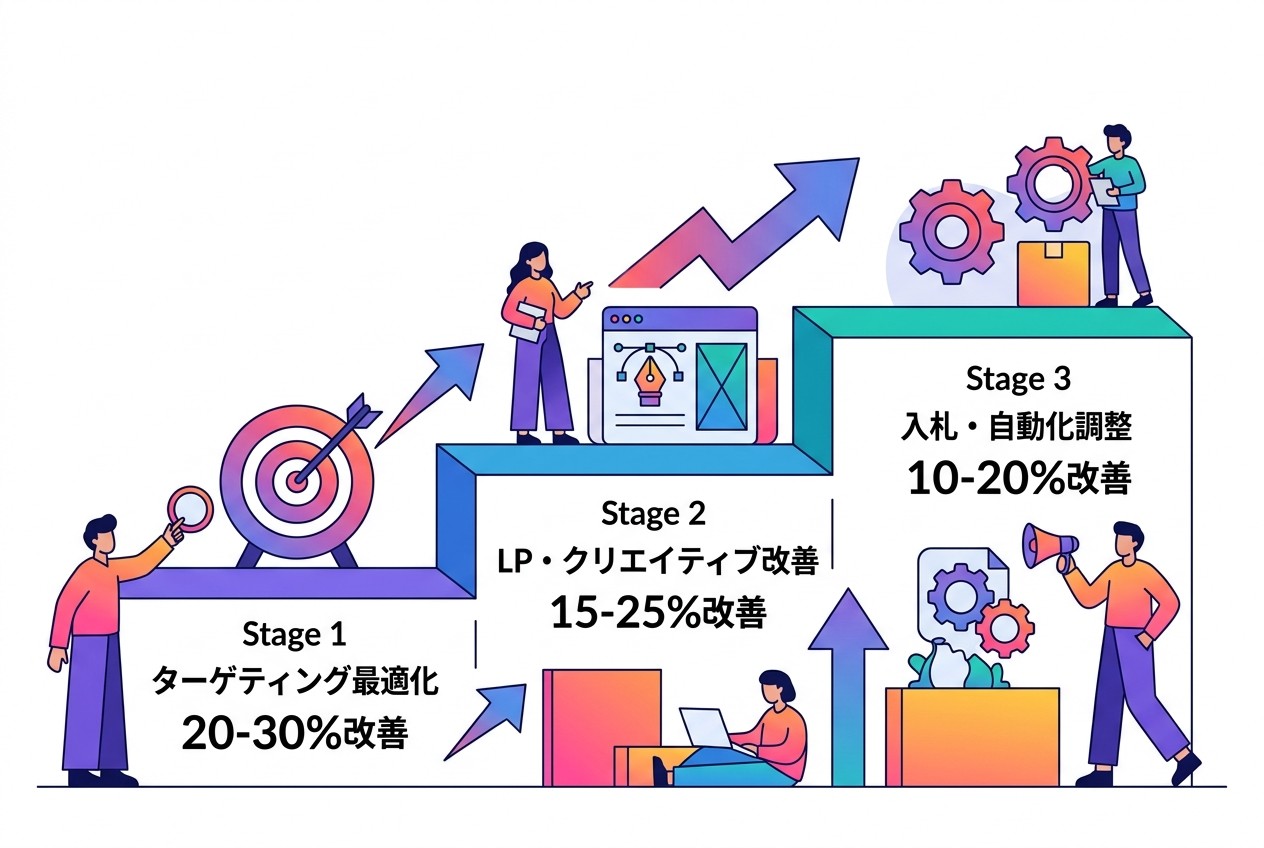
A three-step approach to efficiently improve CPA
Step 3: Use Bid Strategies and Automation
Once sufficient conversion data has accumulated, bid strategies utilizing machine learning become effective.
In Google Ads, you can introduce “Target CPA” bidding with 30 or more monthly conversions. However, at initial setup, it is important to set it to about 120% of your current CPA and then gradually lower it after a two-week data learning period.
In Meta Ads, timing the shift from “Lowest Cost” to “Cost Cap” is important. Transitioning when weekly conversions exceed 50 tends to improve CPA stability.
CPA Improvement Failure Patterns to Avoid
This section explains common failure patterns many operators fall into when improving CPA, and how to address them.
Failure Pattern 1: Sudden Reduction of Target CPA
The most common failure is trying to lower CPA drastically in a short period. If you lower target CPA by more than 30% in one week, the machine learning algorithm gets confused, and as explained in What Is an Impression? Explanation of Calculation Methods and How to Use It, it can cause a sharp drop in impression volume.
Correct approach:
Adjust gradually by 5–10% weekly
If conversions drop by 30% or more week-over-week, temporarily revert the target
Secure at least a two-week data accumulation period before the next adjustment
Failure Pattern 2: Insufficient CVR and CPC Analysis
When CPA worsens, many cases involve blindly adjusting bids without root-cause analysis. In practice, mismatches occur such as “lowering bids when the cause is CVR decline” or “changing LP when the cause is CPC increase.”
Correct root-cause analysis steps:
Identify the period of CPA deterioration (check daily data)
Check CVR and CPC fluctuations during the same period
Investigate external factors (new competitors, seasonality, product changes, etc.)
Execute appropriate improvement measures according to the cause
Failure Pattern 3: Judging by a Single Metric
Some focus only on CPA and ignore impacts on conversion volume and sales. Especially when monthly conversions are under 100, improving CPA carries a high risk of causing a sharp decline in conversion volume.
If your monthly budget is under ¥300,000, you should prioritize securing conversion volume over strict CPA control. Treat CPA within 150% of the target as acceptable and prioritize data accumulation.
Related reading
This explains in detail GA4 setup methods needed for detailed CPA analysis and techniques for analyzing conversion paths.
Continuous CPA Monitoring and Improvement Cycle
For stable CPA improvement, building a regular monitoring system and improvement cycle is essential.
Daily, Weekly, and Monthly Checkpoints
Daily check items (5 minutes):
Deviation rate from CPA target
Day-over-day change in conversion volume
Delivery status of major campaigns
Weekly analysis items (30 minutes):
CVR fluctuation analysis by segment
CPA comparison: new vs existing customers
Survey of competitors’ ad placements
Monthly improvement items (2 hours):
LP heatmap analysis and extraction of improvement points
Test new ad creatives
Review negative keywords and audiences
How to Implement Alert Settings
For efficient monitoring, appropriate alert settings are important. Use Google Ads automated rules and GA4 alert features to set alerts under the following conditions:
Metric | Alert Condition | Frequency | Action |
|---|---|---|---|
CPA | Exceeds 130% of target | Daily | Adjust bids / consider pausing delivery |
CV volume | Less than 50% of same weekday last week | Daily | Check delivery settings and budget |
CTR | Below 0.5% for 3 consecutive days | Daily | Review ad copy and images |
CVR | Drops 20% month-over-month | Weekly | Improve LP / review targeting |
Frequently Asked Questions
How should I decide improvement priorities when CPA is high?
Use a matrix of improvement impact and implementation difficulty. The most effective order is: targeting refinement first (high impact, low difficulty), LP improvement second (high impact, medium difficulty), and new feature testing last (medium impact, high difficulty).
If our CPA is higher than the industry average, do we need immediate improvement?
Use the industry average only as a reference and judge based on your relationship with LTV. If it is within 30% of LTV, it is within an acceptable range. However, if the cause is CPC increases due to competitors increasing ad spend, immediate action is required.
What are the main reasons CPA does not stabilize?
The main causes are insufficient data volume (fewer than 50 monthly CVs), inadequate consideration of seasonality, and changes in the competitive environment. For stabilization, at least three months of data accumulation and delivery adjustments by day of week and time slot are effective.
What should I do if automated bidding makes CPA exceed the target?
If it does not improve even after the machine learning learning period (2 weeks), reset the target CPA to a realistic value. After that, a gradual target-lowering approach is recommended. If data volume is small, consider switching to manual bidding.
Are there differences in CPA management between BtoB and BtoC?
Because BtoB has a longer consideration period, set the attribution window from first contact to deal close to 90 days. For BtoC, 30 days is sufficient. Also, it is important to include lead-to-meeting rate for BtoB and repeat purchase rate for BtoC in CPA evaluation.
Summary
CPA is an important metric for measuring ad performance, but appropriate target setting and improvement approaches vary greatly depending on industry, business phase, and budget scale.
Key points for effective CPA management are as follows:
Target setting: Judge by relationship with LTV and improve step by step
Improvement methods: Implement in three stages: targeting → LP improvement → automation
Avoid failures: Avoid sudden target changes and decisions based on a single metric
Continuous management: Build daily monitoring and a monthly improvement cycle
CPA optimization cannot be achieved overnight. Let’s realize sustainable ad operations through continuous, data-driven improvement.
CPA (Cost Per Acquisition) is a metric that represents the cost required to acquire one customer in ad operations. This article systematically explains practical knowledge you can use in the field of ad management, from how to calculate CPA to industry-specific target setting and actual improvement methods. We will also introduce operational points by budget scale in detail, from a monthly budget of ¥100,000 to ¥5,000,000.
What Is CPA? | Basic Definition of Cost Per Acquisition
CPA (Cost Per Acquisition) is a marketing metric that indicates the cost required to acquire one customer through advertising.
CPA is calculated as “Ad Spend ÷ Number of Conversions.” For example, if you acquire 100 conversions with a monthly ad spend of ¥300,000, CPA = ¥300,000 ÷ 100 = ¥3,000.
CPA is important because it allows you to directly measure profitability. By comparing it with unit price and LTV (Life Time Value), you can numerically judge whether your ad investment is appropriate.
CPA Formula and Specific Examples
Basic formula: CPA = Ad Spend ÷ Number of Conversions
EC example: Monthly ad spend ¥500,000, 200 orders → CPA = ¥2,500
BtoB example: Monthly ad spend ¥200,000, 40 inquiries → CPA = ¥5,000
App example: Monthly ad spend ¥1,000,000, 2,000 installs → CPA = ¥500

Basic CPA calculation structure and examples
Business Impact Indicated by CPA
What counts as a good or bad CPA varies greatly by industry. According to Dentsu’s “Advertising Expenditures in Japan 2025,” average CPA in the EC industry differs by more than 2x depending on product category.
Industry | Typical CPA Benchmark | Judgment Criteria |
|---|---|---|
Fashion EC | ¥1,000–¥3,000 | 10–15% of product unit price |
Consumer Electronics EC | ¥3,000–¥8,000 | 5–10% of product unit price |
BtoSaaS Services | ¥15,000–¥50,000 | 3–10x monthly fee |
Real Estate | ¥10,000–¥30,000 | 3–5% of closing commission |
Differences Between CPA and Related Metrics | Relationship with CPC, CVR, and ROAS
To use CPA properly, you need to understand its relationship with CPC (Cost Per Click), CVR (Conversion Rate), and ROAS (Return On Ad Spend).
Relationship Formula: CPA = CPC ÷ CVR
CPA can be expressed as a function of CPC and CVR. Specifically, since “CPA = CPC ÷ CVR,” there are two approaches to improving CPA:
Lower CPC: Adjust bid prices, improve quality score, and choose less competitive keywords
Increase CVR: Improve LP, enhance targeting accuracy, and optimize ad creatives
According to official Google Ads data (2025), it has been confirmed that a 1% CVR improvement has a CPA reduction impact equivalent to a 10% CPC reduction.
How to Use ROAS and CPA Differently
While ROAS indicates “revenue per ¥1 of ad spend,” CPA indicates “customer acquisition efficiency.” Use the two metrics in the following situations:
Metric | When to Prioritize | Formula | Judgment Criteria |
|---|---|---|---|
CPA | When prioritizing new customer acquisition | Ad Spend ÷ Number of CVs | Comparison with LTV |
ROAS | When prioritizing short-term profit | Revenue ÷ Ad Spend | Target ROAS setting |
For SMEs with monthly budgets under ¥500,000, operations that prioritize CPA over ROAS are more effective. The reason is that the data accumulation period is short, and long-term profitability judgments based on LTV are required.
Practical Methods for Setting CPA Targets by Industry
To set an appropriate CPA target, you need a calculation approach that considers industry characteristics and business phase.
LTV-Based CPA Target Setting
For sustainable ad operations, the relationship “CPA < LTV × 0.3” is important. This coefficient of 0.3 is a safety ratio that accounts for marketing costs other than ad spend (labor costs, system costs, etc.).
Specific calculation steps:
Calculate LTV: Average purchase amount × Purchase frequency × Retention period
Set target CPA: LTV × 0.2–0.4 (adjust by business phase)
Start operations: Set 120% of target CPA as the upper limit
Optimize: Gradually lower after 2 weeks of data accumulation
Related reading
This explains in detail how to analyze each stage of the customer acquisition process and identify bottlenecks that affect CPA.
Industry-Specific Target Setting Patterns
The logic for setting CPA targets varies significantly by industry. Based on Salesforce’s “State of Marketing 2025” research data, the characteristics of major industries are organized as follows:
Industry Category | Target CPA Calculation Basis | Adjustment Factors | Example Range |
|---|---|---|---|
One-time purchase EC | 20–30% of gross profit | Unit price, repeat rate | ¥500–¥5,000 |
Subscription | 3–8x monthly fee | Churn rate, upsell rate | ¥2,000–¥30,000 |
BtoB | 2–5% of deal value | Lead-to-meeting rate, consideration period | ¥5,000–¥100,000 |
App | 15–25% of in-app revenue | Payer rate, ARPPU | ¥100–¥2,000 |
Adjustment Methods by Business Phase
In the startup phase, many businesses prioritize awareness expansion and set target CPA at 40–50% of LTV. In contrast, companies in the mature phase tend to keep it at 20–30% to secure profits.
Guidelines for phase determination:
Startup phase: Fewer than 100 monthly CVs → Higher CPA tolerance
Growth phase: 100–1000 monthly CVs → Stepwise CPA optimization
Mature phase: More than 1000 monthly CVs → Strict CPA management
Specific Methods for Improving CPA | Phase-Based Approach
Improving CPA requires a step-by-step approach according to data volume and room for improvement.
Step 1: Refine Targeting and Keywords
The first step in CPA improvement is reducing wasted traffic. Identify low-CVR segments and stop delivery or lower bids.
Specific implementation steps:
Keyword analysis: Identify keywords with CVR at 50% or less of the overall average
Audience analysis: Compare CVR by age, gender, and region
Delivery time analysis: Check CVR performance by time slot and day of week
Exclusion settings: Gradually exclude low-CVR segments
As a real improvement case, a beauty EC site improved CPA by 30% by excluding price-appeal keywords such as “cheap beauty” and “super cheap beauty.” The reason is that price-focused customers have low LTV and do not contribute to long-term profitability.
Step 2: Optimize LP and Creatives
An approach focused on CVR improvement through What Is a Creative? How to Generate Ideas That Deliver Results in Advertising has a direct effect on reducing CPA.
High-priority improvement points:
First-view improvement: A structure that communicates the value proposition within 3 seconds
Form optimization: Minimize input fields (3–5 items as a guideline)
Trust enhancement: Display customer testimonials, performance figures, and security certifications
Mobile support: Easy-to-tap button size (44px or more)

A three-step approach to efficiently improve CPA
Step 3: Use Bid Strategies and Automation
Once sufficient conversion data has accumulated, bid strategies utilizing machine learning become effective.
In Google Ads, you can introduce “Target CPA” bidding with 30 or more monthly conversions. However, at initial setup, it is important to set it to about 120% of your current CPA and then gradually lower it after a two-week data learning period.
In Meta Ads, timing the shift from “Lowest Cost” to “Cost Cap” is important. Transitioning when weekly conversions exceed 50 tends to improve CPA stability.
CPA Improvement Failure Patterns to Avoid
This section explains common failure patterns many operators fall into when improving CPA, and how to address them.
Failure Pattern 1: Sudden Reduction of Target CPA
The most common failure is trying to lower CPA drastically in a short period. If you lower target CPA by more than 30% in one week, the machine learning algorithm gets confused, and as explained in What Is an Impression? Explanation of Calculation Methods and How to Use It, it can cause a sharp drop in impression volume.
Correct approach:
Adjust gradually by 5–10% weekly
If conversions drop by 30% or more week-over-week, temporarily revert the target
Secure at least a two-week data accumulation period before the next adjustment
Failure Pattern 2: Insufficient CVR and CPC Analysis
When CPA worsens, many cases involve blindly adjusting bids without root-cause analysis. In practice, mismatches occur such as “lowering bids when the cause is CVR decline” or “changing LP when the cause is CPC increase.”
Correct root-cause analysis steps:
Identify the period of CPA deterioration (check daily data)
Check CVR and CPC fluctuations during the same period
Investigate external factors (new competitors, seasonality, product changes, etc.)
Execute appropriate improvement measures according to the cause
Failure Pattern 3: Judging by a Single Metric
Some focus only on CPA and ignore impacts on conversion volume and sales. Especially when monthly conversions are under 100, improving CPA carries a high risk of causing a sharp decline in conversion volume.
If your monthly budget is under ¥300,000, you should prioritize securing conversion volume over strict CPA control. Treat CPA within 150% of the target as acceptable and prioritize data accumulation.
Related reading
This explains in detail GA4 setup methods needed for detailed CPA analysis and techniques for analyzing conversion paths.
Continuous CPA Monitoring and Improvement Cycle
For stable CPA improvement, building a regular monitoring system and improvement cycle is essential.
Daily, Weekly, and Monthly Checkpoints
Daily check items (5 minutes):
Deviation rate from CPA target
Day-over-day change in conversion volume
Delivery status of major campaigns
Weekly analysis items (30 minutes):
CVR fluctuation analysis by segment
CPA comparison: new vs existing customers
Survey of competitors’ ad placements
Monthly improvement items (2 hours):
LP heatmap analysis and extraction of improvement points
Test new ad creatives
Review negative keywords and audiences
How to Implement Alert Settings
For efficient monitoring, appropriate alert settings are important. Use Google Ads automated rules and GA4 alert features to set alerts under the following conditions:
Metric | Alert Condition | Frequency | Action |
|---|---|---|---|
CPA | Exceeds 130% of target | Daily | Adjust bids / consider pausing delivery |
CV volume | Less than 50% of same weekday last week | Daily | Check delivery settings and budget |
CTR | Below 0.5% for 3 consecutive days | Daily | Review ad copy and images |
CVR | Drops 20% month-over-month | Weekly | Improve LP / review targeting |
Frequently Asked Questions
How should I decide improvement priorities when CPA is high?
Use a matrix of improvement impact and implementation difficulty. The most effective order is: targeting refinement first (high impact, low difficulty), LP improvement second (high impact, medium difficulty), and new feature testing last (medium impact, high difficulty).
If our CPA is higher than the industry average, do we need immediate improvement?
Use the industry average only as a reference and judge based on your relationship with LTV. If it is within 30% of LTV, it is within an acceptable range. However, if the cause is CPC increases due to competitors increasing ad spend, immediate action is required.
What are the main reasons CPA does not stabilize?
The main causes are insufficient data volume (fewer than 50 monthly CVs), inadequate consideration of seasonality, and changes in the competitive environment. For stabilization, at least three months of data accumulation and delivery adjustments by day of week and time slot are effective.
What should I do if automated bidding makes CPA exceed the target?
If it does not improve even after the machine learning learning period (2 weeks), reset the target CPA to a realistic value. After that, a gradual target-lowering approach is recommended. If data volume is small, consider switching to manual bidding.
Are there differences in CPA management between BtoB and BtoC?
Because BtoB has a longer consideration period, set the attribution window from first contact to deal close to 90 days. For BtoC, 30 days is sufficient. Also, it is important to include lead-to-meeting rate for BtoB and repeat purchase rate for BtoC in CPA evaluation.
Summary
CPA is an important metric for measuring ad performance, but appropriate target setting and improvement approaches vary greatly depending on industry, business phase, and budget scale.
Key points for effective CPA management are as follows:
Target setting: Judge by relationship with LTV and improve step by step
Improvement methods: Implement in three stages: targeting → LP improvement → automation
Avoid failures: Avoid sudden target changes and decisions based on a single metric
Continuous management: Build daily monitoring and a monthly improvement cycle
CPA optimization cannot be achieved overnight. Let’s realize sustainable ad operations through continuous, data-driven improvement.

© 2025 Cascade Inc, All Rights Reserved.