Complete Guide to Social Media Advertising | Operational Strategies, Cost-Effectiveness, and Major Platform Comparison

Complete Guide to Social Media Advertising | Operational Strategies, Cost-Effectiveness, and Major Platform Comparison

Complete Guide to Social Media Advertising | Operational Strategies, Cost-Effectiveness, and Major Platform Comparison

SNS advertising is an advertising method that can effectively attract customers even with a monthly budget of 50,000 yen. This article provides practical knowledge you can use starting tomorrow, from comparing the features of the four major platforms to actual operational setup and specific optimization methods to maximize cost-effectiveness.

What Is SNS Advertising?

SNS advertising refers to digital ads delivered on social media platforms such as Facebook, Instagram, X, and TikTok.

What makes it significantly different from traditional display advertising is its high targeting accuracy using users’ interest data and social graphs (friend relationships). According to Meta’s research, SNS ads have about 2.5 times the click-through rate and 1.8 times the conversion rate of typical display ads.

Monthly active users on major platforms are as follows:

  • Facebook: approx. 27 million (Japan domestic, 2025 data)

  • Instagram: approx. 33 million

  • X: approx. 45 million

  • TikTok: approx. 17 million

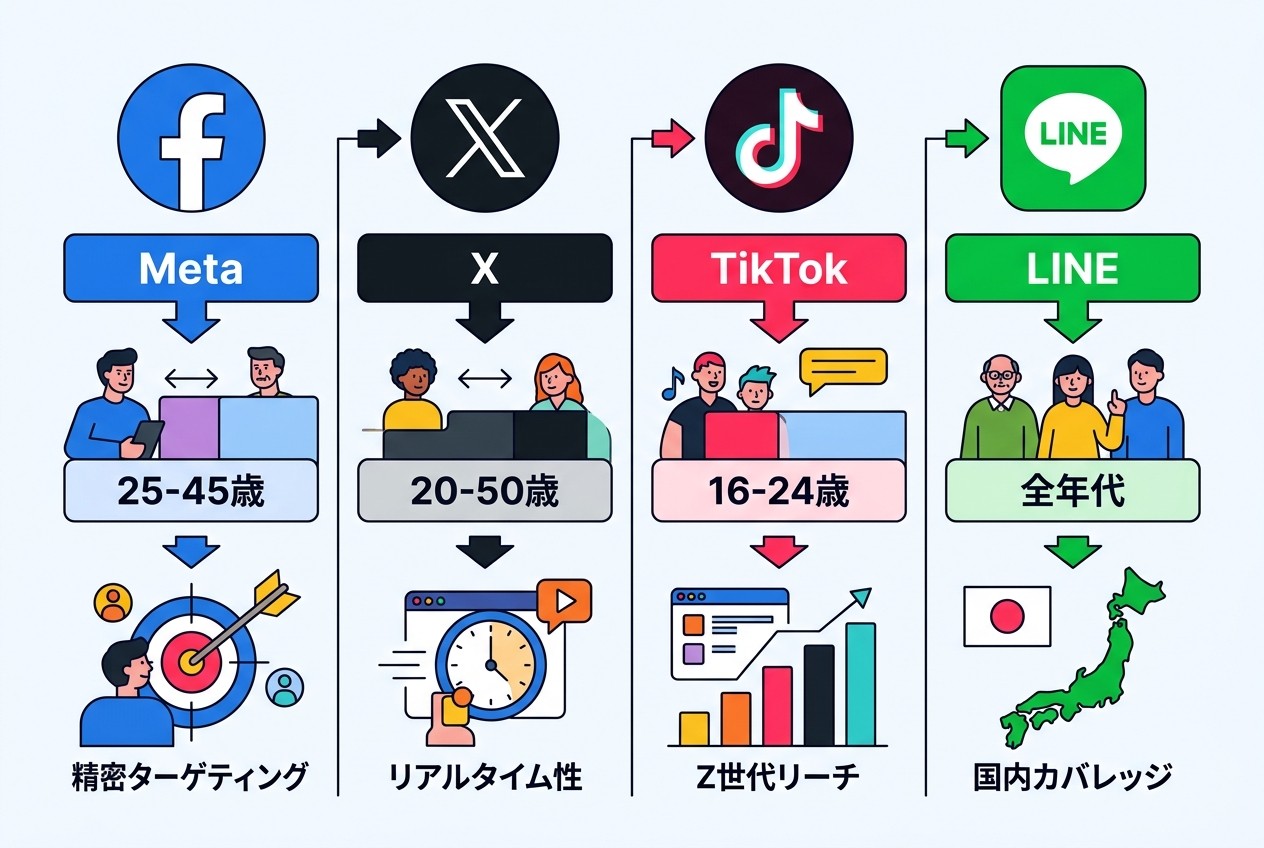
Comparison of Key SNS Advertising Platform Features

Since platform selection directly affects budget allocation and results, it is important to accurately understand the characteristics of each medium.

Facebook/Instagram Ads (Meta Ads)

Enables the most precise targeting and is particularly effective for B2C products. With the lookalike audience feature, users with attributes similar to existing customers can be automatically extracted.

Main features:

  • Detailed interest targeting (20,000+ categories)

  • Custom audiences (use of existing customer lists)

  • Diverse ad formats such as video, image, and carousel

  • Minimum budget: from 100 yen/day

Related reading

AI Optimization for Meta Ads | Audience Design and Campaign Strategies That Deliver Results

Explains detailed Meta ad operation strategies and AI-powered optimization methods.

X Ads (formerly Twitter Ads)

Highly real-time and suitable for topical content. It is the only SNS platform where a certain level of effectiveness can also be expected for B2B products.

In X Ad Operation Setup, combining keyword targeting and follower targeting is effective.

Main features:

  • Keyword targeting (search query-based)

  • Follower targeting (followers of competitor accounts)

  • Three formats: Promoted Tweets, Promoted Accounts, and Promoted Trends

  • Minimum budget: from 50 yen/day

TikTok Ads

Overwhelmingly strong appeal to Gen Z (ages 18–24), with engagement rates reaching 3–5 times those of other platforms. However, content production costs are the highest.

Main features:

  • Ad formats specialized for vertical video

  • Automatic optimization via AI algorithms

  • Tie-up functions with influencers

  • Minimum budget: from 500 yen/day

LINE Ads

Has the highest active user rate in Japan (92%), enabling reach across a wide range of age groups. Particularly effective for acquiring users in their 40s and older.

By leveraging LINE Ad Operation Techniques, CPA can often be improved by 20–30%.

Platform

Strength

Suitable Product Types

Average CPC (guide)

Meta (Facebook/Instagram)

Precise targeting

E-commerce, beauty, education

50–200 yen

X

Real-time nature

B2B, media, entertainment

80–300 yen

TikTok

Gen Z reach

Fashion, music, gaming

30–150 yen

LINE

Domestic coverage

Finance, real estate, daily goods

60–250 yen

主要SNS広告プラットフォームの特徴とターゲット年代比較

Comparison of major SNS advertising platform features and target age groups

Practical Methods for Effective Targeting Settings

In SNS advertising, 90% of results are determined by targeting settings. With proper audience design, CPA can improve by 50–70% even with the same budget.

Basic Principles of Audience Design

Effective targeting is designed in three stages: “broaden → narrow → expand.” The iron rule is to start broad and accumulate data, then identify high-performing segments and expand using lookalike audiences.

How to set each stage:

  1. Phase 1 (Weeks 1–2): Collect data with broad settings (audience size: 2 million+)

  2. Phase 2 (Weeks 3–4): Narrow down to high-performing segments (0.5–1 million)

  3. Phase 3 (Week 5 onward): Expand with lookalike audiences (start from 1% lookalike)

Targeting Strategies by Product Type

For e-commerce/retail: If purchase history data exists, start with a 1% lookalike audience. If not, combining interests (high purchase intent users) × top 25% income bracket is effective.

For services/B2B: In addition to job function × company size targeting, use users who liked competitor company pages as seed data for lookalike audiences.

How to Use Custom Audiences

If existing customer data is available, creating custom audiences in the following order is effective:

  1. Purchaser list (within past 90 days) → create 1% lookalike audience

  2. Site visitors (past 30 days) → retargeting delivery

  3. Video viewers (watched 75%+) → for lookalike expansion

  4. Email subscribers (top 20% open rate) → engagement enhancement measures

Facebook research found that the purchase rate of 1% lookalike audiences is on average 2.2 times higher than normal interest targeting. However, accuracy drops significantly unless the seed customer data contains at least 100 records.

Product Category

Recommended Targeting

Audience Size

Expected CPA Improvement

Fashion/Beauty

Lookalike + interests

0.5–2 million

30–50%

Food/Daily Goods

Region + age group + interests

1–3 million

20–35%

Education/Schools

Job function + behavior + lookalike

0.3–1 million

40–60%

B2B Services

Job function + company size + competitors

0.1–0.5 million

50–70%

Key Points for Creating Ad Creatives

In SNS advertising, creative quality accounts for over 70% of CTR impact. Even with the same targeting, CTR can differ by as much as 10x depending on the creative.

Creative Optimization by Platform

Facebook/Instagram: For static images, 1080×1080 px square is most effective; for video, vertical 9:16 works best. Keep text to under 20% of the image.

As explained in How to Create Effective Ad Creatives, showing specific product usage scenes can increase purchase intent.

X: Trend-linked content leveraging real-time nature is effective. Recommended image size is 1200×675 px (landscape).

TikTok: Capturing users’ attention in the first 3 seconds is essential. Collaboration formats with influencers are natural and have high engagement.

Common Elements of High-CTR Creatives

  1. Craft the first 3 seconds: In video ads, 60% of users decide to drop off within the first 3 seconds

  2. Clearly show benefits: Express concretely “how it improves things,” not just feature descriptions

  3. Social proof: Trust signals such as review count, awards, and media coverage

  4. Scarcity appeal: Urgency such as “limited 100 units” or “2 days left”

Optimization Methods for Budget Settings and Bidding Strategy

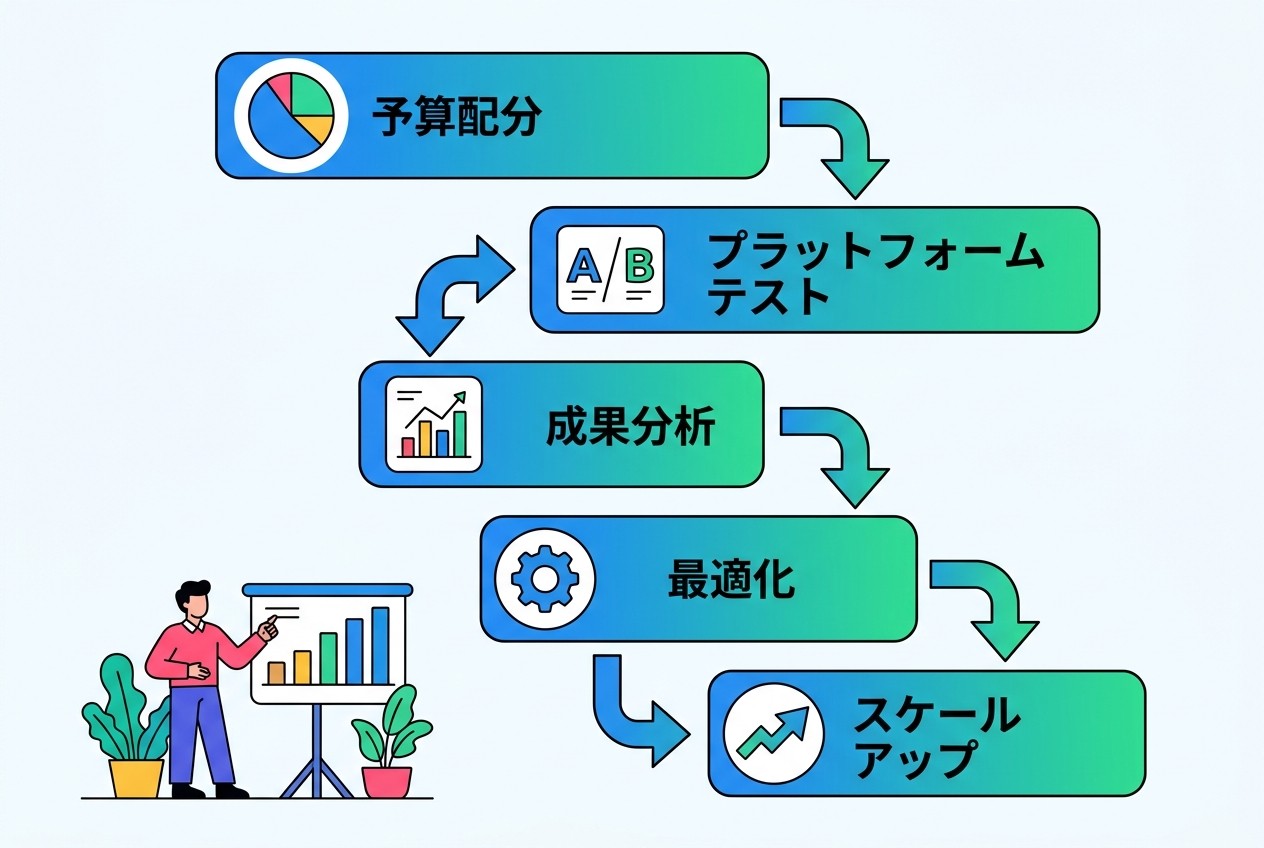
SNS ad budget allocation should be divided into a “test period (20% of total)” and a “scale period (80%).” If learning data is insufficient during testing, performance can deteriorate significantly during scaling.

Recommended Strategies by Budget

Monthly budget of 50,000–200,000 yen: Focus on one platform and test with 3–5 creative patterns. Spreading across multiple platforms leads to insufficient learning data.

Monthly budget of 200,000–1,000,000 yen: Use Meta Ads as the main channel (60%), and test X and TikTok with 20% each. Shift next month’s budget to better-performing channels.

Monthly budget over 1,000,000 yen: Test on all platforms and design independent funnels for each medium. Allocate 20–30% of total budget to retargeting.

Criteria for Choosing Automatic vs Manual Bidding

If weekly conversions are 30 or fewer, choose manual bidding (CPC or CPM). If 30+ occur consistently, switch to automatic bidding (target CPA/ROAS).

The learning period for automatic bidding is usually 7–14 days. If CPA exceeds 150% of target during this period, consider switching back to manual bidding.

According to Meta internal data, automatic bidding improves CPA by an average of 13% compared to manual bidding, but can worsen performance by 20–40% when learning data is insufficient.

効果的なSNS広告予算最適化の5ステップ

Five steps for effective SNS ad budget optimization

Practical Methods for Performance Measurement and Analysis

In SNS ad performance measurement, it is important to measure not only platform-standard metrics but also impact on overall business. In particular, neglecting attribution analysis can lead to misjudging actual contribution.

How to Set and Track Key Metrics

Set different metrics for each funnel stage: “awareness → consideration → purchase → retention.” Track reach/impressions for awareness, CTR/time on site for consideration, CPA/ROAS for purchase, and LTV for retention.

Essential tracking metrics:

  • Short-term metrics: CTR, CPC, conversion rate (1–7 days)

  • Mid-term metrics: CPA, ROAS, branded search growth rate (8–30 days)

  • Long-term metrics: LTV, repeat rate, organic traffic growth (31+ days)

Attribution Analysis Setup

Due to tracking restrictions since iOS 14.5, SNS ad measurement has become more complex. Use both GA4 setup and native platform tools (Meta Pixel, X Pixel), and manage data discrepancies within an acceptable range (±20%).

Measuring view-through conversions is especially important. Cases where users saw SNS ads but did not click, then purchased later via other channels, account for 20–30% of all conversions.

Report Creation and Improvement Planning

In weekly reports, compare with the previous week; in monthly reports, compare with the previous month and the same month last year. Single-month judgments are easily affected by seasonality and external factors.

Priority order for improvement actions:

  1. If CPA exceeds 120% of target: set bid caps or pause delivery

  2. If CTR is below 0.8%: replace creative

  3. If conversion rate is below 2%: improve landing page

  4. If reach frequency exceeds 5: expand audience

Metric

Good

Caution

Improvement Required

Improvement Action

CTR

1.5% or higher

0.8–1.5%

Below 0.8%

Change creative

CPC

80% or less of target

80–120%

120% or higher

Adjust bids/targeting

CPA

At or below target

100–120%

120% or higher

Temporarily pause delivery

ROAS

120% or more of target

80–120%

Below 80%

Reallocate budget

SNS Ad Operation Failure Patterns to Avoid

By understanding in advance the failure patterns that most waste costs in SNS advertising, you can operate a limited budget efficiently.

Fatal Targeting Mistakes

Over-narrowing: When audience size falls below 100,000, platform algorithms fail to function properly and CPC can jump 2–3x. Avoid multi-layer conditions like “women in their 30s × interested in beauty × annual income over 5 million yen × living in Tokyo × single × likes yoga.”

Overlapping audiences: If multiple ad sets target the same users, internal auction competition occurs and CPC rises unnecessarily. In Meta Ads, always use the audience overlap check feature.

Regional targeting trap: Even with a “Tokyo” setting, users commuting or attending school in Tokyo are included, so delivery range becomes broader than expected. For businesses with limited trade areas, city/ward-level settings are required.

Typical Creative Production Failures

Overly sales-heavy expression: SNS users use platforms for entertainment and information gathering, so blatant promotion is disliked. Avoid direct sales phrases like “50% off now!” or “Limited price!” and communicate user benefits naturally.

Ignoring platform culture: Reusing Twitter-like text-heavy creatives on Instagram, or distributing studio-shot high-production videos on TikTok, can significantly reduce engagement.

Risky Decisions in Operational Settings

Daily fine-tuning: Since SNS ad algorithms require a learning period (7–14 days), frequently changing targets or budgets daily resets learning and destabilizes results. Make changes at weekly or longer intervals.

Premature performance judgment: Metrics are unstable for 48–72 hours after launch, so stopping immediately based on short-term CPA deterioration is premature. Decide after at least one week of data accumulation.

Extreme budget concentration: If all budget is put into one ad set, there is no fallback if that set underperforms. Risk diversification is important: allocate 60–70% to the main strategy and 30–40% to sub-strategies.

Meta’s research showed that 78% of SNS ad failure cases were due to three factors: “over-targeting,” “frequent setting changes,” and “insufficient understanding of platform characteristics.”

Frequently Asked Questions

What is the minimum budget needed to start SNS advertising?

You can start ad operation with measurable effects from a monthly budget of 30,000–50,000 yen. However, to test across multiple platforms, a monthly budget of 100,000 yen or more is recommended. If the budget is small, it is efficient to focus on Meta Ads first and expand to other platforms after results stabilize.

Which platform is recommended to start with?

For B2C products, Meta Ads (Facebook/Instagram) are recommended; for B2B products, start with X Ads. Meta Ads have the largest user base in Japan and high targeting precision, making it easier for beginners to achieve results.

How long does it take to see results from SNS ads?

As a guideline, initial metric improvement takes 2–4 weeks, and stable results take 2–3 months. Platform algorithm learning takes 1–2 weeks, and identifying effective creatives/targeting takes another 2–4 weeks. Rather than expecting immediate effects, it is important to build an operation plan based on continuous improvement.

I heard measurement accuracy declined after the iOS 14.5 update. Are there countermeasures?

Use native platform measurement tools (Meta Pixel, X Pixel, etc.) together with GA4, and analyze on the premise of data discrepancies. Perfect tracking is difficult, but by evaluating comprehensively including view-through and assist conversions, you can understand actual ad effectiveness.

We are unsure whether to operate in-house or outsource to an agency.

If monthly ad spend is under 500,000 yen, in-house operation is recommended; if it is 500,000 yen or more and operation across multiple platforms is required, consider outsourcing. However, considering data ownership and improvement speed, in-house capability is advantageous in the long term. Even when outsourcing, it is important for your company to acquire basic operational knowledge.

Summary

With appropriate strategy and continuous optimization, SNS advertising can achieve effective customer acquisition even with a monthly budget of 50,000 yen. The keys to success can be summarized in the following five points.

  • Platform selection: Choose media suited to target attributes and product characteristics

  • Step-by-step targeting: Three-stage approach of broad → narrow → expand

  • Creative optimization: Expressions and formats aligned with platform characteristics

  • Proper budget allocation: 20% for test period, 80% for scale period

  • Continuous improvement: Long-term optimization through weekly analysis and monthly strategy review

With the advancement of AI technology, SNS advertising is expected to become increasingly automated. However, targeting strategy and creative planning will continue to remain areas where human judgment is indispensable. Building foundational operational knowledge and effectively leveraging AI tools will help secure a competitive advantage.

SNS advertising is an advertising method that can effectively attract customers even with a monthly budget of 50,000 yen. This article provides practical knowledge you can use starting tomorrow, from comparing the features of the four major platforms to actual operational setup and specific optimization methods to maximize cost-effectiveness.

What Is SNS Advertising?

SNS advertising refers to digital ads delivered on social media platforms such as Facebook, Instagram, X, and TikTok.

What makes it significantly different from traditional display advertising is its high targeting accuracy using users’ interest data and social graphs (friend relationships). According to Meta’s research, SNS ads have about 2.5 times the click-through rate and 1.8 times the conversion rate of typical display ads.

Monthly active users on major platforms are as follows:

  • Facebook: approx. 27 million (Japan domestic, 2025 data)

  • Instagram: approx. 33 million

  • X: approx. 45 million

  • TikTok: approx. 17 million

Comparison of Key SNS Advertising Platform Features

Since platform selection directly affects budget allocation and results, it is important to accurately understand the characteristics of each medium.

Facebook/Instagram Ads (Meta Ads)

Enables the most precise targeting and is particularly effective for B2C products. With the lookalike audience feature, users with attributes similar to existing customers can be automatically extracted.

Main features:

  • Detailed interest targeting (20,000+ categories)

  • Custom audiences (use of existing customer lists)

  • Diverse ad formats such as video, image, and carousel

  • Minimum budget: from 100 yen/day

Related reading

AI Optimization for Meta Ads | Audience Design and Campaign Strategies That Deliver Results

Explains detailed Meta ad operation strategies and AI-powered optimization methods.

X Ads (formerly Twitter Ads)

Highly real-time and suitable for topical content. It is the only SNS platform where a certain level of effectiveness can also be expected for B2B products.

In X Ad Operation Setup, combining keyword targeting and follower targeting is effective.

Main features:

  • Keyword targeting (search query-based)

  • Follower targeting (followers of competitor accounts)

  • Three formats: Promoted Tweets, Promoted Accounts, and Promoted Trends

  • Minimum budget: from 50 yen/day

TikTok Ads

Overwhelmingly strong appeal to Gen Z (ages 18–24), with engagement rates reaching 3–5 times those of other platforms. However, content production costs are the highest.

Main features:

  • Ad formats specialized for vertical video

  • Automatic optimization via AI algorithms

  • Tie-up functions with influencers

  • Minimum budget: from 500 yen/day

LINE Ads

Has the highest active user rate in Japan (92%), enabling reach across a wide range of age groups. Particularly effective for acquiring users in their 40s and older.

By leveraging LINE Ad Operation Techniques, CPA can often be improved by 20–30%.

Platform

Strength

Suitable Product Types

Average CPC (guide)

Meta (Facebook/Instagram)

Precise targeting

E-commerce, beauty, education

50–200 yen

X

Real-time nature

B2B, media, entertainment

80–300 yen

TikTok

Gen Z reach

Fashion, music, gaming

30–150 yen

LINE

Domestic coverage

Finance, real estate, daily goods

60–250 yen

主要SNS広告プラットフォームの特徴とターゲット年代比較

Comparison of major SNS advertising platform features and target age groups

Practical Methods for Effective Targeting Settings

In SNS advertising, 90% of results are determined by targeting settings. With proper audience design, CPA can improve by 50–70% even with the same budget.

Basic Principles of Audience Design

Effective targeting is designed in three stages: “broaden → narrow → expand.” The iron rule is to start broad and accumulate data, then identify high-performing segments and expand using lookalike audiences.

How to set each stage:

  1. Phase 1 (Weeks 1–2): Collect data with broad settings (audience size: 2 million+)

  2. Phase 2 (Weeks 3–4): Narrow down to high-performing segments (0.5–1 million)

  3. Phase 3 (Week 5 onward): Expand with lookalike audiences (start from 1% lookalike)

Targeting Strategies by Product Type

For e-commerce/retail: If purchase history data exists, start with a 1% lookalike audience. If not, combining interests (high purchase intent users) × top 25% income bracket is effective.

For services/B2B: In addition to job function × company size targeting, use users who liked competitor company pages as seed data for lookalike audiences.

How to Use Custom Audiences

If existing customer data is available, creating custom audiences in the following order is effective:

  1. Purchaser list (within past 90 days) → create 1% lookalike audience

  2. Site visitors (past 30 days) → retargeting delivery

  3. Video viewers (watched 75%+) → for lookalike expansion

  4. Email subscribers (top 20% open rate) → engagement enhancement measures

Facebook research found that the purchase rate of 1% lookalike audiences is on average 2.2 times higher than normal interest targeting. However, accuracy drops significantly unless the seed customer data contains at least 100 records.

Product Category

Recommended Targeting

Audience Size

Expected CPA Improvement

Fashion/Beauty

Lookalike + interests

0.5–2 million

30–50%

Food/Daily Goods

Region + age group + interests

1–3 million

20–35%

Education/Schools

Job function + behavior + lookalike

0.3–1 million

40–60%

B2B Services

Job function + company size + competitors

0.1–0.5 million

50–70%

Key Points for Creating Ad Creatives

In SNS advertising, creative quality accounts for over 70% of CTR impact. Even with the same targeting, CTR can differ by as much as 10x depending on the creative.

Creative Optimization by Platform

Facebook/Instagram: For static images, 1080×1080 px square is most effective; for video, vertical 9:16 works best. Keep text to under 20% of the image.

As explained in How to Create Effective Ad Creatives, showing specific product usage scenes can increase purchase intent.

X: Trend-linked content leveraging real-time nature is effective. Recommended image size is 1200×675 px (landscape).

TikTok: Capturing users’ attention in the first 3 seconds is essential. Collaboration formats with influencers are natural and have high engagement.

Common Elements of High-CTR Creatives

  1. Craft the first 3 seconds: In video ads, 60% of users decide to drop off within the first 3 seconds

  2. Clearly show benefits: Express concretely “how it improves things,” not just feature descriptions

  3. Social proof: Trust signals such as review count, awards, and media coverage

  4. Scarcity appeal: Urgency such as “limited 100 units” or “2 days left”

Optimization Methods for Budget Settings and Bidding Strategy

SNS ad budget allocation should be divided into a “test period (20% of total)” and a “scale period (80%).” If learning data is insufficient during testing, performance can deteriorate significantly during scaling.

Recommended Strategies by Budget

Monthly budget of 50,000–200,000 yen: Focus on one platform and test with 3–5 creative patterns. Spreading across multiple platforms leads to insufficient learning data.

Monthly budget of 200,000–1,000,000 yen: Use Meta Ads as the main channel (60%), and test X and TikTok with 20% each. Shift next month’s budget to better-performing channels.

Monthly budget over 1,000,000 yen: Test on all platforms and design independent funnels for each medium. Allocate 20–30% of total budget to retargeting.

Criteria for Choosing Automatic vs Manual Bidding

If weekly conversions are 30 or fewer, choose manual bidding (CPC or CPM). If 30+ occur consistently, switch to automatic bidding (target CPA/ROAS).

The learning period for automatic bidding is usually 7–14 days. If CPA exceeds 150% of target during this period, consider switching back to manual bidding.

According to Meta internal data, automatic bidding improves CPA by an average of 13% compared to manual bidding, but can worsen performance by 20–40% when learning data is insufficient.

効果的なSNS広告予算最適化の5ステップ

Five steps for effective SNS ad budget optimization

Practical Methods for Performance Measurement and Analysis

In SNS ad performance measurement, it is important to measure not only platform-standard metrics but also impact on overall business. In particular, neglecting attribution analysis can lead to misjudging actual contribution.

How to Set and Track Key Metrics

Set different metrics for each funnel stage: “awareness → consideration → purchase → retention.” Track reach/impressions for awareness, CTR/time on site for consideration, CPA/ROAS for purchase, and LTV for retention.

Essential tracking metrics:

  • Short-term metrics: CTR, CPC, conversion rate (1–7 days)

  • Mid-term metrics: CPA, ROAS, branded search growth rate (8–30 days)

  • Long-term metrics: LTV, repeat rate, organic traffic growth (31+ days)

Attribution Analysis Setup

Due to tracking restrictions since iOS 14.5, SNS ad measurement has become more complex. Use both GA4 setup and native platform tools (Meta Pixel, X Pixel), and manage data discrepancies within an acceptable range (±20%).

Measuring view-through conversions is especially important. Cases where users saw SNS ads but did not click, then purchased later via other channels, account for 20–30% of all conversions.

Report Creation and Improvement Planning

In weekly reports, compare with the previous week; in monthly reports, compare with the previous month and the same month last year. Single-month judgments are easily affected by seasonality and external factors.

Priority order for improvement actions:

  1. If CPA exceeds 120% of target: set bid caps or pause delivery

  2. If CTR is below 0.8%: replace creative

  3. If conversion rate is below 2%: improve landing page

  4. If reach frequency exceeds 5: expand audience

Metric

Good

Caution

Improvement Required

Improvement Action

CTR

1.5% or higher

0.8–1.5%

Below 0.8%

Change creative

CPC

80% or less of target

80–120%

120% or higher

Adjust bids/targeting

CPA

At or below target

100–120%

120% or higher

Temporarily pause delivery

ROAS

120% or more of target

80–120%

Below 80%

Reallocate budget

SNS Ad Operation Failure Patterns to Avoid

By understanding in advance the failure patterns that most waste costs in SNS advertising, you can operate a limited budget efficiently.

Fatal Targeting Mistakes

Over-narrowing: When audience size falls below 100,000, platform algorithms fail to function properly and CPC can jump 2–3x. Avoid multi-layer conditions like “women in their 30s × interested in beauty × annual income over 5 million yen × living in Tokyo × single × likes yoga.”

Overlapping audiences: If multiple ad sets target the same users, internal auction competition occurs and CPC rises unnecessarily. In Meta Ads, always use the audience overlap check feature.

Regional targeting trap: Even with a “Tokyo” setting, users commuting or attending school in Tokyo are included, so delivery range becomes broader than expected. For businesses with limited trade areas, city/ward-level settings are required.

Typical Creative Production Failures

Overly sales-heavy expression: SNS users use platforms for entertainment and information gathering, so blatant promotion is disliked. Avoid direct sales phrases like “50% off now!” or “Limited price!” and communicate user benefits naturally.

Ignoring platform culture: Reusing Twitter-like text-heavy creatives on Instagram, or distributing studio-shot high-production videos on TikTok, can significantly reduce engagement.

Risky Decisions in Operational Settings

Daily fine-tuning: Since SNS ad algorithms require a learning period (7–14 days), frequently changing targets or budgets daily resets learning and destabilizes results. Make changes at weekly or longer intervals.

Premature performance judgment: Metrics are unstable for 48–72 hours after launch, so stopping immediately based on short-term CPA deterioration is premature. Decide after at least one week of data accumulation.

Extreme budget concentration: If all budget is put into one ad set, there is no fallback if that set underperforms. Risk diversification is important: allocate 60–70% to the main strategy and 30–40% to sub-strategies.

Meta’s research showed that 78% of SNS ad failure cases were due to three factors: “over-targeting,” “frequent setting changes,” and “insufficient understanding of platform characteristics.”

Frequently Asked Questions

What is the minimum budget needed to start SNS advertising?

You can start ad operation with measurable effects from a monthly budget of 30,000–50,000 yen. However, to test across multiple platforms, a monthly budget of 100,000 yen or more is recommended. If the budget is small, it is efficient to focus on Meta Ads first and expand to other platforms after results stabilize.

Which platform is recommended to start with?

For B2C products, Meta Ads (Facebook/Instagram) are recommended; for B2B products, start with X Ads. Meta Ads have the largest user base in Japan and high targeting precision, making it easier for beginners to achieve results.

How long does it take to see results from SNS ads?

As a guideline, initial metric improvement takes 2–4 weeks, and stable results take 2–3 months. Platform algorithm learning takes 1–2 weeks, and identifying effective creatives/targeting takes another 2–4 weeks. Rather than expecting immediate effects, it is important to build an operation plan based on continuous improvement.

I heard measurement accuracy declined after the iOS 14.5 update. Are there countermeasures?

Use native platform measurement tools (Meta Pixel, X Pixel, etc.) together with GA4, and analyze on the premise of data discrepancies. Perfect tracking is difficult, but by evaluating comprehensively including view-through and assist conversions, you can understand actual ad effectiveness.

We are unsure whether to operate in-house or outsource to an agency.

If monthly ad spend is under 500,000 yen, in-house operation is recommended; if it is 500,000 yen or more and operation across multiple platforms is required, consider outsourcing. However, considering data ownership and improvement speed, in-house capability is advantageous in the long term. Even when outsourcing, it is important for your company to acquire basic operational knowledge.

Summary

With appropriate strategy and continuous optimization, SNS advertising can achieve effective customer acquisition even with a monthly budget of 50,000 yen. The keys to success can be summarized in the following five points.

  • Platform selection: Choose media suited to target attributes and product characteristics

  • Step-by-step targeting: Three-stage approach of broad → narrow → expand

  • Creative optimization: Expressions and formats aligned with platform characteristics

  • Proper budget allocation: 20% for test period, 80% for scale period

  • Continuous improvement: Long-term optimization through weekly analysis and monthly strategy review

With the advancement of AI technology, SNS advertising is expected to become increasingly automated. However, targeting strategy and creative planning will continue to remain areas where human judgment is indispensable. Building foundational operational knowledge and effectively leveraging AI tools will help secure a competitive advantage.

\FreeDownload Now/

\FreeDownload Now/

\FreeDownload Now/

Cascade - Introduction Material

Table of Contents