7 Rules for Successful In-House Ad Operations in the AI Era

7 Rules for Successful In-House Ad Operations in the AI Era

Dec 5, 2025

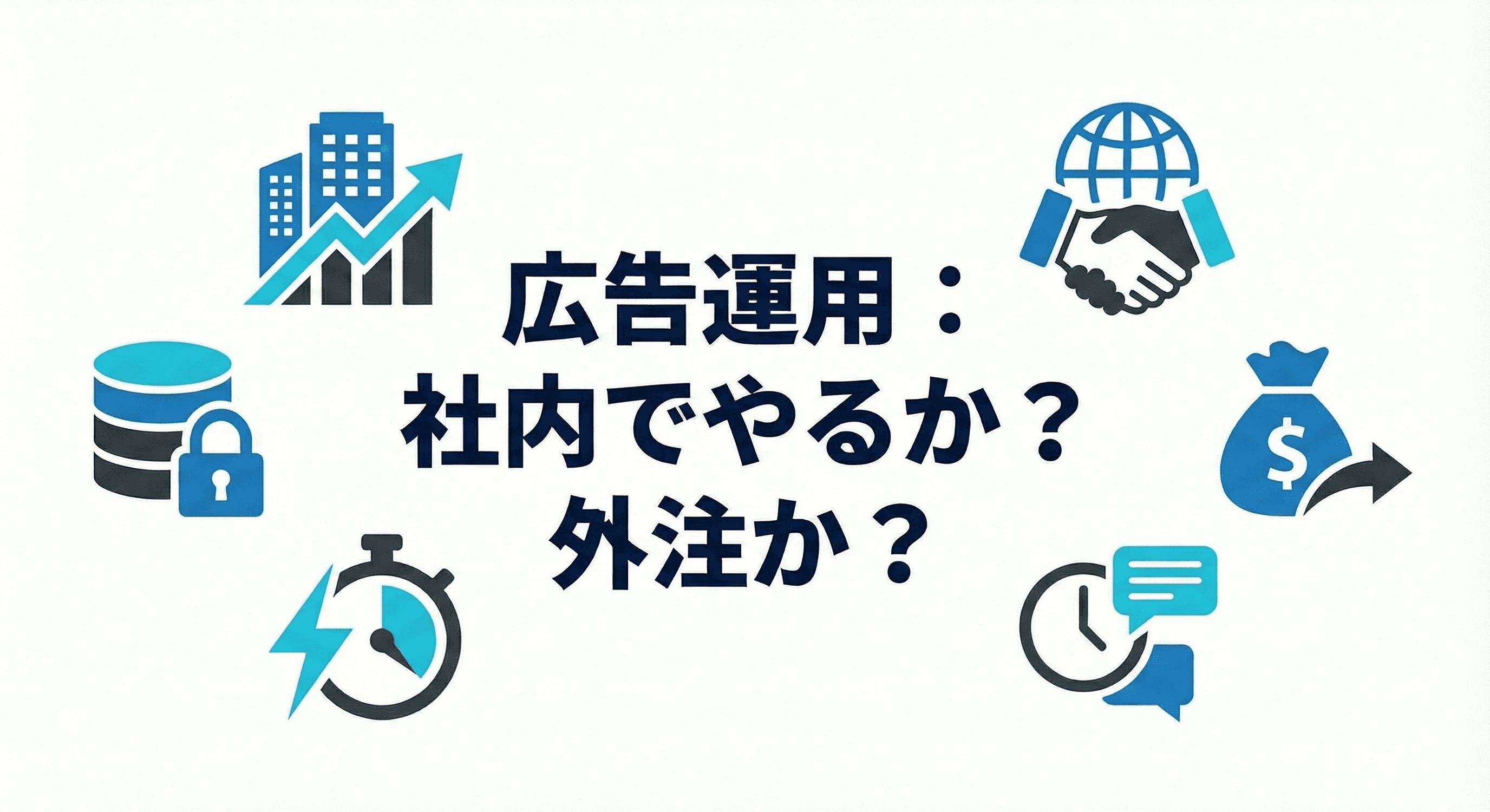
Advertising operations: Should we do it in-house or outsource it?

Introduction: Why is "In-house Advertising Management" Important Now?

The managerial decision many companies face is whether to outsource advertising management to an agency or to manage it in-house. In the past, it was common to outsource to agencies as it was seen as a highly specialized field.

However, in recent years, the changes in the market environment have been rapid, and the speed and flexibility required for advertising management are increasing. Against this backdrop, many companies are swiftly shifting to in-house advertising management to accumulate know-how and achieve quicker decision-making. The evolution of advertising platforms has made it possible for non-experts to manage at a certain level, further supporting this trend.

This article will not only list the merits and demerits but will also explain the essential "seven iron rules" necessary to successfully implement in-house management and establish a sustainable system, along with concrete actions.

1. "Cost Reduction" is Just the Beginning. Understand the True Strategic Value of In-house Management

The most straightforward motivation for considering in-house management is likely the reduction of agency fees. Typically, it is said that about 20% of advertising costs are attributed to fees, which means that if the monthly advertising budget is 1 million yen, you can save 2.4 million yen annually, and if it is 5 million yen, the savings amount to 12 million yen per year. In fact, a real estate company managed to successfully reduce fees by about 360 million yen annually through in-house management, demonstrating its immense impact.

However, this monetary benefit is just a small part of the value that in-house management brings. The true strategic value can be summarized in the following three points.

  • Permanent Asset of Know-how Both successes and failures from advertising management accumulate within the organization as intangible assets. Retaining know-how that would be lost once the contract with the agency ends strengthens the overall marketing capability of the organization in the long term.

  • Overwhelming Speed The ability to respond immediately to market changes and competitor movements provides a strong competitive edge. There is no loss of communication via agencies, allowing for a rapid PDCA cycle such as "implementing the measures decided in the morning meeting by the afternoon of the same day."

  • Deepening Business Understanding Those who best understand their own products, services, and customer pain points are the individuals within the company. This deep business understanding serves as a source for advertisements that resonate with customers and for more accurate targeting strategies.

However, to maximize this value, it is necessary to understand and implement measures to avoid the greatest risks unique to in-house management.

2. The Greatest Risk is Not Lack of Skills. Avoid the "Personalization" Time Bomb

One of the biggest failure patterns in in-house management is "personalization." This refers to a situation where the knowledge and know-how of advertising management are concentrated in a particular person. If that key person should leave the company unexpectedly, it could cease advertising management or lead to a sudden decline in performance, causing serious damage to the business.

To defuse this "time bomb," it is absolutely essential to embed the following protocols into the organization from the very first day of establishing the structure.

  • Thorough Documentation Standardize daily operational tasks and clearly document campaign naming conventions, budget management rules, and reporting formats. This aims to create a state where anyone can reproduce the work.

  • Team Structure with Multiple Members Avoid situations where a single individual is responsible, and form teams of at least two people. This allows for mutual coverage of tasks and implements checks on each other.

  • Regular Knowledge Sharing Sessions Establish forums weekly or monthly for each person to share insights gained, as well as success and failure cases. Elevating individual experience to organizational knowledge can prevent personalization and raise the overall skill level of the organization.

3. Don’t Aim for “Complete Transition.” Start with a “Hybrid Model” to Minimize Failure Risks

As soon as you decide to "go in-house," prematurely cutting all contracts with agencies and rushing to transfer all operations to the company is a typical gateway to failure. If you rush into a full transition without proper preparation, the risk of declining operational quality and poor results becomes very high.

What is recommended is to start with a "hybrid model" where the company collaborates with external partners. This is a realistic and effective option that allows you to enjoy the benefits of in-house management while cleverly compensating for its disadvantages.

  • Strategy and Analysis Externally, Execution and Operations Internally An effective model during the initial phase of in-house management. Assign external experts (strategists) to strategy formulation and advanced analysis while allowing internal members to concentrate on daily operations (execution), ensuring they sharpen their practical skills steadily.

  • Creative Production Externally, Operations Internally An optimal model when there is no in-house designer. Delegate the production of quality banners and videos externally, while the company focuses on core advertising management and performance analysis.

  • Consulting Combined Model All operational tasks conducted internally while receiving regular advice and account assessments from external consultants. This allows for an increase in the company's operational capabilities while incorporating an objective perspective.

4. Not Only “Operation Personnel” are Needed. Design a Cross-Functional Team that Supports Success

The idea that "having one person who can operate the advertising management screen is sufficient for in-house management" is a significant misconception. Effective advertising management is built on the collaboration of diverse skill sets.

A successful in-house organization requires at least the following three skill sets.

  • Strategic Planning and Marketing Skills Analyzing customer needs and conducting competitor research, designing KPIs based on business goals, and making data-driven decisions that directly contribute to business value and analysis capabilities.

  • Creative and Content Production Skills Copywriting skills to convey advertising text and article content appealingly, design skills using tools like Photoshop, and video editing skills. Having in-house designers and marketers who deeply understand the company's brand and services brings consistency.

  • Technical Skills Basic knowledge of HTML/CSS for understanding website structures, SEO knowledge, and know-how for operating CMS (such as WordPress). This is a critical skill that supports the foundation of data measurement.

It is challenging for one person to cover all these skills. The ideal situation is to organize a "cross-functional team" where different experts collaborate. This includes a project leader who manages the progress of the entire initiative, a marketer who handles everything from research to strategy design and data analysis, a creator who produces advertising banners and articles, and an engineer who supports technical issues like site construction. By breaking down barriers between departments and enhancing information sharing, swift decision-making becomes possible.

5. Ambiguity of Purpose Leads to Failure. Define “Why Are We Doing This?” and Establish KPIs from the Beginning

One of the most common reasons in-house projects fail is starting with an ambiguous purpose.

Clearly defining the purpose of "why we are going in-house" and sharing it among all stakeholders, from management to the frontline, is an absolute condition for success. The purposes can include the following points.

  • Cost Reduction

  • Accumulation of Know-how

  • Speeding Up

  • Deepening Data Utilization

Once the purpose is established, the next step is to set specific KPIs (Key Performance Indicators) to measure the degree of achievement. Without KPIs, it becomes impossible to objectively evaluate the results of operations, leading to ad-hoc tactics. This makes it impossible to maintain an effective PDCA cycle.

If the purpose of going in-house remains ambiguous while beginning the structure establishment, the operation will become ad-hoc without defining KPIs or success metrics, making failures likely.

As this statement suggests, setting clear objectives and KPIs serves as the compass that determines the success of the project.

6. The Cookie-less Era Turns In-house Management into a “Strategic Necessity”

Due to the global trend of user privacy protection, the effectiveness of traditional targeting methods using 3rd Party Cookies is declining. We are entering the “Cookie-less era.”

The key to establishing competitive advantage in this new environment is the "first-party data" that companies collect directly from customers. And the in-house team is precisely capable of maximizing the use of this valuable data.

  • Security You can manage and utilize highly confidential customer data safely within the company without sharing it with external third parties.

  • Rapid Data Integration The in-house marketing team can directly collaborate with engineers and data teams. This allows for a seamless and swift integration of customer data accumulated in internal systems like CRM or SFA with advertising platforms.

  • Advanced Customer Approach Data integration enables you to deliver advertisements to users with characteristics similar to high LTV (lifetime value) customers or re-engage dormant customers, achieving advanced advertising strategies that competitors cannot imitate.

For companies to take the lead in data utilization, in-house management is no longer just an option but is becoming a strategic necessity.

7. AI is the “Ultimate Weapon” to Solve the Challenges of In-house Management

Significant challenges that traditional in-house management faced, such as "difficulty in hiring skilled professionals" and "the enormous time required for data analysis," are currently being addressed through the evolution of AI technology.

Tools equipped with AI automate complex tasks that specialists previously spent a lot of time on, drastically enhancing the capabilities of in-house teams.

  • Solving the Challenge of “Skill Shortage and Laborious Analysis” AI analyzes complex advertising data in just a few seconds and identifies the root causes of performance fluctuations, even providing tips for improvement.

  • Eliminating “Personalization Risks” and “Judgment Errors” AI objectively analyzes the outcomes of each campaign and proposes optimal budget allocations to maximize return on investment (ROI).

  • Supplementing “Resource Shortages” AI assists in generating diverse advertising images and texts, accelerating the cycle of creative tests.

AI enables even a small in-house team to achieve levels of advanced management that were once only possible with large agencies. The evolution of technology is making the choice for in-house management more realistic and powerful than ever before.

Conclusion: With AI, Transform Advertising Management into Your Company's “Strategic Asset”

To successfully implement in-house advertising management, it is essential to go beyond the simple viewpoint of cost reduction and approach it as a strategic transformation. Set a clear objective, build a mechanism to avoid personalization, and tackle it with a cross-functional team. Then, utilize your own data to the fullest. This is the way to success.

In the coming era where AI and data privacy take center stage, internalizing advertising management is the most certain pathway to elevate marketing from a mere "expense" to a "strategic asset" that determines a company's competitiveness.

If you genuinely want to succeed in this strategic transformation, the AI-powered marketing and advertising optimization platform “Cascade” will be a powerful partner. Cascade automates complex analyses and realizes optimal performance, guiding your in-house team to success. See how Cascade can strengthen your team to accelerate this strategic transformation and build a professional-level operational structure from day one.

Introduction: Why is "In-house Advertising Management" Important Now?

The managerial decision many companies face is whether to outsource advertising management to an agency or to manage it in-house. In the past, it was common to outsource to agencies as it was seen as a highly specialized field.

However, in recent years, the changes in the market environment have been rapid, and the speed and flexibility required for advertising management are increasing. Against this backdrop, many companies are swiftly shifting to in-house advertising management to accumulate know-how and achieve quicker decision-making. The evolution of advertising platforms has made it possible for non-experts to manage at a certain level, further supporting this trend.

This article will not only list the merits and demerits but will also explain the essential "seven iron rules" necessary to successfully implement in-house management and establish a sustainable system, along with concrete actions.

1. "Cost Reduction" is Just the Beginning. Understand the True Strategic Value of In-house Management

The most straightforward motivation for considering in-house management is likely the reduction of agency fees. Typically, it is said that about 20% of advertising costs are attributed to fees, which means that if the monthly advertising budget is 1 million yen, you can save 2.4 million yen annually, and if it is 5 million yen, the savings amount to 12 million yen per year. In fact, a real estate company managed to successfully reduce fees by about 360 million yen annually through in-house management, demonstrating its immense impact.

However, this monetary benefit is just a small part of the value that in-house management brings. The true strategic value can be summarized in the following three points.

  • Permanent Asset of Know-how Both successes and failures from advertising management accumulate within the organization as intangible assets. Retaining know-how that would be lost once the contract with the agency ends strengthens the overall marketing capability of the organization in the long term.

  • Overwhelming Speed The ability to respond immediately to market changes and competitor movements provides a strong competitive edge. There is no loss of communication via agencies, allowing for a rapid PDCA cycle such as "implementing the measures decided in the morning meeting by the afternoon of the same day."

  • Deepening Business Understanding Those who best understand their own products, services, and customer pain points are the individuals within the company. This deep business understanding serves as a source for advertisements that resonate with customers and for more accurate targeting strategies.

However, to maximize this value, it is necessary to understand and implement measures to avoid the greatest risks unique to in-house management.

2. The Greatest Risk is Not Lack of Skills. Avoid the "Personalization" Time Bomb

One of the biggest failure patterns in in-house management is "personalization." This refers to a situation where the knowledge and know-how of advertising management are concentrated in a particular person. If that key person should leave the company unexpectedly, it could cease advertising management or lead to a sudden decline in performance, causing serious damage to the business.

To defuse this "time bomb," it is absolutely essential to embed the following protocols into the organization from the very first day of establishing the structure.

  • Thorough Documentation Standardize daily operational tasks and clearly document campaign naming conventions, budget management rules, and reporting formats. This aims to create a state where anyone can reproduce the work.

  • Team Structure with Multiple Members Avoid situations where a single individual is responsible, and form teams of at least two people. This allows for mutual coverage of tasks and implements checks on each other.

  • Regular Knowledge Sharing Sessions Establish forums weekly or monthly for each person to share insights gained, as well as success and failure cases. Elevating individual experience to organizational knowledge can prevent personalization and raise the overall skill level of the organization.

3. Don’t Aim for “Complete Transition.” Start with a “Hybrid Model” to Minimize Failure Risks

As soon as you decide to "go in-house," prematurely cutting all contracts with agencies and rushing to transfer all operations to the company is a typical gateway to failure. If you rush into a full transition without proper preparation, the risk of declining operational quality and poor results becomes very high.

What is recommended is to start with a "hybrid model" where the company collaborates with external partners. This is a realistic and effective option that allows you to enjoy the benefits of in-house management while cleverly compensating for its disadvantages.

  • Strategy and Analysis Externally, Execution and Operations Internally An effective model during the initial phase of in-house management. Assign external experts (strategists) to strategy formulation and advanced analysis while allowing internal members to concentrate on daily operations (execution), ensuring they sharpen their practical skills steadily.

  • Creative Production Externally, Operations Internally An optimal model when there is no in-house designer. Delegate the production of quality banners and videos externally, while the company focuses on core advertising management and performance analysis.

  • Consulting Combined Model All operational tasks conducted internally while receiving regular advice and account assessments from external consultants. This allows for an increase in the company's operational capabilities while incorporating an objective perspective.

4. Not Only “Operation Personnel” are Needed. Design a Cross-Functional Team that Supports Success

The idea that "having one person who can operate the advertising management screen is sufficient for in-house management" is a significant misconception. Effective advertising management is built on the collaboration of diverse skill sets.

A successful in-house organization requires at least the following three skill sets.

  • Strategic Planning and Marketing Skills Analyzing customer needs and conducting competitor research, designing KPIs based on business goals, and making data-driven decisions that directly contribute to business value and analysis capabilities.

  • Creative and Content Production Skills Copywriting skills to convey advertising text and article content appealingly, design skills using tools like Photoshop, and video editing skills. Having in-house designers and marketers who deeply understand the company's brand and services brings consistency.

  • Technical Skills Basic knowledge of HTML/CSS for understanding website structures, SEO knowledge, and know-how for operating CMS (such as WordPress). This is a critical skill that supports the foundation of data measurement.

It is challenging for one person to cover all these skills. The ideal situation is to organize a "cross-functional team" where different experts collaborate. This includes a project leader who manages the progress of the entire initiative, a marketer who handles everything from research to strategy design and data analysis, a creator who produces advertising banners and articles, and an engineer who supports technical issues like site construction. By breaking down barriers between departments and enhancing information sharing, swift decision-making becomes possible.

5. Ambiguity of Purpose Leads to Failure. Define “Why Are We Doing This?” and Establish KPIs from the Beginning

One of the most common reasons in-house projects fail is starting with an ambiguous purpose.

Clearly defining the purpose of "why we are going in-house" and sharing it among all stakeholders, from management to the frontline, is an absolute condition for success. The purposes can include the following points.

  • Cost Reduction

  • Accumulation of Know-how

  • Speeding Up

  • Deepening Data Utilization

Once the purpose is established, the next step is to set specific KPIs (Key Performance Indicators) to measure the degree of achievement. Without KPIs, it becomes impossible to objectively evaluate the results of operations, leading to ad-hoc tactics. This makes it impossible to maintain an effective PDCA cycle.

If the purpose of going in-house remains ambiguous while beginning the structure establishment, the operation will become ad-hoc without defining KPIs or success metrics, making failures likely.

As this statement suggests, setting clear objectives and KPIs serves as the compass that determines the success of the project.

6. The Cookie-less Era Turns In-house Management into a “Strategic Necessity”

Due to the global trend of user privacy protection, the effectiveness of traditional targeting methods using 3rd Party Cookies is declining. We are entering the “Cookie-less era.”

The key to establishing competitive advantage in this new environment is the "first-party data" that companies collect directly from customers. And the in-house team is precisely capable of maximizing the use of this valuable data.

  • Security You can manage and utilize highly confidential customer data safely within the company without sharing it with external third parties.

  • Rapid Data Integration The in-house marketing team can directly collaborate with engineers and data teams. This allows for a seamless and swift integration of customer data accumulated in internal systems like CRM or SFA with advertising platforms.

  • Advanced Customer Approach Data integration enables you to deliver advertisements to users with characteristics similar to high LTV (lifetime value) customers or re-engage dormant customers, achieving advanced advertising strategies that competitors cannot imitate.

For companies to take the lead in data utilization, in-house management is no longer just an option but is becoming a strategic necessity.

7. AI is the “Ultimate Weapon” to Solve the Challenges of In-house Management

Significant challenges that traditional in-house management faced, such as "difficulty in hiring skilled professionals" and "the enormous time required for data analysis," are currently being addressed through the evolution of AI technology.

Tools equipped with AI automate complex tasks that specialists previously spent a lot of time on, drastically enhancing the capabilities of in-house teams.

  • Solving the Challenge of “Skill Shortage and Laborious Analysis” AI analyzes complex advertising data in just a few seconds and identifies the root causes of performance fluctuations, even providing tips for improvement.

  • Eliminating “Personalization Risks” and “Judgment Errors” AI objectively analyzes the outcomes of each campaign and proposes optimal budget allocations to maximize return on investment (ROI).

  • Supplementing “Resource Shortages” AI assists in generating diverse advertising images and texts, accelerating the cycle of creative tests.

AI enables even a small in-house team to achieve levels of advanced management that were once only possible with large agencies. The evolution of technology is making the choice for in-house management more realistic and powerful than ever before.

Conclusion: With AI, Transform Advertising Management into Your Company's “Strategic Asset”

To successfully implement in-house advertising management, it is essential to go beyond the simple viewpoint of cost reduction and approach it as a strategic transformation. Set a clear objective, build a mechanism to avoid personalization, and tackle it with a cross-functional team. Then, utilize your own data to the fullest. This is the way to success.

In the coming era where AI and data privacy take center stage, internalizing advertising management is the most certain pathway to elevate marketing from a mere "expense" to a "strategic asset" that determines a company's competitiveness.

If you genuinely want to succeed in this strategic transformation, the AI-powered marketing and advertising optimization platform “Cascade” will be a powerful partner. Cascade automates complex analyses and realizes optimal performance, guiding your in-house team to success. See how Cascade can strengthen your team to accelerate this strategic transformation and build a professional-level operational structure from day one.
\FreeDownload Now/

\FreeDownload Now/

\FreeDownload Now/

Cascade - ご紹介資料
Cascade - ご紹介資料

Table of Contents