Ad Analysis Tools: Types, Functions, and How to Choose
Ad Analysis Tools: Types, Functions, and How to Choose

Are you running web ads but feeling unsure if they’re really effective…
Despite spending money, are you facing issues like not being able to convert, not knowing if the achievements match the expenses, or experiencing other similar concerns?
To maximize effectiveness within a limited budget, it is essential to utilize appropriate "advertising analysis tools". By conducting data-driven analysis, you can gain benefits such as improving cost-effectiveness, data-driven decision-making, and reducing work time.
In this article, the Cascade editorial team thoroughly explains the types of "advertising analysis tools," their functions, how to choose them, recommendations for free and paid tools, key performance indicators, and the steps to master these tools!
Find the optimal advertising analysis tool and get plenty of tips to maximize the effectiveness of your web ads. Be sure to read through to the end and apply it to your advertising strategy.
The Basics of Advertising Effect Measurement! Explanation of Specific Methods and Indicators
When operating web ads, advertising effect measurement is crucial for enhancing cost-effectiveness. By conducting proper effect measurement, you can identify areas for improvement and operate ads more efficiently. In this chapter, we will explain the basics of advertising effect measurement, specific methods, and key indicators.
What is Advertising Effect Measurement?
Advertising effect measurement is the process of quantifying and analyzing the results obtained from advertising campaigns. The goal of advertising varies from product purchases to inquiries, and it's important to objectively assess how much achievement has been gained based on those objectives. Instead of vaguely running ads, by utilizing effect measurement to cycle through the PDCA (Plan-Do-Check-Act) process, you can eliminate unnecessary advertising costs and maximize cost-effectiveness.
For example, in the case of ads aimed at product purchases on an e-commerce site, measuring indicators such as ad clicks, conversion numbers, conversion rates, and CPA can evaluate the cost-effectiveness of the ads. By analyzing these indicators, you can determine which ads are effective and which need improvement.
Methods of Advertising Effect Measurement
It is important to compare the periods “before” and “after” running ads. By understanding the current situation and setting goals before launching ads, you can accurately measure the effects afterward. Specific methods include utilizing access analysis tools or analytics tools provided by advertising platforms. By using these tools, it is possible to measure and analyze various indicators like number of clicks, impressions, conversion numbers, conversion rates, etc.
Also, conducting A/B testing is an effective method. For example, you can prepare multiple patterns of ad creatives or targets and compare their effectiveness across each pattern to discover the more effective advertising delivery methods.
Step | Content |
|---|---|
1. Set Goals | Clearly define what you want to achieve through advertising (e.g., 100 requests for materials, 50 product purchases, etc.) |
2. Analyze Current Status | Check access numbers and conversion numbers before launching ads to understand the current situation |
3. Launch Ads | Based on the set goals, choose the appropriate advertising platform and launch ads |
4. Collect Data | Utilize access analysis tools and analytical tools from advertising platforms to gather data, such as clicks, impressions, conversions, etc. |
5. Analyze and Evaluate | Based on the collected data, analyze and evaluate the achievement against the goals and identify challenges |
6. Implement Improvements | Based on the analysis results, implement specific improvement measures such as changing ad creatives, revising targeting, or adding keywords |
Key Advertising Effect Measurement Indicators
There are various indicators for measuring advertising effectiveness, but here are some particularly important ones summarized. Understanding these indicators allows you to analyze advertising effectiveness from multiple angles and leads to improvements.
Indicator | Meaning |
|---|---|
Impressions (Imp) | The number of times the ad was displayed |
Clicks | The number of times the ad was clicked |
CTR (Click-Through Rate) | The percentage of clicks relative to the number of times the ad was displayed |
Conversions (CV) | The number of times the set goals (product purchases, material requests, etc.) were achieved as a result of the ad |
Conversion Rate (CVR) | The proportion of visitors to the website who converted |
CPA (Cost Per Acquisition) | The cost incurred to acquire one conversion |
ROAS (Return On Advertising Spend) | An indicator that shows how much revenue was generated compared to advertising expenses |
ROI (Return On Investment) | The percentage of profit relative to the advertising expenses |
These indicators need to be used differently depending on the type and purpose of the advertisement. For example, for brand advertising, you may emphasize impressions and reach, while for direct response ads, you might prioritize conversions and CPA. Understanding the characteristics of each indicator and using them appropriately can maximize advertising effectiveness.
Key Advertising Effect Measurement Indicators You Must Know!
There are many indicators for measuring the effectiveness of web ads, and here we will explain 10 particularly important indicators. By understanding these indicators, you can accurately assess advertising performance and lead to improvements.
Indicator | Description | Calculation Method |
|---|---|---|
Impressions | The number of times the ad was displayed | - |
Clicks | The number of times the ad was clicked | - |
CTR (Click Through Rate) | The ad's click-through rate. It indicates the percentage of times the ad was clicked out of the times it was shown. | (Clicks ÷ Impressions) × 100 |
Conversions | The number of times goals set on the website (e.g., purchases, sign-ups) were achieved | - |
Conversion Rate (CVR) | Indicates the percentage of users who clicked the ad and achieved conversion. | (Conversions ÷ Clicks) × 100 |
CPA (Cost Per Acquisition) | The cost incurred to secure one conversion | Advertising Cost ÷ Conversions |
ROAS (Return On Advertising Spend) | The ratio of revenue generated from advertising expenses | (Revenue from Ads ÷ Advertising Cost) × 100 |
CPC (Cost Per Click) | The cost per click | Advertising Cost ÷ Clicks |
CPM (Cost Per Mille/Thousand) | The cost per 1,000 impressions | (Advertising Cost ÷ Impressions) × 1,000 |
CVR (Conversion Rate) | The ratio of conversions to the number of website visitors | (Conversions ÷ Sessions) × 100 |
These indicators should not be evaluated in isolation but should be analyzed in combination. For example, if your CTR is high but your conversion rate is low, it may indicate that while the ad is being clicked, the content of the website does not meet user needs.
Moreover, indicators like ROAS and CPA that demonstrate cost-effectiveness should be evaluated according to business goals. For example, if acquiring new customers is prioritized, focus on CPA; if increasing revenue is prioritized, focus on ROAS.
By understanding and appropriately utilizing these indicators, you can maximize the effectiveness of your web ads.
Types of Advertising Analysis Tools
Advertising analysis tools can be broadly categorized into "free tools" and "paid tools." Each has its advantages and disadvantages, and it is essential to select the optimal tool according to your company’s needs and budget. First, let's grasp the general differences between free and paid tools.
Type | Advantages | Disadvantages |
|---|---|---|
Free Tools | - Can be used without costs. | - Limited volume of data and features for analysis |
Paid Tools | - Possibility of rich features and detailed data analysis | - Usage costs incurred |
Free tools are suitable for small businesses, individual entrepreneurs, or those conducting advertising analysis for the first time. On the other hand, businesses of medium size and larger, or those aiming for advanced analysis, may find value in considering paid tools.
Since features available can differ greatly between free and paid versions, it is advisable to first perform basic analyses with free tools and consider transitioning to paid tools as necessary.
Functions of Advertising Analysis Tools
To maximize the effectiveness of web advertising, it is important to understand the functions available in advertising analysis tools and utilize them appropriately. Advertising analysis tools generally have three main functions: "data collection," "data analysis," and "reporting." The synergy between these functions supports effective ad operations.
Data Collection
Advertising analysis tools automatically collect ad data from various platforms. By managing data from diverse advertising media such as listing ads, social media ads, and display ads in one place, it becomes easier to grasp the overall picture. This reduces the burden of manual data collection, securing time to focus on analysis. The types of data collected may differ by tool, but they often include basic indicators like the number of impressions, clicks, conversions, and costs, along with more detailed data such as region, device, and time-of-day. Some tools can completely automate data collection and reporting.
Type of Data | Description |
|---|---|
Impressions | The number of times the ad was displayed |
Clicks | The number of times the ad was clicked |
Conversions | The number of goal achievements on the website (e.g., purchases, registrations) |
Cost | The amount spent on the ad |
Region | The region of users who clicked on the ad |
Device | The device used to click on the ad (e.g., PC, smartphone) |
Time | The time the ad was clicked |
Data Analysis
By analyzing the collected data, you can discover potential areas for improvement in advertising effectiveness. Advertising analysis tools offer a variety of analysis methods, such as comparing the performance of specific keywords or ad creatives, analyzing user behavior leading to conversions, and analyzing results from A/B tests. Based on these analysis results, you can make data-based decisions, such as optimizing keywords and ad creatives, refining targeting, and adjusting advertising budgets.
Analysis Methods | Description |
|---|---|
Performance Comparison | Comparing the effectiveness of different keywords and ad creatives |
User Behavior Analysis | Analyzing user behavior leading to conversions |
A/B Test Result Analysis | Comparing the effectiveness of different versions of ads |
Reporting
To clearly visualize analysis results, reporting features are essential. Advertising analysis tools create visually easy-to-understand reports automatically using graphs and tables. The content of reports can be customized, allowing you to select necessary indicators and periods for use as reporting materials for clients or superiors. Some tools also have features that automatically send reports regularly, allowing for continuous understanding based on the latest data.
How to Choose an Advertising Analysis Tool
To maximize the effectiveness of web advertising, it is important to choose an advertising analysis tool that fits your company’s needs. With a wealth of tools available, let’s discuss four perspectives to help find the optimal tool.
Clarifying Objectives
First, clarify the objective of introducing the advertising analysis tool: “What do you want to achieve?” If the objective is not clearly defined, no matter how high-functioning a tool you introduce, it will be wasted. For example,
I want to increase conversion numbers
I want to improve cost-effectiveness
I want to analyze customer behavior
I want to reduce the time spent on advertising operations
Setting specific goals will clarify the necessary functions and data, making the tool selection process smoother.
Budget
Next, determine the budget that can be allocated for the tool. There’s a wide price range from free tools to paid tools that can cost tens of thousands per month. Free tools have the advantage of being easy to start, but they often come with limited functions. Paid tools offer high-functionality and robust support, but there are costs involved. Choose a tool considering the balance between your budget and the desired functions.
Type | Advantages | Disadvantages |
|---|---|---|
Free Tools | - Can be used at no cost | - Limited features |
Paid Tools | - High functionality allows for diverse analysis | - Costs incurred |
Functions
The functions provided can vary considerably from one tool to another. Choose a tool that has the necessary functions tailored to your company’s objectives. For instance,
Access Analysis: Analyze access status to the website
Conversion Analysis: Analyze the path to conversion
Attribution Analysis: Analyze the contribution of each advertisement
Reporting Function: Make analysis results easy to understand in report form
and many other functions exist. Prior to making a decision, compare the functions of different tools to ensure the necessary functions are included.
Ease of Use
Finally, ease of use is also an important criterion for tool selection. Tools requiring complex operations or specialized knowledge can become burdensome for operations, making continuous usage difficult. Look for tools with intuitive operation, clear UIs, and robust manuals or support systems.
Considering these points, we recommend comparing multiple tools and using free trials to test out usability. Select the optimal advertising analysis tool and maximize the effectiveness of web advertising.
Three Steps to Mastering Advertising Analysis Tools
To maximize the effectiveness of web ads, it is necessary to effectively use advertising analysis tools. Collecting data aimlessly is not meaningful. It is important to effectively utilize tools and execute the PDCA cycle. Here are three steps to master advertising analysis tools.
Step 1: Set Goals
First, clarify what you want to achieve through web advertising. If goal-setting is vague, it will be unclear which indicators should be prioritized, and data analysis cannot be effectively conducted. By setting concrete goals, the data to be analyzed and the points for improvement will become clear.
For example, if you are selling products on an e-commerce site, the following goals might be considered.
Goal | Specific Numerical Goal |
|---|---|
Increase Sales | 10% increase compared to the previous month |
Increase Recognition | 100,000 impressions |
Acquire New Customers | 100 new customer acquisitions |
Enhance Brand Image | Increase number of searches for brand keywords |
It is important to establish specific numerical goals and set deadlines for them. This enables clear tracking of the level of achievement.
Step 2: Data Collection
Once goal-setting is complete, proceed to data collection. Utilize advertising analysis tools to gather the required data. The types of data that can be collected may differ depending on the tool, but the key indicators are as follows.
Indicator | Description |
|---|---|
Impressions | The number of times the ad was displayed |
Clicks | The number of times the ad was clicked |
CTR (Click-Through Rate) | Clicks ÷ Impressions |
Conversions | The number of times goals were achieved on the website (e.g., purchases, registrations) |
Conversion Rate | Conversions ÷ Clicks |
CPA (Cost Per Acquisition) | Advertising Cost ÷ Conversions |
ROAS (Return On Advertising Spend) | Conversion Amount ÷ Advertising Cost |
By analyzing these indicators, it becomes evident the cost-effectiveness of ads and areas for improvement. Choose a tool that suits your purpose, such as Google Analytics or dedicated ad effect measurement tools.
Step 3: Analysis and Improvement
Analyze the collected data and implement improvement measures to achieve the goals. For instance, if CPA is too high, you might improve the creatives of ads with low click-through rates or narrow down the targeting. If the conversion rate is low, it may require improvements to the landing page.
It is crucial to formulate and execute specific improvement measures based on the analysis results. After executing the improvement measures, conduct data collection and analysis again and verify the effectiveness. Continuously cycling through this PDCA process can maximize the effectiveness of web advertising.
Benefits of Using Advertising Analysis Tools
To maximize the effectiveness of web ads, analyzing the current situation and improving is essential. Utilizing advertising analysis tools provides various benefits. The main benefits are summarized as follows.
Improving Cost-Effectiveness
The greatest benefit of using advertising analysis tools is improving cost-effectiveness (ROI). By analyzing which ads effectively contribute to conversions and which have low cost-effectiveness, you can optimize budget allocation. By stopping ineffective ads and focusing budgets on high-performing ones, you can reduce unnecessary advertising expenses and achieve more efficient outcomes.
Benefit | Details |
|---|---|
Reduction of Wasted Advertising Costs | By identifying ineffective ads and optimizing the budget, unnecessary expenditures can be curbed. |
Effective Budget Allocation | Data-driven investments can be focused on high-performing ads. |
Improvement of ROI | Maximizing cost-effectiveness enhances business profitability. |
Data-Driven Decision Making
Advertising analysis tools enable data-driven decision making. By basing advertising strategies on concrete data instead of emotions or experiences, you can implement more objective and effective measures. For instance, analyzing the attributes and behavior history of target groups can lead to decisions about more effective ad creatives or delivery methods.
Benefit | Details |
|---|---|
Objective Analysis | You can objectively assess the current situation based on data. |
Effective Strategy Development | Data-driven decisions enable the formulation of highly precise strategies. |
Performance Enhancement | By implementing optimal measures, advertising performance can improve. |
Time Savings
Analyzing ad effectiveness requires considerable time and effort. By utilizing advertising analysis tools, these tasks can be automated, significantly reducing the time required. Automating data collection, analysis, and reporting allows staff to focus on more important tasks.
Benefit | Details |
|---|---|
Task Automation | Automating data collection, analysis, and report generation reduces workloads. |
Operational Efficiency | Time and effort savings allow for more focus on other tasks. |
Increased Productivity | Efficient processes enhance productivity. |
To gain these benefits, selecting an appropriate advertising analysis tool that fits your company’s needs is crucial. In the next chapter, we will discuss the types of advertising analysis tools.
Top 10 Advertising Analysis Tools! A Detailed Comparison of Prices and Functions
To maximize web advertising effectiveness, it is important to select the right advertising analysis tool. Various tools exist in the market, each differing in price and functions. Here we will compare 10 major advertising analysis tools and explain the key points for selection. From free tools to advanced enterprise-level tools, there’s a comprehensive introduction to help you find the optimal tool for your company’s needs.
Tool Name | Price | Main Functions | Features | Recommended For |
|---|---|---|---|---|
AdEbis | Contact for Quote | - Cross-device measurement | - Diverse analysis dimensions | - Companies conducting large-scale advertising operations |
Google Analytics | Free | - Access analysis | - Offers comprehensive basic analysis features for free | - Beginners in advertising analysis |
Adobe Analytics | Contact for Quote | - Multi-channel data analysis | - Advanced analysis features | - Large enterprises |
Yahoo! Analytics | Free | - Access analysis | - Free to use while integrating with Yahoo! advertising | - Companies that use Yahoo! advertising |
SimilarWeb | Free (some features are paid) | - Competitive site analysis | - Useful for competitive investigations | - Companies focusing on competitive analysis |
HubSpot Marketing Hub | Paid (depending on plan) | - Advertising effectiveness measurement | - Manages overall marketing operations | - Companies looking to streamline marketing operations |
Salesforce Marketing Cloud | Contact for Quote | - Cross-channel marketing | - Best suited for large-scale marketing activities | - Large enterprises |
ADGoCoo | Contact for Quote | - Centralized management of multiple ad media | - Simple UI | - Companies utilizing various advertising media |
Web Antenna | Contact for Quote | - Long-term effect measurement | - Can track touch histories until conversion over long periods | - Companies aiming to increase brand recognition |
Cascade | Pay-per-use | - Advertising analysis | - Equipped with cutting-edge AI | - Advertising agencies |
In addition to the above, various other advertising analysis tools exist. When selecting tools, consider your company’s objectives, budget, necessary functions, and ease of use. Many tools offer free trials or demo versions, so we recommend trying them out.
Effectively utilizing these tools allows you to make data-driven decisions and maximize the effectiveness of web advertising.
Conclusion: Choose the Optimal Advertising Analysis Tool to Maximize Advertising Effectiveness!
This article introduced what advertising analysis tools are, their types and functions, how to choose them, and provided an extensive overview ranging from free tools to major paid tools. The benefits gained from utilizing advertising analysis tools include improved cost-effectiveness, data-driven decision-making, and time savings.
While free tools can be easily implemented, they may have limited functionalities. Paid tools allow for more sophisticated analysis, but you also need to weigh this against your budget. It is crucial to select the optimal tool based on your company’s objectives, budget, necessary functions, and ease of use.
Tools suited for various advertising formats like web ads, listing ads, and affiliate ads also exist. By understanding the unique characteristics of each, you can select the right tool to maximize advertising effectiveness.
Furthermore, we discussed the basic methods of advertising effect measurement and key indicators. It is important to comprehend the meaning of basic indicators like impressions and clicks, as well as cost-effectiveness-related indicators like ROAS and CPA, and utilize them in your analysis.
Finally, we introduced the three steps to mastering advertising analysis tools: setting goals, data collection, and analysis and improvement. By following these steps and continuously cycling through the PDCA process, you can achieve ongoing improvements and aim for even greater advertising effectiveness.
By selecting the optimal advertising analysis tool and implementing data-driven strategic advertising operations, you can accelerate business growth. We encourage you to use this article as a reference to choose the right advertising analysis tool and maximize your advertising effectiveness.
For those seeking advanced advertising analysis, consider pre-registering for Cascade. Cascade is a next-generation advertising analysis platform utilizing AI. For more details, please see here.
Are you running web ads but feeling unsure if they’re really effective…
Despite spending money, are you facing issues like not being able to convert, not knowing if the achievements match the expenses, or experiencing other similar concerns?
To maximize effectiveness within a limited budget, it is essential to utilize appropriate "advertising analysis tools". By conducting data-driven analysis, you can gain benefits such as improving cost-effectiveness, data-driven decision-making, and reducing work time.
In this article, the Cascade editorial team thoroughly explains the types of "advertising analysis tools," their functions, how to choose them, recommendations for free and paid tools, key performance indicators, and the steps to master these tools!
Find the optimal advertising analysis tool and get plenty of tips to maximize the effectiveness of your web ads. Be sure to read through to the end and apply it to your advertising strategy.
The Basics of Advertising Effect Measurement! Explanation of Specific Methods and Indicators
When operating web ads, advertising effect measurement is crucial for enhancing cost-effectiveness. By conducting proper effect measurement, you can identify areas for improvement and operate ads more efficiently. In this chapter, we will explain the basics of advertising effect measurement, specific methods, and key indicators.
What is Advertising Effect Measurement?
Advertising effect measurement is the process of quantifying and analyzing the results obtained from advertising campaigns. The goal of advertising varies from product purchases to inquiries, and it's important to objectively assess how much achievement has been gained based on those objectives. Instead of vaguely running ads, by utilizing effect measurement to cycle through the PDCA (Plan-Do-Check-Act) process, you can eliminate unnecessary advertising costs and maximize cost-effectiveness.
For example, in the case of ads aimed at product purchases on an e-commerce site, measuring indicators such as ad clicks, conversion numbers, conversion rates, and CPA can evaluate the cost-effectiveness of the ads. By analyzing these indicators, you can determine which ads are effective and which need improvement.
Methods of Advertising Effect Measurement
It is important to compare the periods “before” and “after” running ads. By understanding the current situation and setting goals before launching ads, you can accurately measure the effects afterward. Specific methods include utilizing access analysis tools or analytics tools provided by advertising platforms. By using these tools, it is possible to measure and analyze various indicators like number of clicks, impressions, conversion numbers, conversion rates, etc.
Also, conducting A/B testing is an effective method. For example, you can prepare multiple patterns of ad creatives or targets and compare their effectiveness across each pattern to discover the more effective advertising delivery methods.
Step | Content |
|---|---|
1. Set Goals | Clearly define what you want to achieve through advertising (e.g., 100 requests for materials, 50 product purchases, etc.) |
2. Analyze Current Status | Check access numbers and conversion numbers before launching ads to understand the current situation |
3. Launch Ads | Based on the set goals, choose the appropriate advertising platform and launch ads |
4. Collect Data | Utilize access analysis tools and analytical tools from advertising platforms to gather data, such as clicks, impressions, conversions, etc. |
5. Analyze and Evaluate | Based on the collected data, analyze and evaluate the achievement against the goals and identify challenges |
6. Implement Improvements | Based on the analysis results, implement specific improvement measures such as changing ad creatives, revising targeting, or adding keywords |
Key Advertising Effect Measurement Indicators
There are various indicators for measuring advertising effectiveness, but here are some particularly important ones summarized. Understanding these indicators allows you to analyze advertising effectiveness from multiple angles and leads to improvements.
Indicator | Meaning |
|---|---|
Impressions (Imp) | The number of times the ad was displayed |
Clicks | The number of times the ad was clicked |
CTR (Click-Through Rate) | The percentage of clicks relative to the number of times the ad was displayed |
Conversions (CV) | The number of times the set goals (product purchases, material requests, etc.) were achieved as a result of the ad |
Conversion Rate (CVR) | The proportion of visitors to the website who converted |
CPA (Cost Per Acquisition) | The cost incurred to acquire one conversion |
ROAS (Return On Advertising Spend) | An indicator that shows how much revenue was generated compared to advertising expenses |
ROI (Return On Investment) | The percentage of profit relative to the advertising expenses |
These indicators need to be used differently depending on the type and purpose of the advertisement. For example, for brand advertising, you may emphasize impressions and reach, while for direct response ads, you might prioritize conversions and CPA. Understanding the characteristics of each indicator and using them appropriately can maximize advertising effectiveness.
Key Advertising Effect Measurement Indicators You Must Know!
There are many indicators for measuring the effectiveness of web ads, and here we will explain 10 particularly important indicators. By understanding these indicators, you can accurately assess advertising performance and lead to improvements.
Indicator | Description | Calculation Method |
|---|---|---|
Impressions | The number of times the ad was displayed | - |
Clicks | The number of times the ad was clicked | - |
CTR (Click Through Rate) | The ad's click-through rate. It indicates the percentage of times the ad was clicked out of the times it was shown. | (Clicks ÷ Impressions) × 100 |
Conversions | The number of times goals set on the website (e.g., purchases, sign-ups) were achieved | - |
Conversion Rate (CVR) | Indicates the percentage of users who clicked the ad and achieved conversion. | (Conversions ÷ Clicks) × 100 |
CPA (Cost Per Acquisition) | The cost incurred to secure one conversion | Advertising Cost ÷ Conversions |
ROAS (Return On Advertising Spend) | The ratio of revenue generated from advertising expenses | (Revenue from Ads ÷ Advertising Cost) × 100 |
CPC (Cost Per Click) | The cost per click | Advertising Cost ÷ Clicks |
CPM (Cost Per Mille/Thousand) | The cost per 1,000 impressions | (Advertising Cost ÷ Impressions) × 1,000 |
CVR (Conversion Rate) | The ratio of conversions to the number of website visitors | (Conversions ÷ Sessions) × 100 |
These indicators should not be evaluated in isolation but should be analyzed in combination. For example, if your CTR is high but your conversion rate is low, it may indicate that while the ad is being clicked, the content of the website does not meet user needs.
Moreover, indicators like ROAS and CPA that demonstrate cost-effectiveness should be evaluated according to business goals. For example, if acquiring new customers is prioritized, focus on CPA; if increasing revenue is prioritized, focus on ROAS.
By understanding and appropriately utilizing these indicators, you can maximize the effectiveness of your web ads.
Types of Advertising Analysis Tools
Advertising analysis tools can be broadly categorized into "free tools" and "paid tools." Each has its advantages and disadvantages, and it is essential to select the optimal tool according to your company’s needs and budget. First, let's grasp the general differences between free and paid tools.
Type | Advantages | Disadvantages |
|---|---|---|
Free Tools | - Can be used without costs. | - Limited volume of data and features for analysis |
Paid Tools | - Possibility of rich features and detailed data analysis | - Usage costs incurred |
Free tools are suitable for small businesses, individual entrepreneurs, or those conducting advertising analysis for the first time. On the other hand, businesses of medium size and larger, or those aiming for advanced analysis, may find value in considering paid tools.
Since features available can differ greatly between free and paid versions, it is advisable to first perform basic analyses with free tools and consider transitioning to paid tools as necessary.
Functions of Advertising Analysis Tools
To maximize the effectiveness of web advertising, it is important to understand the functions available in advertising analysis tools and utilize them appropriately. Advertising analysis tools generally have three main functions: "data collection," "data analysis," and "reporting." The synergy between these functions supports effective ad operations.
Data Collection
Advertising analysis tools automatically collect ad data from various platforms. By managing data from diverse advertising media such as listing ads, social media ads, and display ads in one place, it becomes easier to grasp the overall picture. This reduces the burden of manual data collection, securing time to focus on analysis. The types of data collected may differ by tool, but they often include basic indicators like the number of impressions, clicks, conversions, and costs, along with more detailed data such as region, device, and time-of-day. Some tools can completely automate data collection and reporting.
Type of Data | Description |
|---|---|
Impressions | The number of times the ad was displayed |
Clicks | The number of times the ad was clicked |
Conversions | The number of goal achievements on the website (e.g., purchases, registrations) |
Cost | The amount spent on the ad |
Region | The region of users who clicked on the ad |
Device | The device used to click on the ad (e.g., PC, smartphone) |
Time | The time the ad was clicked |
Data Analysis
By analyzing the collected data, you can discover potential areas for improvement in advertising effectiveness. Advertising analysis tools offer a variety of analysis methods, such as comparing the performance of specific keywords or ad creatives, analyzing user behavior leading to conversions, and analyzing results from A/B tests. Based on these analysis results, you can make data-based decisions, such as optimizing keywords and ad creatives, refining targeting, and adjusting advertising budgets.
Analysis Methods | Description |
|---|---|
Performance Comparison | Comparing the effectiveness of different keywords and ad creatives |
User Behavior Analysis | Analyzing user behavior leading to conversions |
A/B Test Result Analysis | Comparing the effectiveness of different versions of ads |
Reporting
To clearly visualize analysis results, reporting features are essential. Advertising analysis tools create visually easy-to-understand reports automatically using graphs and tables. The content of reports can be customized, allowing you to select necessary indicators and periods for use as reporting materials for clients or superiors. Some tools also have features that automatically send reports regularly, allowing for continuous understanding based on the latest data.
How to Choose an Advertising Analysis Tool
To maximize the effectiveness of web advertising, it is important to choose an advertising analysis tool that fits your company’s needs. With a wealth of tools available, let’s discuss four perspectives to help find the optimal tool.
Clarifying Objectives
First, clarify the objective of introducing the advertising analysis tool: “What do you want to achieve?” If the objective is not clearly defined, no matter how high-functioning a tool you introduce, it will be wasted. For example,
I want to increase conversion numbers
I want to improve cost-effectiveness
I want to analyze customer behavior
I want to reduce the time spent on advertising operations
Setting specific goals will clarify the necessary functions and data, making the tool selection process smoother.
Budget
Next, determine the budget that can be allocated for the tool. There’s a wide price range from free tools to paid tools that can cost tens of thousands per month. Free tools have the advantage of being easy to start, but they often come with limited functions. Paid tools offer high-functionality and robust support, but there are costs involved. Choose a tool considering the balance between your budget and the desired functions.
Type | Advantages | Disadvantages |
|---|---|---|
Free Tools | - Can be used at no cost | - Limited features |
Paid Tools | - High functionality allows for diverse analysis | - Costs incurred |
Functions
The functions provided can vary considerably from one tool to another. Choose a tool that has the necessary functions tailored to your company’s objectives. For instance,
Access Analysis: Analyze access status to the website
Conversion Analysis: Analyze the path to conversion
Attribution Analysis: Analyze the contribution of each advertisement
Reporting Function: Make analysis results easy to understand in report form
and many other functions exist. Prior to making a decision, compare the functions of different tools to ensure the necessary functions are included.
Ease of Use
Finally, ease of use is also an important criterion for tool selection. Tools requiring complex operations or specialized knowledge can become burdensome for operations, making continuous usage difficult. Look for tools with intuitive operation, clear UIs, and robust manuals or support systems.
Considering these points, we recommend comparing multiple tools and using free trials to test out usability. Select the optimal advertising analysis tool and maximize the effectiveness of web advertising.
Three Steps to Mastering Advertising Analysis Tools
To maximize the effectiveness of web ads, it is necessary to effectively use advertising analysis tools. Collecting data aimlessly is not meaningful. It is important to effectively utilize tools and execute the PDCA cycle. Here are three steps to master advertising analysis tools.
Step 1: Set Goals
First, clarify what you want to achieve through web advertising. If goal-setting is vague, it will be unclear which indicators should be prioritized, and data analysis cannot be effectively conducted. By setting concrete goals, the data to be analyzed and the points for improvement will become clear.
For example, if you are selling products on an e-commerce site, the following goals might be considered.
Goal | Specific Numerical Goal |
|---|---|
Increase Sales | 10% increase compared to the previous month |
Increase Recognition | 100,000 impressions |
Acquire New Customers | 100 new customer acquisitions |
Enhance Brand Image | Increase number of searches for brand keywords |
It is important to establish specific numerical goals and set deadlines for them. This enables clear tracking of the level of achievement.
Step 2: Data Collection
Once goal-setting is complete, proceed to data collection. Utilize advertising analysis tools to gather the required data. The types of data that can be collected may differ depending on the tool, but the key indicators are as follows.
Indicator | Description |
|---|---|
Impressions | The number of times the ad was displayed |
Clicks | The number of times the ad was clicked |
CTR (Click-Through Rate) | Clicks ÷ Impressions |
Conversions | The number of times goals were achieved on the website (e.g., purchases, registrations) |
Conversion Rate | Conversions ÷ Clicks |
CPA (Cost Per Acquisition) | Advertising Cost ÷ Conversions |
ROAS (Return On Advertising Spend) | Conversion Amount ÷ Advertising Cost |
By analyzing these indicators, it becomes evident the cost-effectiveness of ads and areas for improvement. Choose a tool that suits your purpose, such as Google Analytics or dedicated ad effect measurement tools.
Step 3: Analysis and Improvement
Analyze the collected data and implement improvement measures to achieve the goals. For instance, if CPA is too high, you might improve the creatives of ads with low click-through rates or narrow down the targeting. If the conversion rate is low, it may require improvements to the landing page.
It is crucial to formulate and execute specific improvement measures based on the analysis results. After executing the improvement measures, conduct data collection and analysis again and verify the effectiveness. Continuously cycling through this PDCA process can maximize the effectiveness of web advertising.
Benefits of Using Advertising Analysis Tools
To maximize the effectiveness of web ads, analyzing the current situation and improving is essential. Utilizing advertising analysis tools provides various benefits. The main benefits are summarized as follows.
Improving Cost-Effectiveness
The greatest benefit of using advertising analysis tools is improving cost-effectiveness (ROI). By analyzing which ads effectively contribute to conversions and which have low cost-effectiveness, you can optimize budget allocation. By stopping ineffective ads and focusing budgets on high-performing ones, you can reduce unnecessary advertising expenses and achieve more efficient outcomes.
Benefit | Details |
|---|---|
Reduction of Wasted Advertising Costs | By identifying ineffective ads and optimizing the budget, unnecessary expenditures can be curbed. |
Effective Budget Allocation | Data-driven investments can be focused on high-performing ads. |
Improvement of ROI | Maximizing cost-effectiveness enhances business profitability. |
Data-Driven Decision Making
Advertising analysis tools enable data-driven decision making. By basing advertising strategies on concrete data instead of emotions or experiences, you can implement more objective and effective measures. For instance, analyzing the attributes and behavior history of target groups can lead to decisions about more effective ad creatives or delivery methods.
Benefit | Details |
|---|---|
Objective Analysis | You can objectively assess the current situation based on data. |
Effective Strategy Development | Data-driven decisions enable the formulation of highly precise strategies. |
Performance Enhancement | By implementing optimal measures, advertising performance can improve. |
Time Savings
Analyzing ad effectiveness requires considerable time and effort. By utilizing advertising analysis tools, these tasks can be automated, significantly reducing the time required. Automating data collection, analysis, and reporting allows staff to focus on more important tasks.
Benefit | Details |
|---|---|
Task Automation | Automating data collection, analysis, and report generation reduces workloads. |
Operational Efficiency | Time and effort savings allow for more focus on other tasks. |
Increased Productivity | Efficient processes enhance productivity. |
To gain these benefits, selecting an appropriate advertising analysis tool that fits your company’s needs is crucial. In the next chapter, we will discuss the types of advertising analysis tools.
Top 10 Advertising Analysis Tools! A Detailed Comparison of Prices and Functions
To maximize web advertising effectiveness, it is important to select the right advertising analysis tool. Various tools exist in the market, each differing in price and functions. Here we will compare 10 major advertising analysis tools and explain the key points for selection. From free tools to advanced enterprise-level tools, there’s a comprehensive introduction to help you find the optimal tool for your company’s needs.
Tool Name | Price | Main Functions | Features | Recommended For |
|---|---|---|---|---|
AdEbis | Contact for Quote | - Cross-device measurement | - Diverse analysis dimensions | - Companies conducting large-scale advertising operations |
Google Analytics | Free | - Access analysis | - Offers comprehensive basic analysis features for free | - Beginners in advertising analysis |
Adobe Analytics | Contact for Quote | - Multi-channel data analysis | - Advanced analysis features | - Large enterprises |
Yahoo! Analytics | Free | - Access analysis | - Free to use while integrating with Yahoo! advertising | - Companies that use Yahoo! advertising |
SimilarWeb | Free (some features are paid) | - Competitive site analysis | - Useful for competitive investigations | - Companies focusing on competitive analysis |
HubSpot Marketing Hub | Paid (depending on plan) | - Advertising effectiveness measurement | - Manages overall marketing operations | - Companies looking to streamline marketing operations |
Salesforce Marketing Cloud | Contact for Quote | - Cross-channel marketing | - Best suited for large-scale marketing activities | - Large enterprises |
ADGoCoo | Contact for Quote | - Centralized management of multiple ad media | - Simple UI | - Companies utilizing various advertising media |
Web Antenna | Contact for Quote | - Long-term effect measurement | - Can track touch histories until conversion over long periods | - Companies aiming to increase brand recognition |
Cascade | Pay-per-use | - Advertising analysis | - Equipped with cutting-edge AI | - Advertising agencies |
In addition to the above, various other advertising analysis tools exist. When selecting tools, consider your company’s objectives, budget, necessary functions, and ease of use. Many tools offer free trials or demo versions, so we recommend trying them out.
Effectively utilizing these tools allows you to make data-driven decisions and maximize the effectiveness of web advertising.
Conclusion: Choose the Optimal Advertising Analysis Tool to Maximize Advertising Effectiveness!
This article introduced what advertising analysis tools are, their types and functions, how to choose them, and provided an extensive overview ranging from free tools to major paid tools. The benefits gained from utilizing advertising analysis tools include improved cost-effectiveness, data-driven decision-making, and time savings.
While free tools can be easily implemented, they may have limited functionalities. Paid tools allow for more sophisticated analysis, but you also need to weigh this against your budget. It is crucial to select the optimal tool based on your company’s objectives, budget, necessary functions, and ease of use.
Tools suited for various advertising formats like web ads, listing ads, and affiliate ads also exist. By understanding the unique characteristics of each, you can select the right tool to maximize advertising effectiveness.
Furthermore, we discussed the basic methods of advertising effect measurement and key indicators. It is important to comprehend the meaning of basic indicators like impressions and clicks, as well as cost-effectiveness-related indicators like ROAS and CPA, and utilize them in your analysis.
Finally, we introduced the three steps to mastering advertising analysis tools: setting goals, data collection, and analysis and improvement. By following these steps and continuously cycling through the PDCA process, you can achieve ongoing improvements and aim for even greater advertising effectiveness.
By selecting the optimal advertising analysis tool and implementing data-driven strategic advertising operations, you can accelerate business growth. We encourage you to use this article as a reference to choose the right advertising analysis tool and maximize your advertising effectiveness.
For those seeking advanced advertising analysis, consider pre-registering for Cascade. Cascade is a next-generation advertising analysis platform utilizing AI. For more details, please see here.
\FreeDownload Now/
\FreeDownload Now/
\FreeDownload Now/
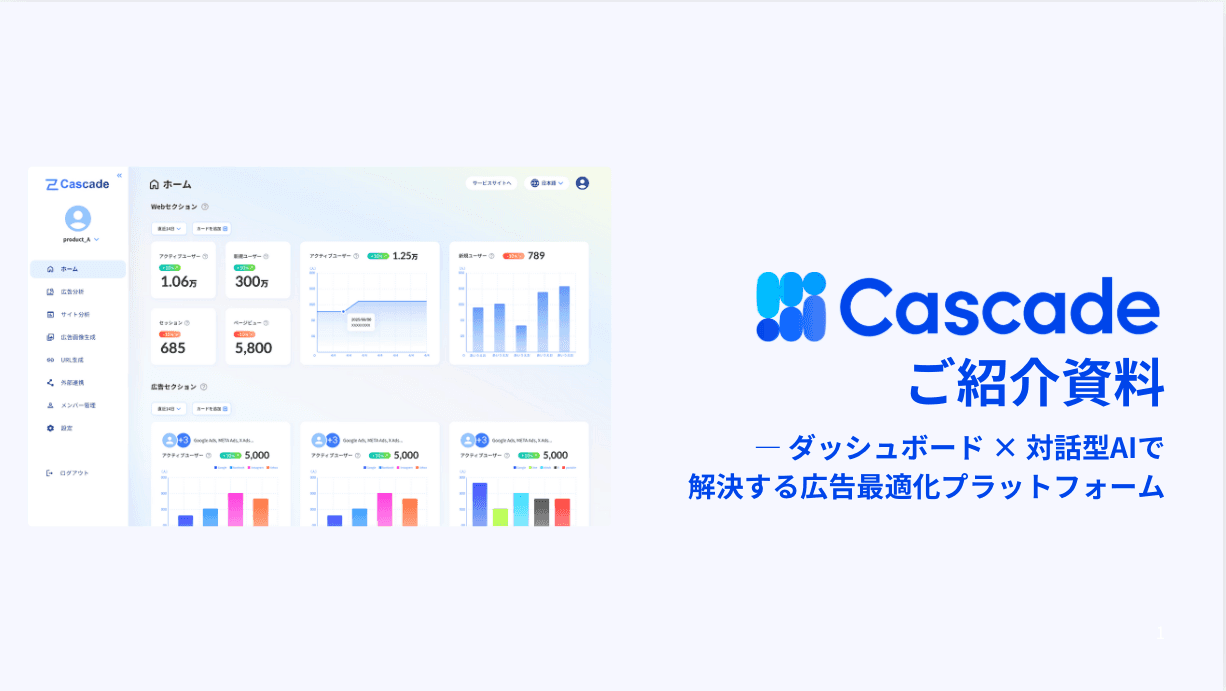
Table of Contents

© 2025 Cascade Inc, All Rights Reserved.

© 2025 Cascade Inc, All Rights Reserved.
© 2025 Cascade Inc, All Rights Reserved.